Transanal endoscopic microsurgery was associated with higher R0 resection rates than endoscopic submucosal dissection
Endoscopic Submucosal Dissection and Transanal Endoscopic Microsurgery in the Treatment of Rectal Neuroendocrine Tumors: Systematic Review and Meta-Analysis of the Observational Studies
Systematic review and meta-analysis of observational studiesMixed results
Is endoscopic submucosal dissection or transanal endoscopic microsurgery more effective and safe for rectal neuroendocrine tumors?
Who
2804
Patients with rectal neuroendocrine tumors
Compared
Endoscopic submucosal dissection: R0 resection rate: 0.854
Transanal endoscopic microsurgery: R0 resection rate: 0.924
Main outcome
R0 resection rate, recurrence rate, and complication rates
Result: risk ratio for R0 resection was approximately 10% lower for ESD
Bottom line: Transanal endoscopic microsurgery has higher R0 resection rates but higher complication rates and recurrence rates than endoscopic submucosal dissection.
Clin Transl Gastroenterol · 2025-10-01Download image
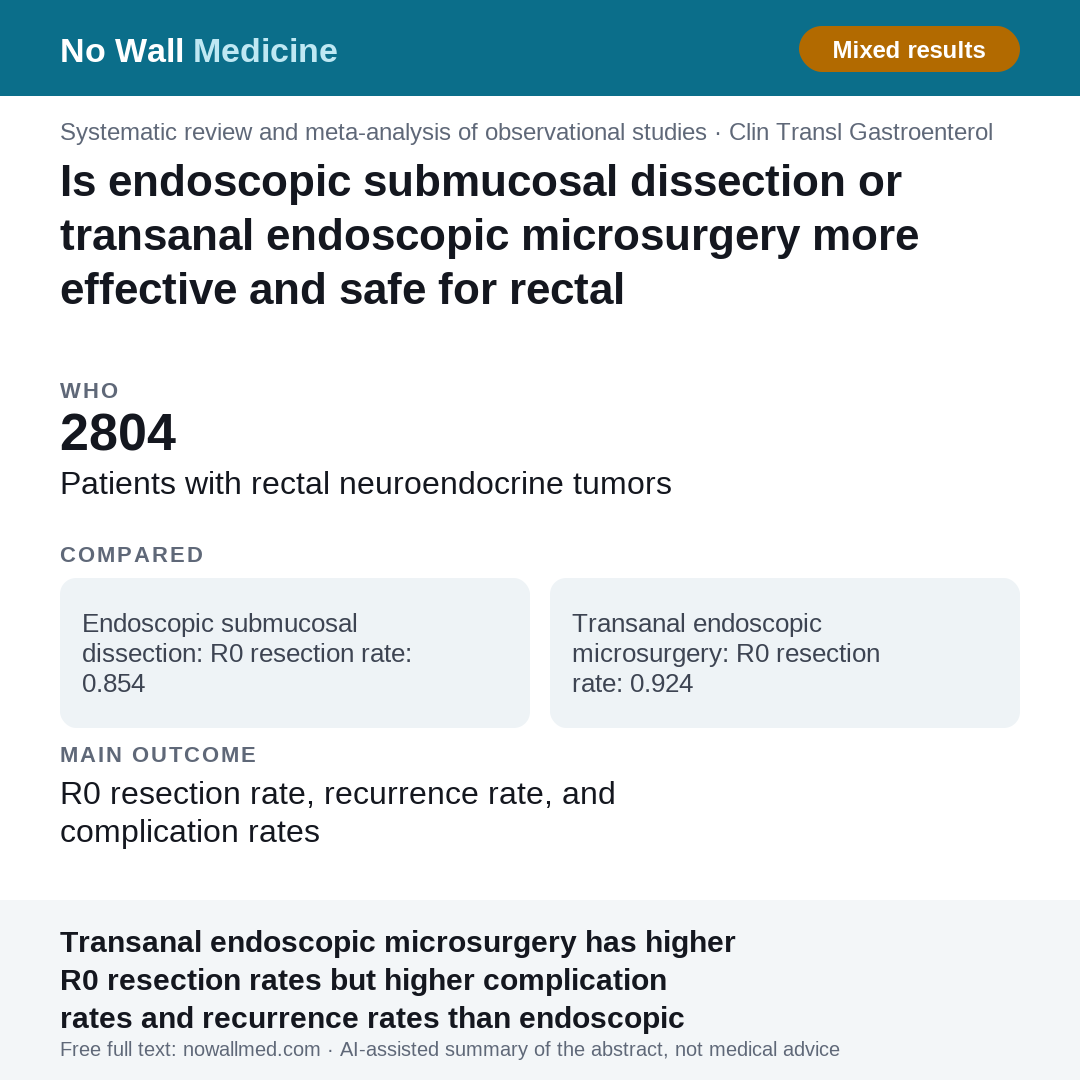
Clinical question: Is endoscopic submucosal dissection or transanal endoscopic microsurgery more effective and safe for rectal neuroendocrine tumors?
Why it matters: Clinical guidelines recommend removing rectal neuroendocrine tumors measuring 10-20 mm, but choosing between endoscopic submucosal dissection and transanal endoscopic microsurgery remains a dilemma.
Key points
- Researchers analyzed 59 observational studies involving 2,804 participants to compare endoscopic submucosal dissection and transanal endoscopic microsurgery for rectal neuroendocrine tumors.
- The R0 resection rate, meaning complete removal of the tumor with clear margins, was 0.854 for endoscopic submucosal dissection and 0.924 for transanal endoscopic microsurgery.
- Transanal endoscopic microsurgery was associated with a higher recurrence rate of 0.035 compared to 0.015 for endoscopic submucosal dissection and a higher rate of other complications.
Limitation the authors note: The analysis was based on observational studies rather than randomized controlled trials.
Headline and key points written with AI from the paper’s abstract, with every number checked against it. Read the paper before relying on them.
Topics
Cite this article
Dąbkowski K, Skonieczna-Żydecka K, Gaweł K, Marlicz W, Szredzki P, Białek A. Endoscopic Submucosal Dissection and Transanal Endoscopic Microsurgery in the Treatment of Rectal Neuroendocrine Tumors: Systematic Review and Meta-Analysis of the Observational Studies. Clin Transl Gastroenterol. 2025. doi:10.14309/ctg.0000000000000882
Spotted a mistake? Suggest a correction