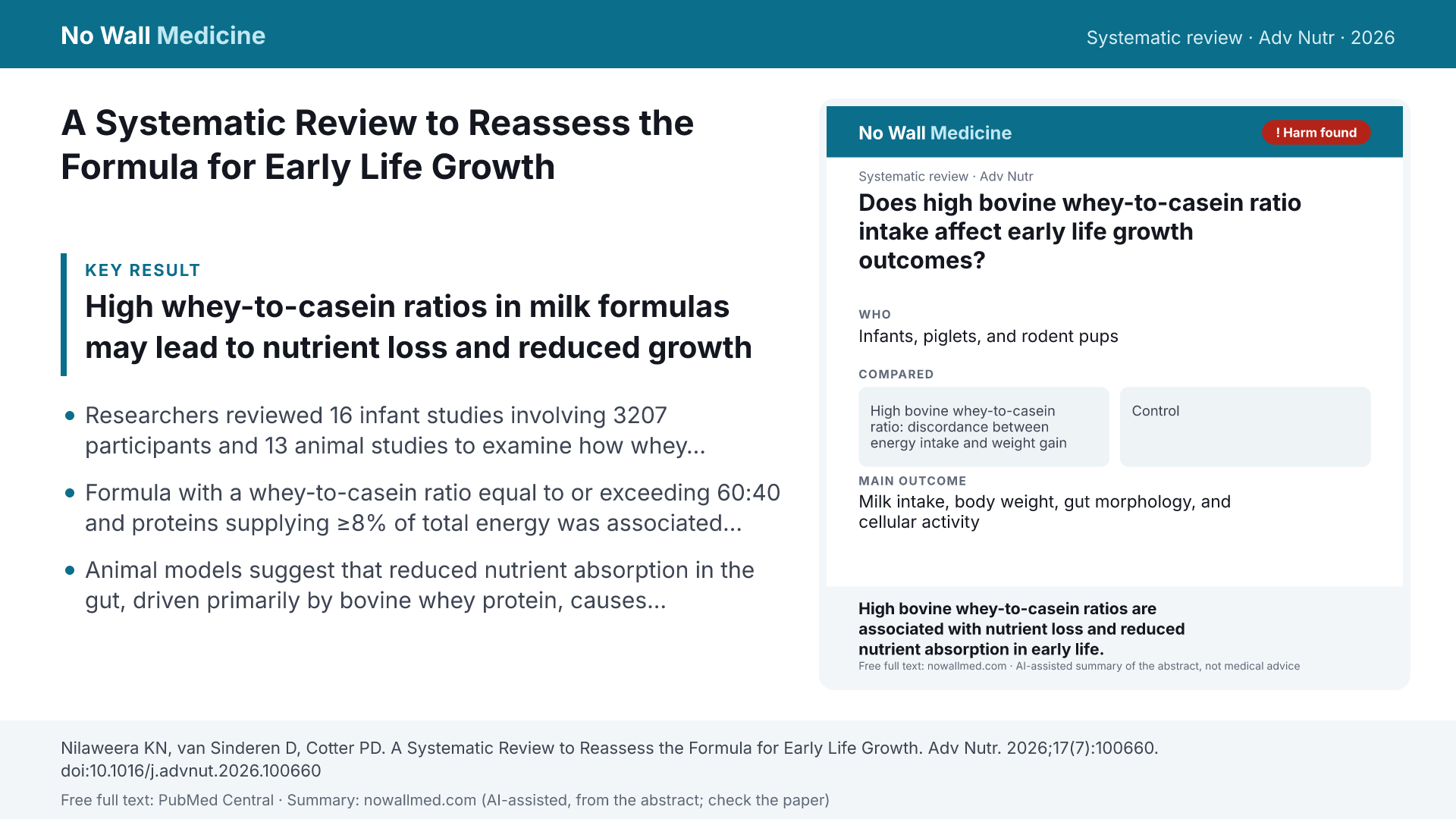
High whey-to-casein ratios in milk formulas may lead to nutrient loss and reduced growth
A Systematic Review to Reassess the Formula for Early Life Growth
Systematic reviewHarm found
Does high bovine whey-to-casein ratio intake affect early life growth outcomes?
Who
Infants, piglets, and rodent pups
Compared
High bovine whey-to-casein ratio: discordance between energy intake and weight gain
Control
Main outcome
Milk intake, body weight, gut morphology, and cellular activity
Bottom line: High bovine whey-to-casein ratios are associated with nutrient loss and reduced nutrient absorption in early life.
Adv Nutr · 2026-05-22 · Save PNG
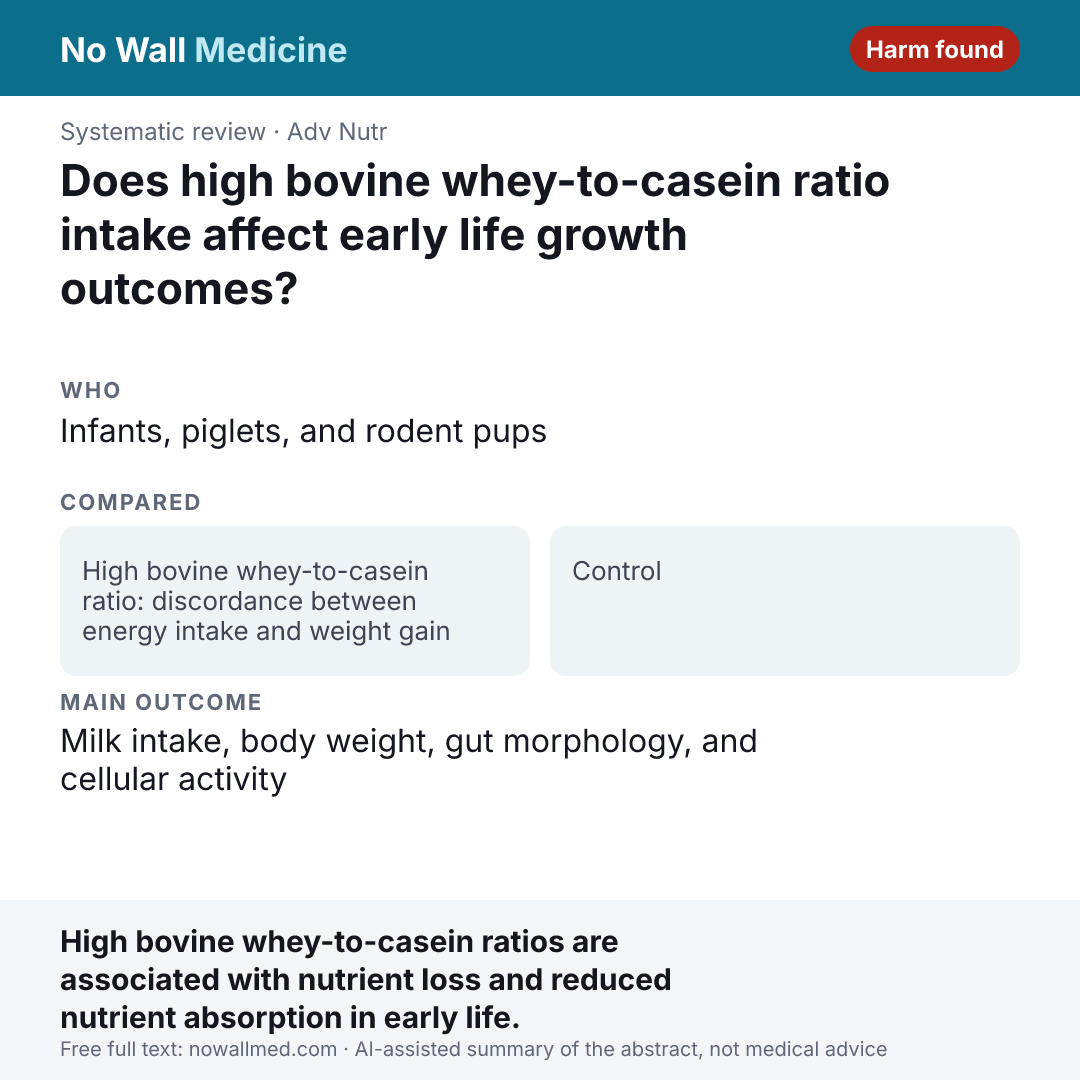
Clinical question: Does high bovine whey-to-casein ratio intake affect early life growth outcomes?
Why it matters: Mammals have species-specific milk compositions, and consuming milk proteins from other species may cause different growth outcomes during early life.
Key points
- Researchers reviewed 16 infant studies involving 3207 participants and 13 animal studies to examine how whey protein to casein protein ratios affect growth.
- Formula with a whey-to-casein ratio equal to or exceeding 60:40 and proteins supplying ≥8% of total energy was associated with weight gain discordance.
- Animal models suggest that reduced nutrient absorption in the gut, driven primarily by bovine whey protein, causes this nutrient loss.
Headline and key points written with AI from the paper’s abstract, with every number checked against it. Read the paper before relying on them.
Was this summary helpful?
Subject terms
Headline, design, result, key points, caveat and citation as plain text.
Cite this article
Nilaweera KN, van Sinderen D, Cotter PD. A Systematic Review to Reassess the Formula for Early Life Growth. Adv Nutr. 2026;17(7):100660. doi:10.1016/j.advnut.2026.100660
Spotted a mistake? Suggest a correction