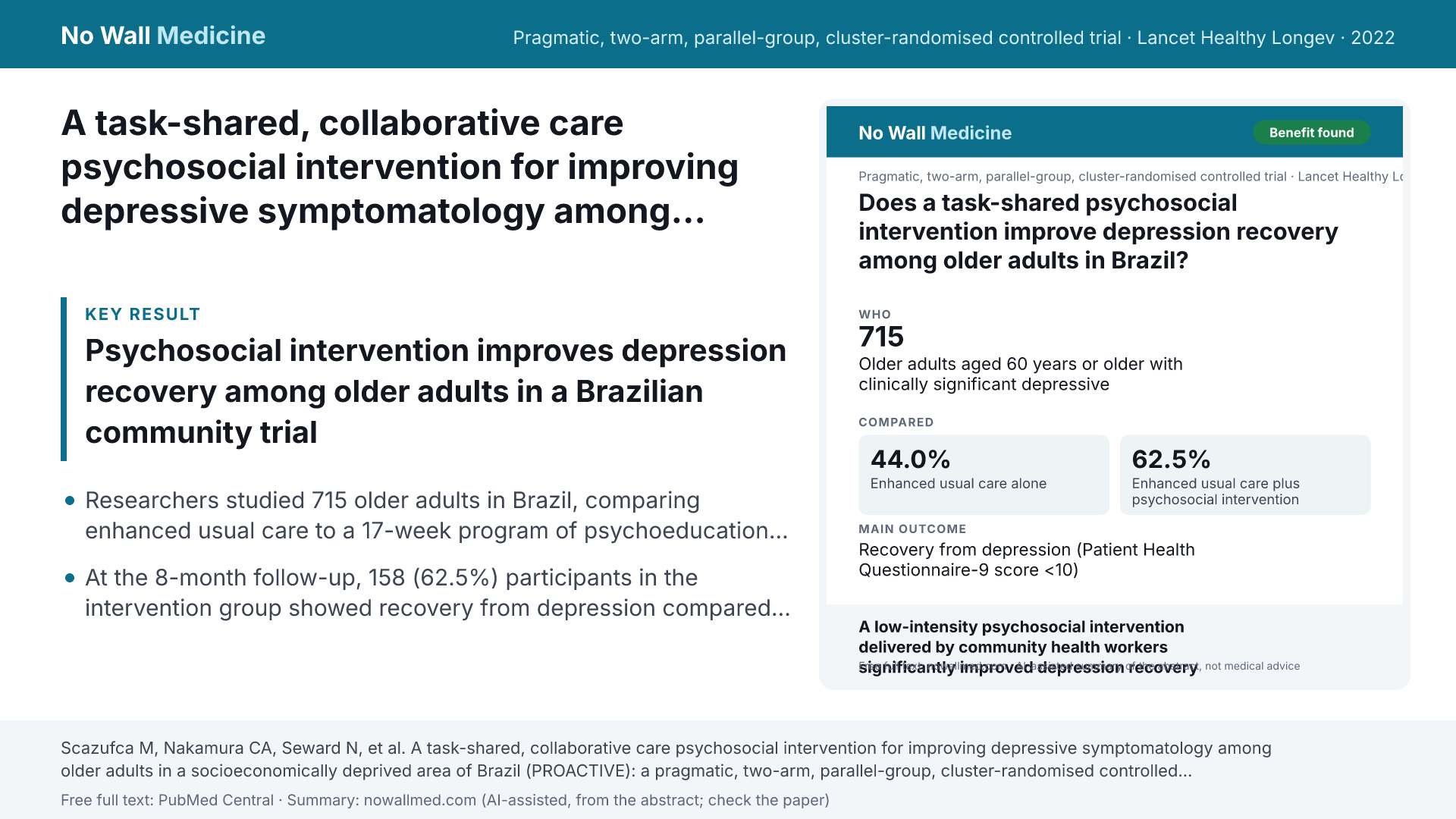
A task-shared, collaborative care psychosocial intervention for improving depressive symptomatology among older adults in a socioeconomically deprived area of Brazil (PROACTIVE): a pragmatic, two-arm, parallel-group, cluster-randomised controlled trial
Key result: Psychosocial intervention improves depression recovery among older adults in a Brazilian community trial
Key points
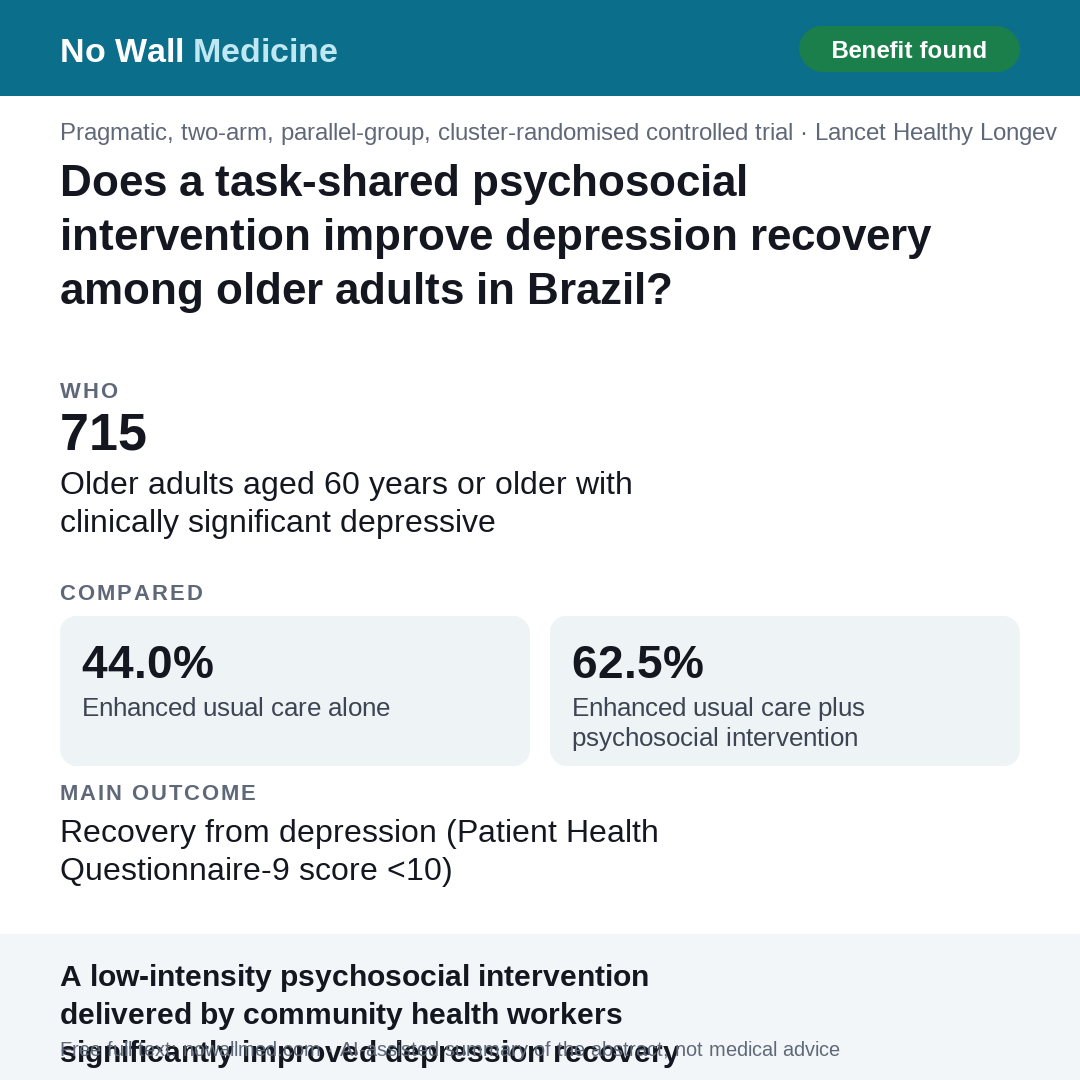
- Researchers studied 715 older adults in Brazil, comparing enhanced usual care to a 17-week program of psychoeducation and behavioral activation delivered by community health workers.
- At the 8-month follow-up, 158 (62.5%) participants in the intervention group showed recovery from depression compared to 125 (44.0%) in the control group.
- No adverse events related to the intervention were observed during the trial.
Why it matters: The burden of depression among older adults in low-income and middle-income countries needs to be reduced.
Discussion prompts
- Would these patients look like yours? Who was left out?
- Is the main outcome one that matters to patients?
- Is the difference large enough to change what you do?
Cite: Scazufca M, Nakamura CA, Seward N, et al. A task-shared, collaborative care psychosocial intervention for improving depressive symptomatology among older adults in a socioeconomically deprived area of Brazil (PROACTIVE): a pragmatic, two-arm, parallel-group, cluster-randomised controlled trial. Lancet Healthy Longev. 2022. doi:10.1016/S2666-7568(22)00194-5
Free full text: PubMed Central · Summary and visual abstract: nowallmed.com/a/a-task-shared-collaborative-care-psychosocial-intervention-for-1an1xfk/ (AI-assisted from the abstract; check the paper before relying on it).