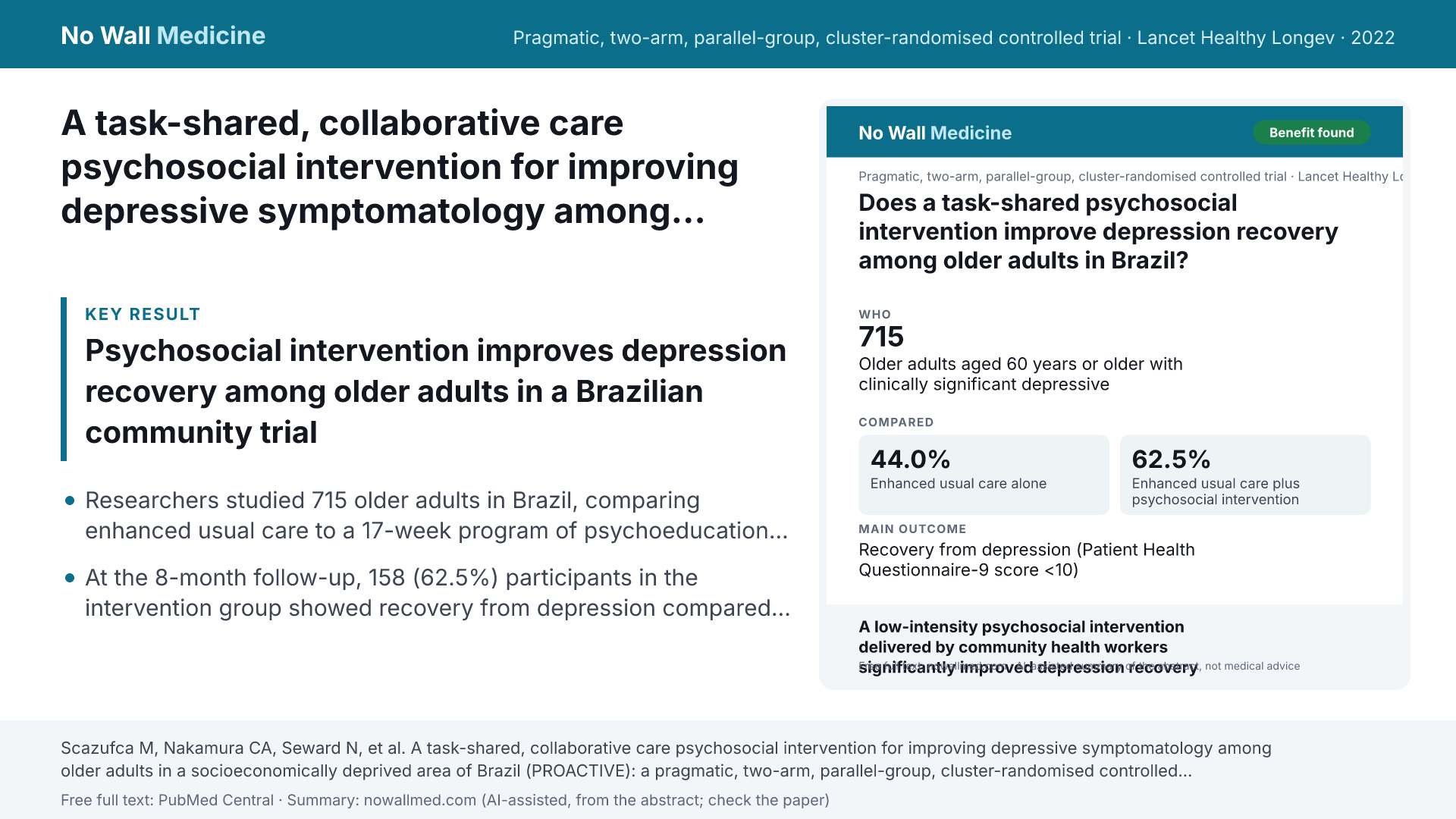
Psychosocial intervention improves depression recovery among older adults in a Brazilian community trial
A task-shared, collaborative care psychosocial intervention for improving depressive symptomatology among older adults in a socioeconomically deprived area of Brazil (PROACTIVE): a pragmatic, two-arm, parallel-group, cluster-randomised controlled trial
Pragmatic, two-arm, parallel-group, cluster-randomised controlled trialBenefit found
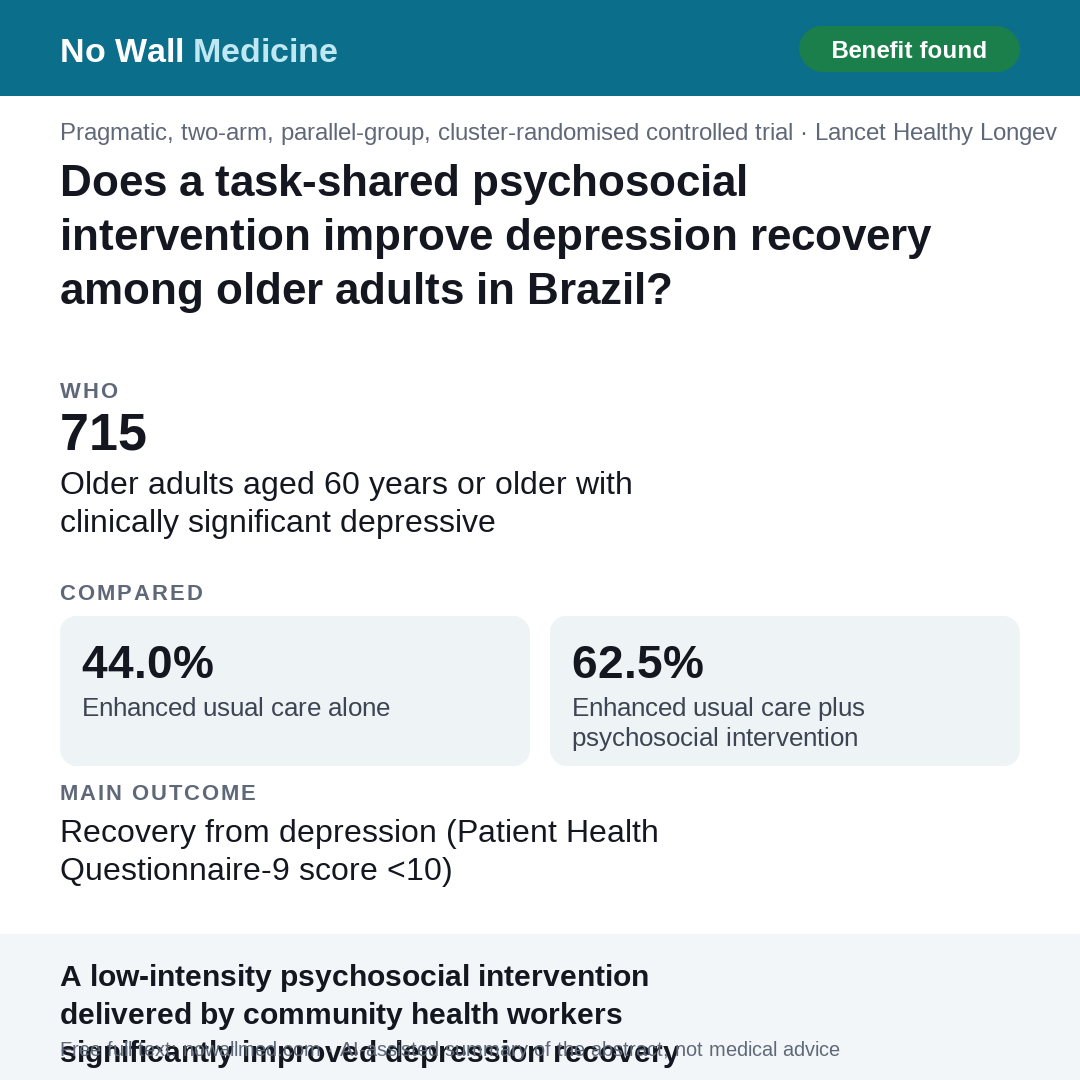
Does a task-shared psychosocial intervention improve depression recovery among older adults in Brazil?
Who
715
Older adults aged 60 years or older with clinically significant depressive symptomatology · Primary care clinics in Guarulhos, Brazil
Compared
44.0%Enhanced usual care alone
62.5%Enhanced usual care plus psychosocial intervention
Main outcome
Recovery from depression (Patient Health Questionnaire-9 score <10)
Result: adjusted odds ratio 2.16 (95% CI 1.47-3.18)
Bottom line: A low-intensity psychosocial intervention delivered by community health workers significantly improved depression recovery in older adults in Brazil.
Limitation: The COVID-19 pandemic altered delivery, stopping recruitment and intervention home sessions.
Funded by: São Paulo Research Foundation and Joint Global Health Trials
Lancet Healthy Longev · 2022-10-06Download image
Clinical question: Does a task-shared psychosocial intervention improve depression recovery among older adults in Brazil?
Why it matters: The burden of depression among older adults in low-income and middle-income countries needs to be reduced.
Key points
- Researchers studied 715 older adults in Brazil, comparing enhanced usual care to a 17-week program of psychoeducation and behavioral activation delivered by community health workers.
- At the 8-month follow-up, 158 (62.5%) participants in the intervention group showed recovery from depression compared to 125 (44.0%) in the control group.
- No adverse events related to the intervention were observed during the trial.
Headline and key points written with AI from the paper’s abstract, with every number checked against it. Read the paper before relying on them.
Was this summary helpful?
Abstract
Background
There is an urgent need to reduce the burden of depression among older adults in low-income and middle-income countries (LMICs). We aimed to evaluate the efficacy of a task-shared, collaborative care psychosocial intervention for improving recovery from depression in older adults in Brazil. Methods
PROACTIVE was a pragmatic, two-arm, parallel-group, cluster-randomised controlled trial conducted in Guarulhos, Brazil. Primary care clinics (clusters) were stratified by educational level and randomly allocated (1:1) to either enhanced usual care alone (control group) or to enhanced usual care plus the psychosocial intervention (intervention group), which involved a 17-week psychosocial programme based on psychoeducation and behavioural activation approaches. Individuals approached for the initial screening assessment were selected randomly from a list of individuals provided by the Health Secretariat of Guarulhos. Face-to-face baseline assessments were conducted among adults aged 60 years or older registered with one of the primary care clinics and identified with clinically significant depressive symptomatology (9-item Patient Health Questionnaire [PHQ-9] score ≥10). Community health workers delivered the programme through home sessions, supported by a dedicated tablet application. Masking of clinic staff and community health workers who delivered the intervention was not feasible; however, research assistants conducting recruitment and follow-up assessments were masked to trial allocation. The primary outcome was recovery from depression (PHQ-9 score <10) at 8-month follow-up. All primary analyses were performed by intention to treat with imputed data. Adaptations to the protocol were made due to the COVID-19 pandemic; recruitment and intervention home sessions were stopped, and follow-up assessments were conducted by telephone. This trial is registered with the ISRCTN registry, ISRCTN57805470. Findings
We identified 24 primary care clinics in Guarulhos that were willing to participate, of which 20 were randomly allocated to either the control group (ten [50%] clusters) or to the intervention group (ten [50%] clusters). The four remaining eligible clusters were kept as reserves. Between May 23, 2019, and Feb 21, 2020, 8146 individuals were assessed for eligibility, of whom 715 (8·8%) participants were recruited: 355 (49·7%) in the control group and 360 (50·3%) in the intervention group. 284 (80·0%) participants in the control group and 253 (70·3%) in the intervention group completed follow-up at 8 months. At 8-month follow-up, 158 (62·5%) participants in the intervention group showed recovery from depression (PHQ-9 score <10) compared with 125 (44·0%) in the control group (adjusted odds ratio 2·16 [95% CI 1·47-3·18]; p<0·0001). These findings were maintained in the complete case analysis. No adverse events related to the intervention were observed. Interpretation
Although the COVID-19 pandemic altered delivery of the intervention, the low-intensity psychosocial intervention delivered mainly by non-mental health professionals was highly efficacious in improving recovery from depression in older adults in Brazil. Our results support a low-resource intervention that could be useful to reduce the treatment gap for depression among older people in other LMICs. Funding
São Paulo Research Foundation and Joint Global Health Trials (UK Department for International Development, Medical Research Council, and the Wellcome Trust).
Abstract reproduced under the article’s CC BY licence.
Subject terms
Cite this article
Scazufca M, Nakamura CA, Seward N, et al. A task-shared, collaborative care psychosocial intervention for improving depressive symptomatology among older adults in a socioeconomically deprived area of Brazil (PROACTIVE): a pragmatic, two-arm, parallel-group, cluster-randomised controlled trial. Lancet Healthy Longev. 2022. doi:10.1016/S2666-7568(22)00194-5
Spotted a mistake? Suggest a correction