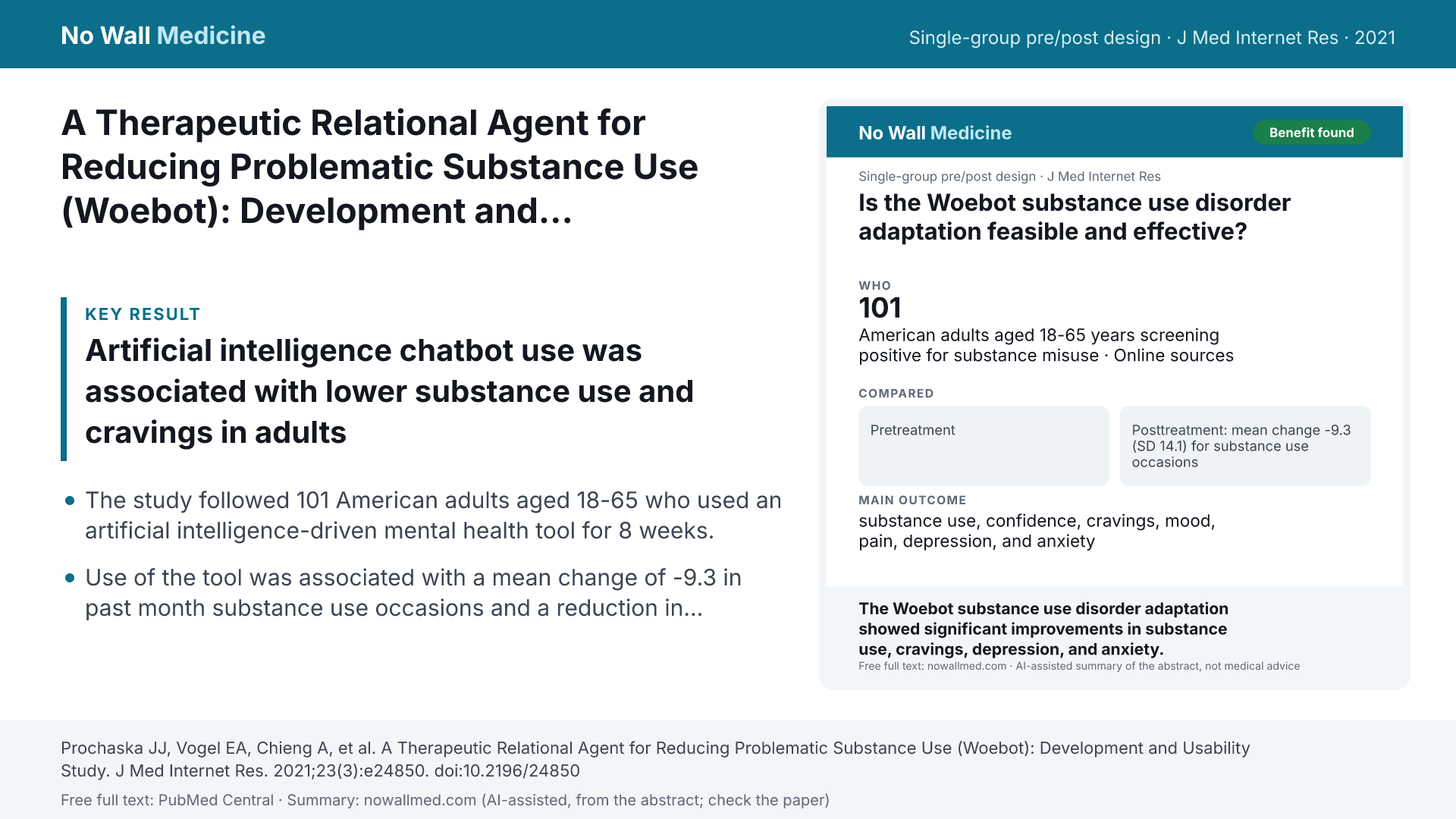
Artificial intelligence chatbot use was associated with lower substance use and cravings in adults
A Therapeutic Relational Agent for Reducing Problematic Substance Use (Woebot): Development and Usability Study
Single-group pre/post designBenefit found
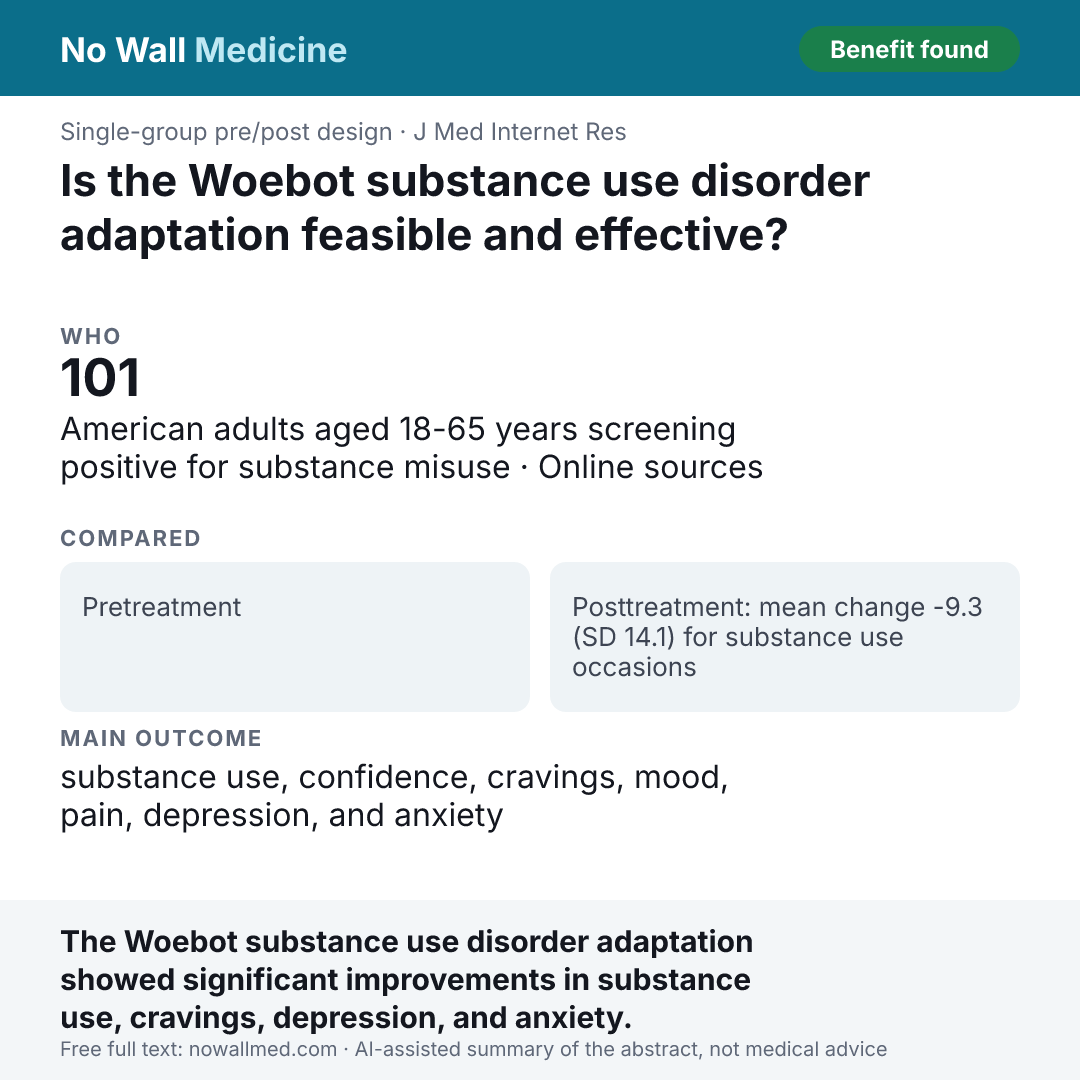
Is the Woebot substance use disorder adaptation feasible and effective?
Who
101
American adults aged 18-65 years screening positive for substance misuse · Online sources and flyers
Compared
Pretreatment
Posttreatment: mean change -9.3 (SD 14.1) for substance use occasions
Main outcome
substance use, confidence, cravings, mood, pain, depression, and anxiety
Result: odds ratio 0.48 (95% CI 0.32-0.73) for in-app craving ratings
Bottom line: The Woebot substance use disorder adaptation showed significant improvements in substance use, cravings, depression, and anxiety.
Limitation: Study attrition was high.
J Med Internet Res · 2021-03-23 · Save PNG
Clinical question: Is the Woebot substance use disorder adaptation feasible and effective?
Key points
- The study followed 101 American adults aged 18-65 who used an artificial intelligence-driven mental health tool for 8 weeks.
- Use of the tool was associated with a mean change of -9.3 in past month substance use occasions and a reduction in cravings from 86.1% to 47.1% reporting moderate to extreme levels.
- Participants reported a mean increase of 16.9 in confidence to resist urges to use substances.
Limitation the authors note: The authors stated that study attrition was high.
Headline and key points written with AI from the paper’s abstract, with every number checked against it. Read the paper before relying on them.
Was this summary helpful?
Subject terms
Headline, design, result, key points, caveat and citation as plain text.
Cite this article
Prochaska JJ, Vogel EA, Chieng A, et al. A Therapeutic Relational Agent for Reducing Problematic Substance Use (Woebot): Development and Usability Study. J Med Internet Res. 2021;23(3):e24850. doi:10.2196/24850
Spotted a mistake? Suggest a correction