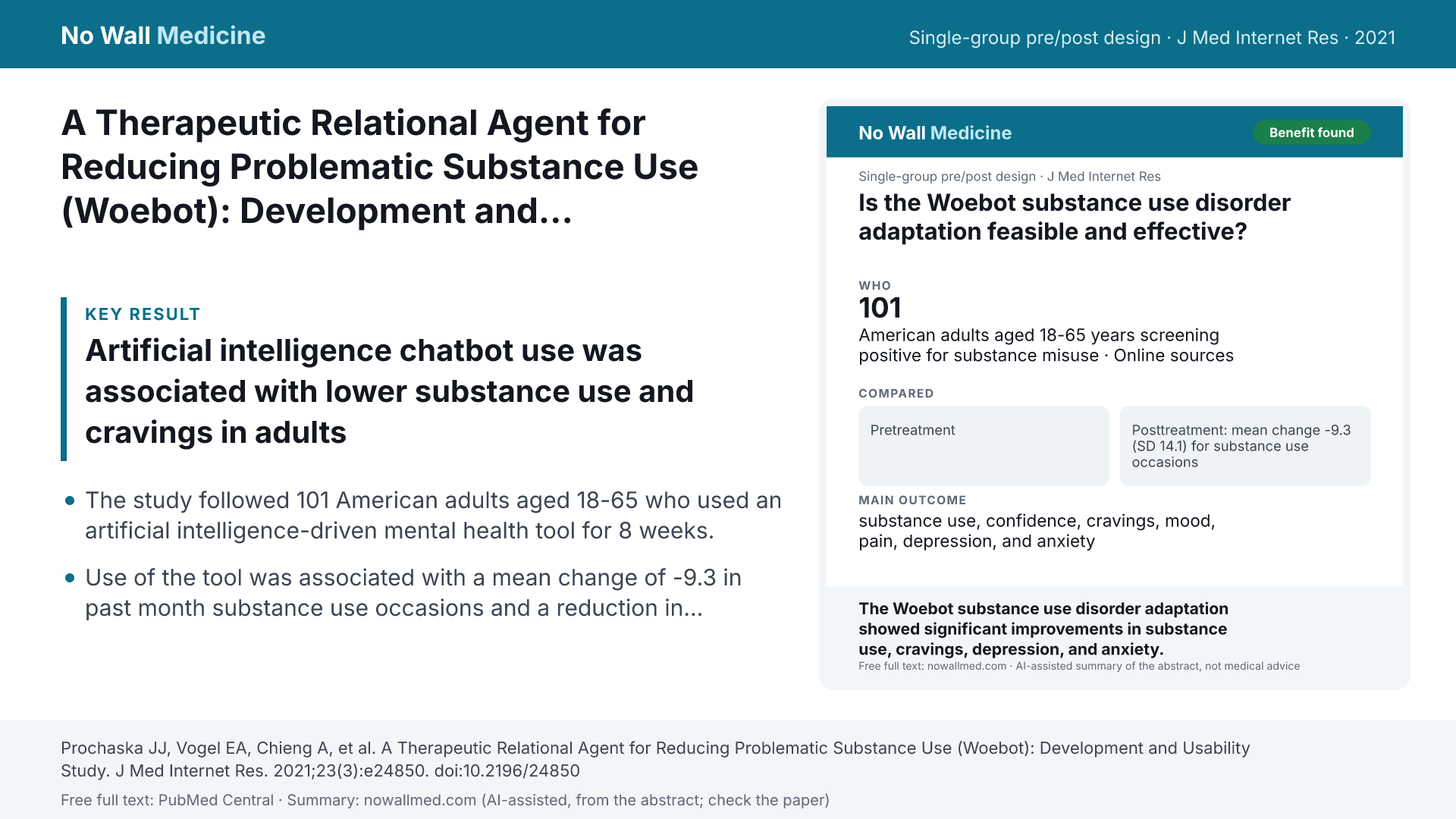
A Therapeutic Relational Agent for Reducing Problematic Substance Use (Woebot): Development and Usability Study
Key result: Artificial intelligence chatbot use was associated with lower substance use and cravings in adults
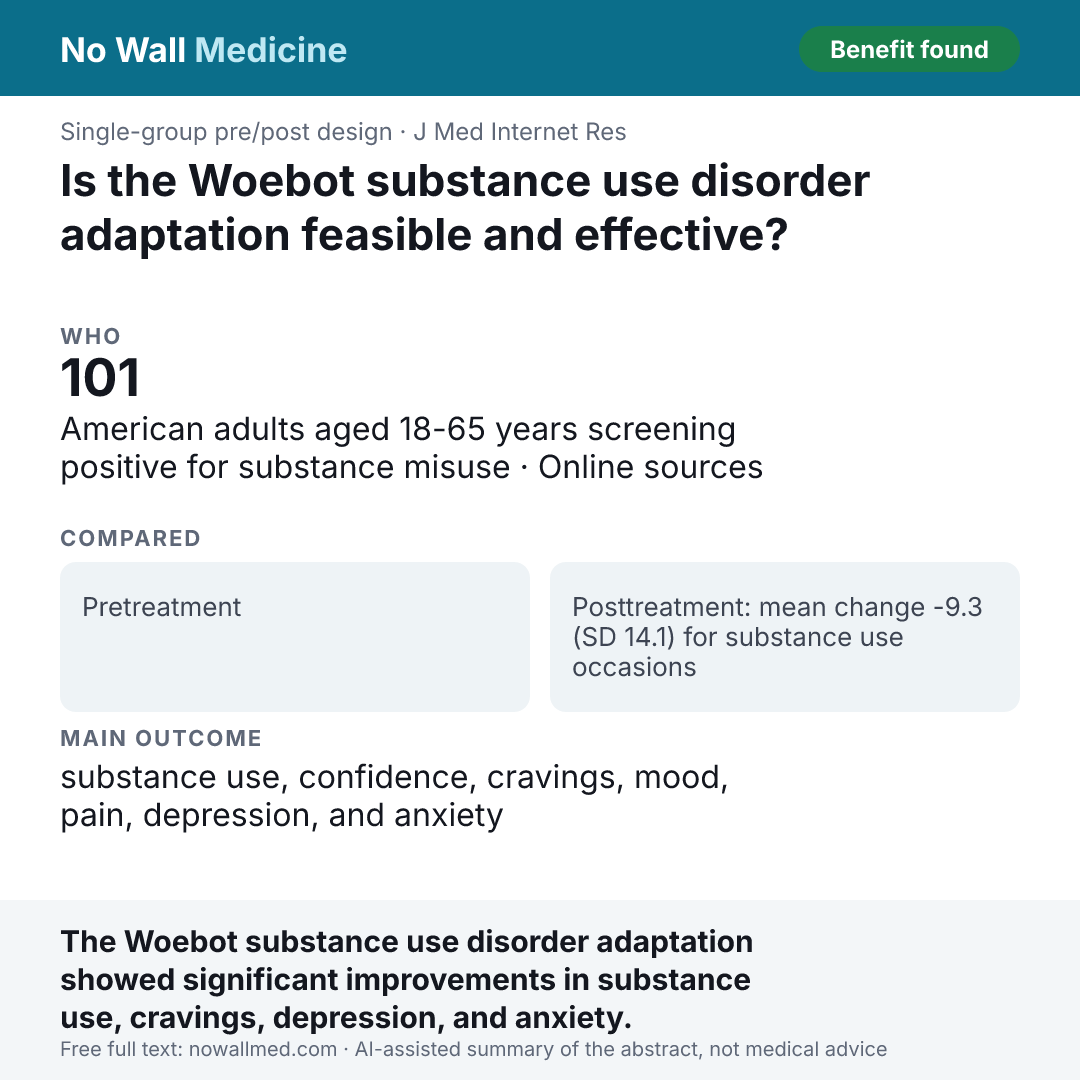
Single-group pre/post designBenefit found
Is the Woebot substance use disorder adaptation feasible and effective?
Who
101
American adults aged 18-65 years screening positive for substance misuse · Online sources and flyers
Compared
Pretreatment
Posttreatment: mean change -9.3 (SD 14.1) for substance use occasions
Main outcome
substance use, confidence, cravings, mood, pain, depression, and anxiety
Result: odds ratio 0.48 (95% CI 0.32-0.73) for in-app craving ratings
Bottom line: The Woebot substance use disorder adaptation showed significant improvements in substance use, cravings, depression, and anxiety.
Limitation: Study attrition was high.
J Med Internet Res · 2021-03-23 · Save PNG
Key points
- The study followed 101 American adults aged 18-65 who used an artificial intelligence-driven mental health tool for 8 weeks.
- Use of the tool was associated with a mean change of -9.3 in past month substance use occasions and a reduction in cravings from 86.1% to 47.1% reporting moderate to extreme levels.
- Participants reported a mean increase of 16.9 in confidence to resist urges to use substances.
Limitation the authors note: The authors stated that study attrition was high.
Discussion prompts
- Would these patients look like yours? Who was left out?
- Is the main outcome one that matters to patients?
- Is the difference large enough to change what you do?
Cite: Prochaska JJ, Vogel EA, Chieng A, et al. A Therapeutic Relational Agent for Reducing Problematic Substance Use (Woebot): Development and Usability Study. J Med Internet Res. 2021;23(3):e24850. doi:10.2196/24850
Free full text: PubMed Central · Summary and visual abstract: nowallmed.com/a/a-therapeutic-relational-agent-for-reducing-problematic-substance-use-6dn0y8/ (AI-assisted from the abstract; check the paper before relying on it).