Web-based mental health program did not improve social or occupational functioning in adults with type 2 diabetes
A Web-Based Mental Health Intervention to Improve Social and Occupational Functioning in Adults With Type 2 Diabetes (The Springboard Trial): 12-Month Outcomes of a Randomized Controlled Trial
Randomized controlled trialNo clear difference
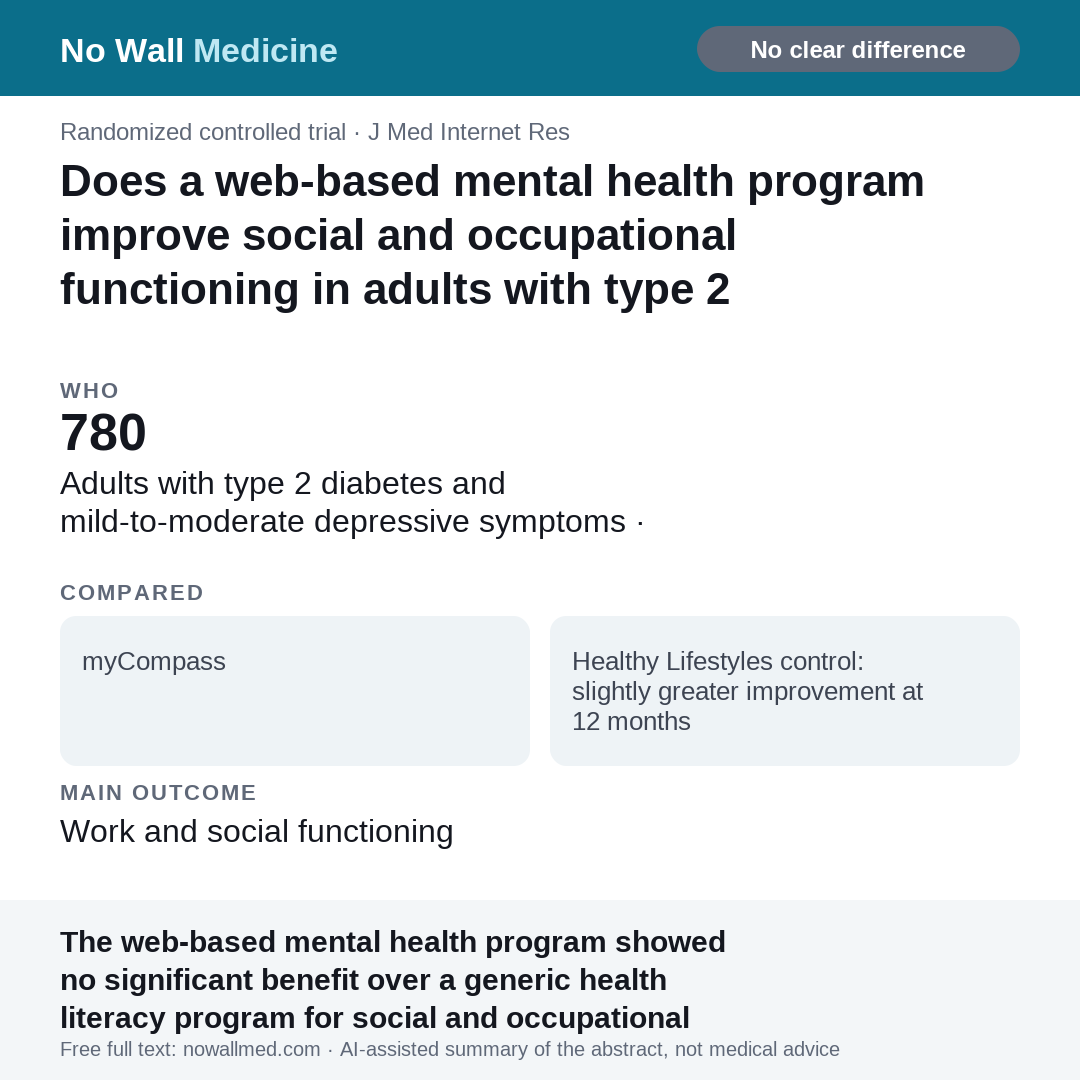
Does a web-based mental health program improve social and occupational functioning in adults with type 2 diabetes?
Who
780
Adults with type 2 diabetes and mild-to-moderate depressive symptoms · Community sample via online advertisements and general practices
Compared
myCompass
Healthy Lifestyles control: slightly greater improvement at 12 months
Main outcome
Work and social functioning
Bottom line: The web-based mental health program showed no significant benefit over a generic health literacy program for social and occupational functioning.
Limitation: Findings should be interpreted in light of the near-floor symptom scores at baseline.
J Med Internet Res · 2020-12-01Download image
Clinical question: Does a web-based mental health program improve social and occupational functioning in adults with type 2 diabetes?
Why it matters: It is unknown if automated web-based mental health programs can effectively improve social and occupational functioning for people living with type 2 diabetes.
Key points
- Researchers randomized 780 adults with type 2 diabetes and mild-to-moderate depressive symptoms to either a web-based mental health program or a generic health literacy program.
- At 12 months, the generic health literacy group showed slightly greater improvement in work and social functioning compared to the web-based mental health group.
- No differences were observed between the two groups for secondary outcomes including depression, anxiety, diabetes distress, diabetes self-management, or blood sugar control.
Limitation the authors note: The authors state that findings should be interpreted in light of the near-floor symptom scores at baseline.
Headline and key points written with AI from the paper’s abstract, with every number checked against it. Read the paper before relying on them.
Was this summary helpful?
Subject terms
Cite this article
Baldwin PA, Sanatkar S, Clarke J, Fletcher S, Gunn J, Wilhelm K. A Web-Based Mental Health Intervention to Improve Social and Occupational Functioning in Adults With Type 2 Diabetes (The Springboard Trial): 12-Month Outcomes of a Randomized Controlled Trial. J Med Internet Res. 2020. doi:10.2196/16729
Spotted a mistake? Suggest a correction
Top studies every Monday
The week’s key trials and guidelines in your specialties, plus any topics you follow. By email, free.
Get the weekly digest