Biofeedback interventions in workplace settings were associated with reduced stress and improved mental health
Interventions Based on Biofeedback Systems to Improve Workers' Psychological Well-Being, Mental Health, and Safety: Systematic Literature Review
Systematic literature reviewBenefit found
Do biofeedback interventions improve workers' psychological well-being and mental health in real-world settings?
Who
9
Employees in real-world occupational settings · Real-world occupational settings
Compared
Biofeedback interventions: 8 (89%) reported positive outcomes
Other: 1 (11%) study showing initial increases in stress
Main outcome
Psychological well-being and mental health
Bottom line: Biofeedback interventions show promising short-term results in reducing stress and improving mental health in workplace settings.
Limitation: Sample sizes were generally small, and long-term follow-up data were limited.
J Med Internet Res · 2025-09-12Download image
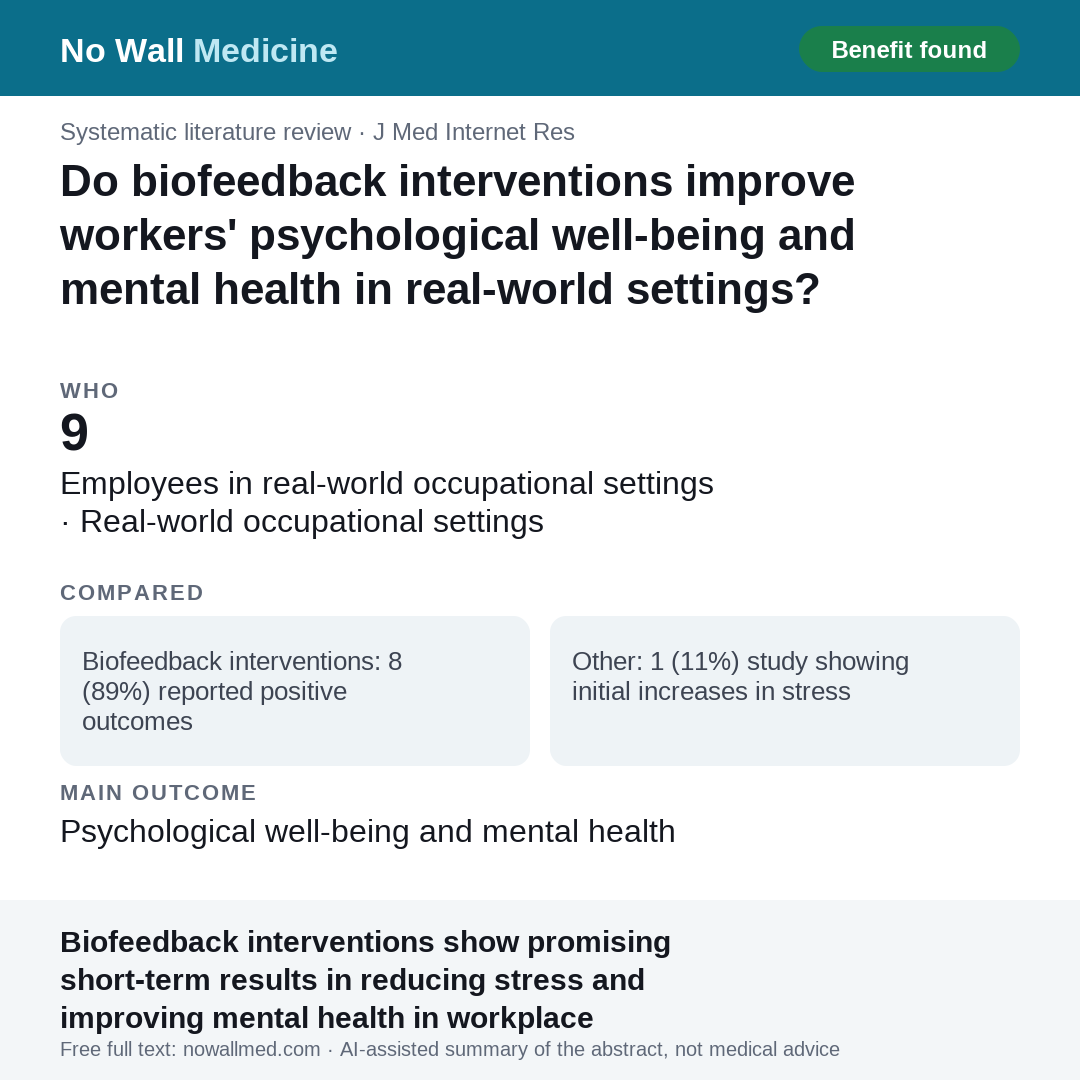
Clinical question: Do biofeedback interventions improve workers' psychological well-being and mental health in real-world settings?
Why it matters: Most research on biofeedback interventions has been conducted in controlled laboratory settings rather than real-world occupational environments.
Key points
- Researchers reviewed 9 studies published between 2012 and 2024 that used biofeedback tools like mobile apps and virtual reality to support employee mental health.
- Of the 9 studies, 8 (89%) reported positive outcomes, while 1 (11%) showed initial increases in stress due to logistical limitations in accessing biofeedback.
- Most interventions focused on breathing techniques to regulate physiological responses such as heart rate variability and respiratory sinus arrhythmia.
Limitation the authors note: Sample sizes were generally small and long-term follow-up data were limited.
Headline and key points written with AI from the paper’s abstract, with every number checked against it. Read the paper before relying on them.
Topics
Cite this article
Ferreira S, Rodrigues MA, Mateus C, Rodrigues PP, Rocha NB. Interventions Based on Biofeedback Systems to Improve Workers' Psychological Well-Being, Mental Health, and Safety: Systematic Literature Review. J Med Internet Res. 2025. doi:10.2196/70134
Spotted a mistake? Suggest a correction