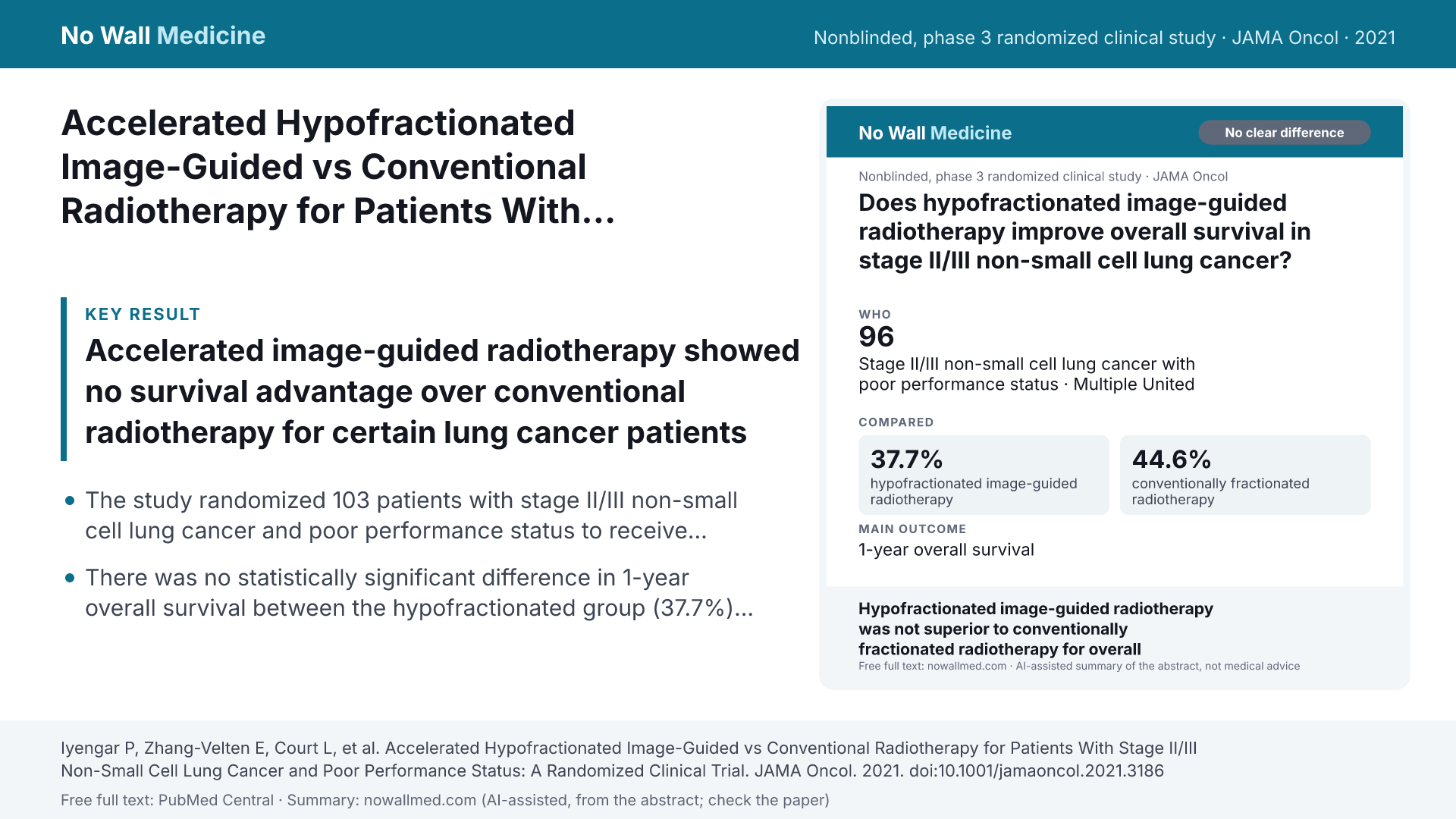
Accelerated image-guided radiotherapy showed no survival advantage over conventional radiotherapy for certain lung cancer patients
Accelerated Hypofractionated Image-Guided vs Conventional Radiotherapy for Patients With Stage II/III Non-Small Cell Lung Cancer and Poor Performance Status: A Randomized Clinical Trial
Nonblinded, phase 3 randomized clinical studyNo clear difference
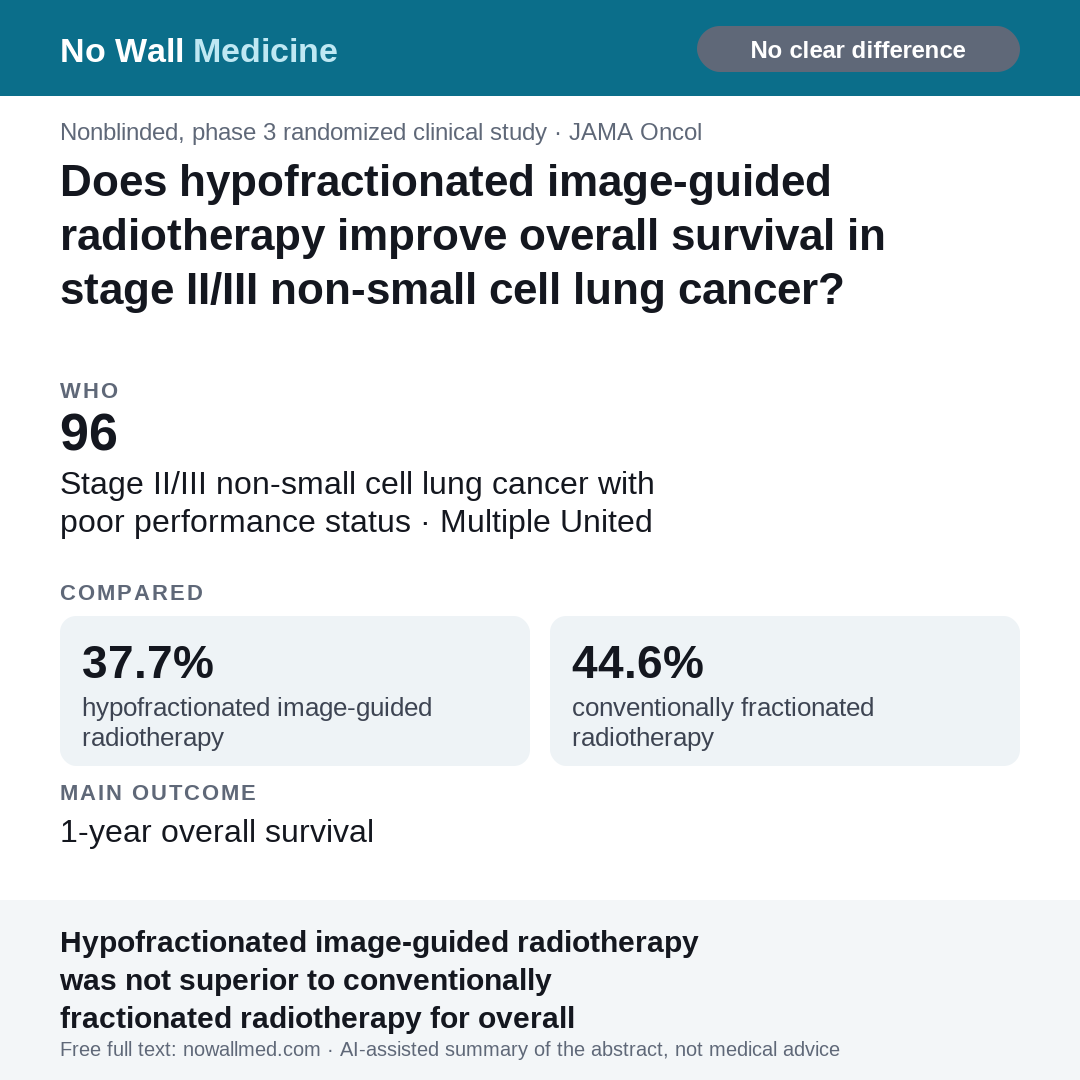
Does hypofractionated image-guided radiotherapy improve overall survival in stage II/III non-small cell lung cancer?
Who
96
Stage II/III non-small cell lung cancer with poor performance status · Multiple United States institutions
Compared
37.7%hypofractionated image-guided radiotherapy (95% CI, 24.2%-51.0%)
44.6%conventionally fractionated radiotherapy (95% CI, 29.9%-58.3%)
Main outcome
1-year overall survival
Result: no statistically significant difference (P = .29)
Bottom line: Hypofractionated image-guided radiotherapy was not superior to conventionally fractionated radiotherapy for overall survival in these patients.
Limitation: A planned interim analysis suggested futility in reaching the primary end point, and the study was closed.
JAMA Oncol · 2021-08-13Download image
Clinical question: Does hypofractionated image-guided radiotherapy improve overall survival in stage II/III non-small cell lung cancer?
Key points
- The study randomized 103 patients with stage II/III non-small cell lung cancer and poor performance status to receive either hypofractionated image-guided radiotherapy or conventional radiotherapy.
- There was no statistically significant difference in 1-year overall survival between the hypofractionated group (37.7%) and the conventional group (44.6%).
- No significant differences were found between the two groups regarding median overall survival, progression-free survival, time to local failure, time to distant metastasis, or grade 3 or greater toxic effects.
Limitation the authors note: The study was closed to further accrual when a planned interim analysis suggested futility in reaching the primary end point.
Headline and key points written with AI from the paper’s abstract, with every number checked against it. Read the paper before relying on them.
Was this summary helpful?
Subject terms
Headline, design, result, key points, caveat and citation as plain text.
Cite this article
Iyengar P, Zhang-Velten E, Court L, et al. Accelerated Hypofractionated Image-Guided vs Conventional Radiotherapy for Patients With Stage II/III Non-Small Cell Lung Cancer and Poor Performance Status: A Randomized Clinical Trial. JAMA Oncol. 2021. doi:10.1001/jamaoncol.2021.3186
Spotted a mistake? Suggest a correction