Accelerated Hypofractionated Image-Guided vs Conventional Radiotherapy for Patients With Stage II/III Non-Small Cell Lung Cancer and Poor Performance Status: A Randomized Clinical Trial
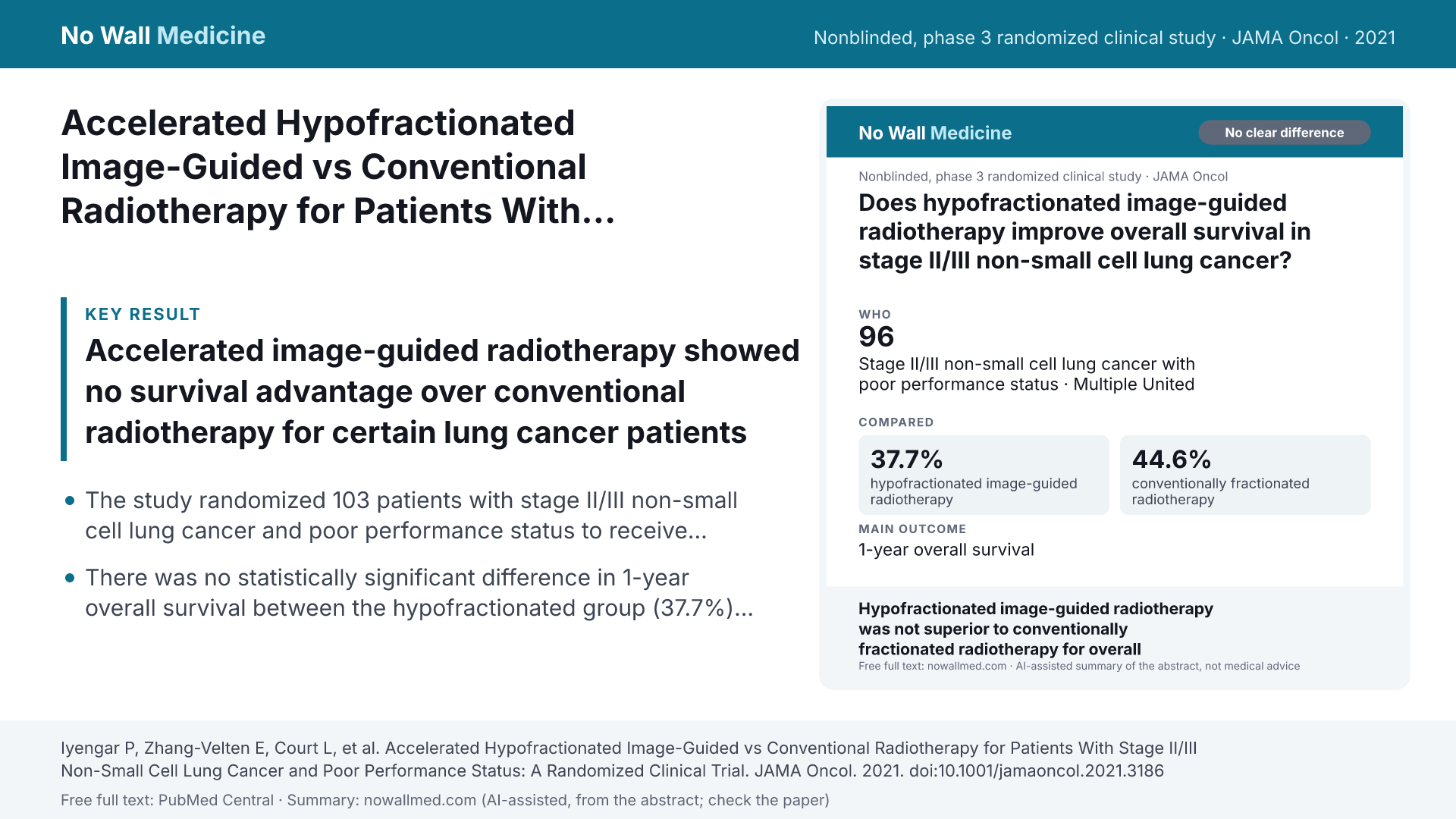
Key result: Accelerated image-guided radiotherapy showed no survival advantage over conventional radiotherapy for certain lung cancer patients
Key points
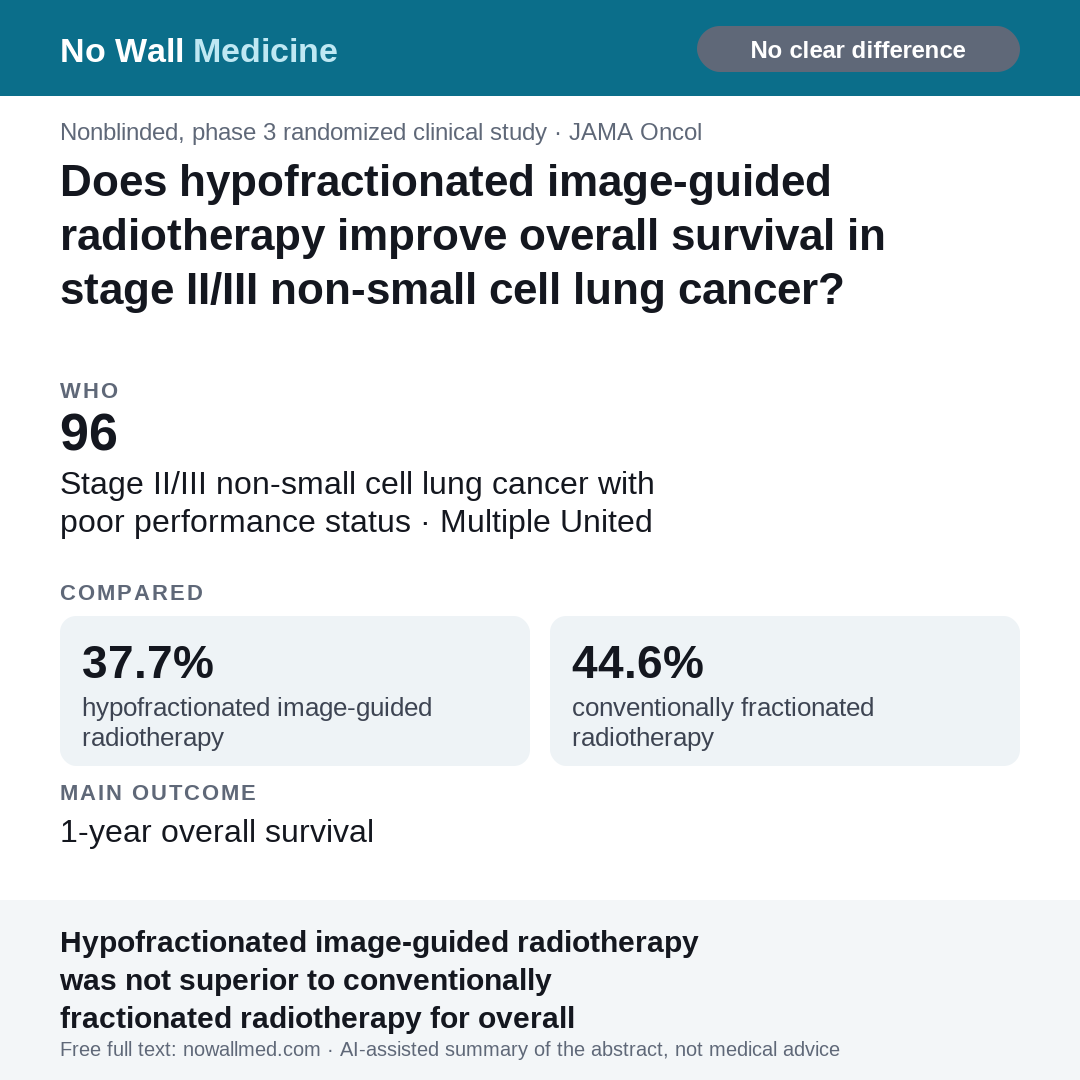
- The study randomized 103 patients with stage II/III non-small cell lung cancer and poor performance status to receive either hypofractionated image-guided radiotherapy or conventional radiotherapy.
- There was no statistically significant difference in 1-year overall survival between the hypofractionated group (37.7%) and the conventional group (44.6%).
- No significant differences were found between the two groups regarding median overall survival, progression-free survival, time to local failure, time to distant metastasis, or grade 3 or greater toxic effects.
Limitation the authors note: The study was closed to further accrual when a planned interim analysis suggested futility in reaching the primary end point.
Discussion prompts
- Would these patients look like yours? Who was left out?
- Is the main outcome one that matters to patients?
- Is the difference large enough to change what you do?
Cite: Iyengar P, Zhang-Velten E, Court L, et al. Accelerated Hypofractionated Image-Guided vs Conventional Radiotherapy for Patients With Stage II/III Non-Small Cell Lung Cancer and Poor Performance Status: A Randomized Clinical Trial. JAMA Oncol. 2021. doi:10.1001/jamaoncol.2021.3186
Free full text: PubMed Central · Summary and visual abstract: nowallmed.com/a/accelerated-hypofractionated-image-guided-vs-conventional-117k9ew/ (AI-assisted from the abstract; check the paper before relying on it).