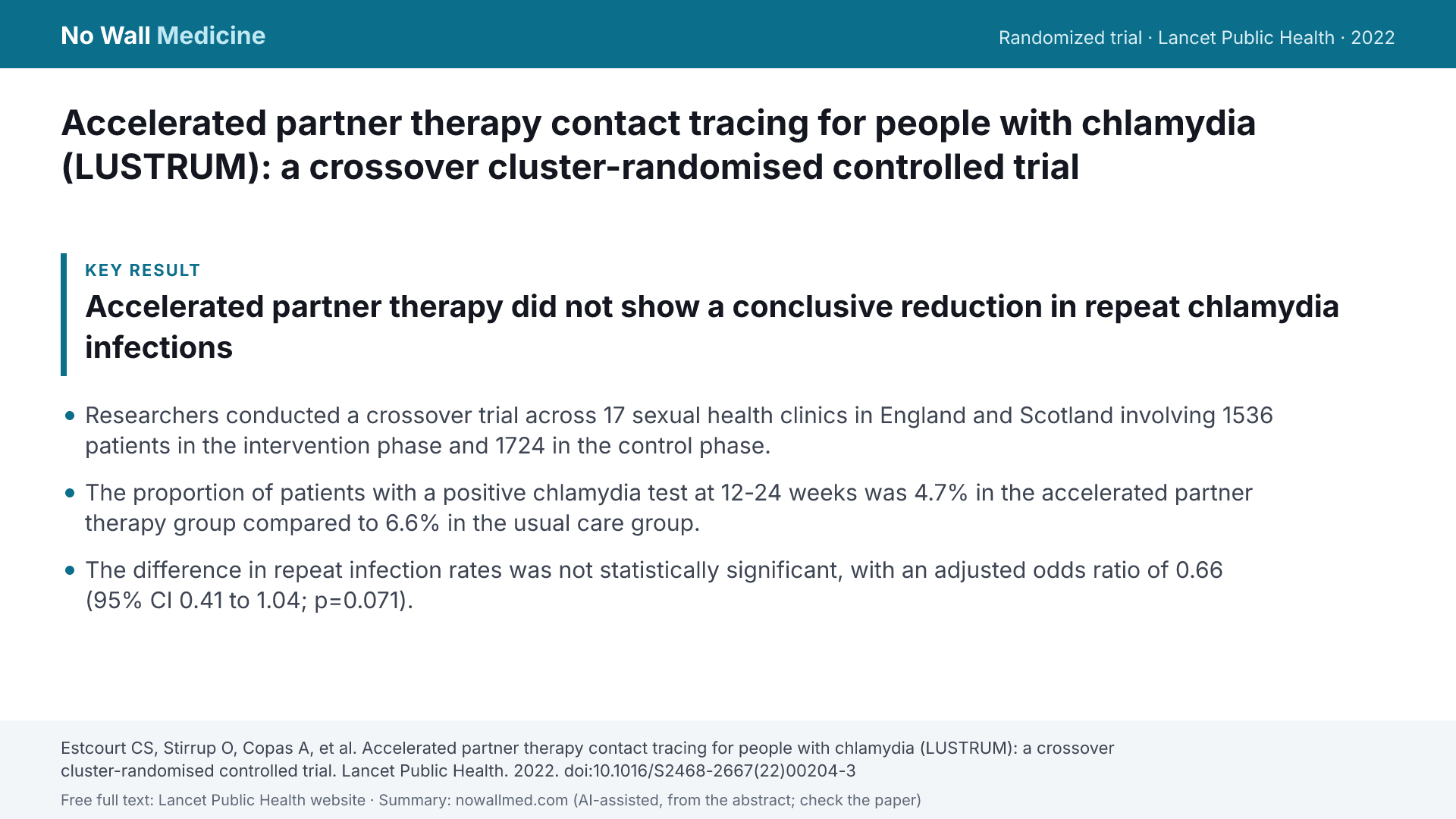
Accelerated partner therapy did not show a conclusive reduction in repeat chlamydia infections
Accelerated partner therapy contact tracing for people with chlamydia (LUSTRUM): a crossover cluster-randomised controlled trial
Why it matters: It was unknown if providing antibiotics and self-sampling kits directly to patients for their partners, known as accelerated partner therapy, is more effective than usual contact tracing.
Key points
- Researchers conducted a crossover trial across 17 sexual health clinics in England and Scotland involving 1536 patients in the intervention phase and 1724 in the control phase.
- The proportion of patients with a positive chlamydia test at 12-24 weeks was 4.7% in the accelerated partner therapy group compared to 6.6% in the usual care group.
- The difference in repeat infection rates was not statistically significant, with an adjusted odds ratio of 0.66 (95% CI 0.41 to 1.04; p=0.071).
Headline and key points written with AI from the paper’s abstract, with every number checked against it. Read the paper before relying on them.
Was this summary helpful?
Abstract
Background
Accelerated partner therapy has shown promise in improving contact tracing. We aimed to evaluate the effectiveness of accelerated partner therapy in addition to usual contact tracing compared with usual practice alone in heterosexual people with chlamydia, using a biological primary outcome measure. Methods
We did a crossover cluster-randomised controlled trial in 17 sexual health clinics (clusters) across England and Scotland. Participants were heterosexual people aged 16 years or older with a positive Chlamydia trachomatis test result, or a clinical diagnosis of conditions for which presumptive chlamydia treatment and contact tracing are initially provided, and their sexual partners. We allocated phase order for clinics through random permutation within strata. In the control phase, participants received usual care (health-care professional advised the index patient to tell their sexual partner[s] to attend clinic for sexually transmitted infection screening and treatment). In the intervention phase, participants received usual care plus an offer of accelerated partner therapy (health-care professional assessed sexual partner[s] by telephone, then sent or gave the index patient antibiotics and sexually transmitted infection self-sampling kits for their sexual partner[s]). Each phase lasted 6 months, with a 2-week washout at crossover. The primary outcome was the proportion of index patients with a positive C trachomatis test result at 12-24 weeks after contact tracing consultation. Secondary outcomes included proportions and types of sexual partners treated. Analysis was done by intention-to-treat, fitting random effects logistic regression models. This trial is registered with the ISRCTN registry, 15996256. Findings
Between Oct 24, 2018, and Nov 17, 2019, 1536 patients were enrolled in the intervention phase and 1724 were enrolled in the control phase. All clinics completed both phases. In total, 4807 sexual partners were reported, of whom 1636 (34%) were steady established partners. Overall, 293 (19%) of 1536 index patients chose accelerated partner therapy for a total of 305 partners, of whom 248 (81%) accepted. 666 (43%) of 1536 index patients in the intervention phase and 800 (46%) of 1724 in the control phase were tested for C trachomatis at 12-24 weeks after contact tracing consultation; 31 (4·7%) in the intervention phase and 53 (6·6%) in the control phase had a positive C trachomatis test result (adjusted odds ratio [OR] 0·66 [95% CI 0·41 to 1·04]; p=0·071; marginal absolute difference -2·2% [95% CI -4·7 to 0·3]). Among index patients with treatment status recorded, 775 (88·0%) of 881 patients in the intervention phase and 760 (84·6%) of 898 in the control phase had at least one treated sexual partner at 2-4 weeks after contact tracing consultation (adjusted OR 1·27 [95% CI 0·96 to 1·68]; p=0·10; marginal absolute difference 2·7% [95% CI -0·5 to 6·0]). No clinically significant harms were reported. Interpretation
Although the evidence that the intervention reduces repeat infection was not conclusive, the trial results suggest that accelerated partner therapy can be safely offered as a contact tracing option and is also likely to be cost saving. Future research should find ways to increase uptake of accelerated partner therapy and develop alternative interventions for one-off sexual partners. Funding
National Institute for Health Research.
Abstract reproduced under the article’s CC BY licence.
Subject terms
Cite this article
Estcourt CS, Stirrup O, Copas A, et al. Accelerated partner therapy contact tracing for people with chlamydia (LUSTRUM): a crossover cluster-randomised controlled trial. Lancet Public Health. 2022. doi:10.1016/S2468-2667(22)00204-3
Spotted a mistake? Suggest a correction