Accelerated partner therapy contact tracing for people with chlamydia (LUSTRUM): a crossover cluster-randomised controlled trial
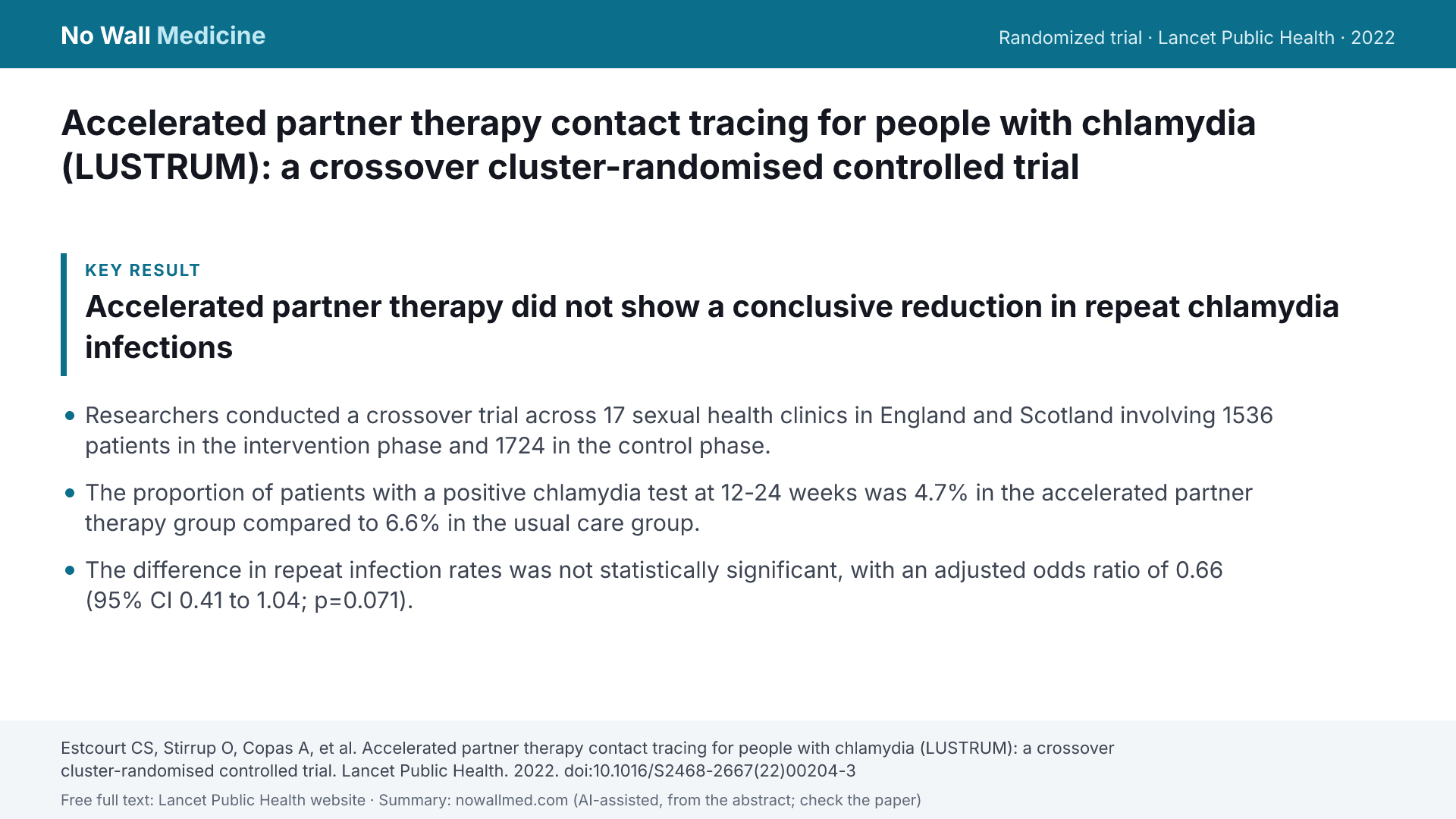
Key result: Accelerated partner therapy did not show a conclusive reduction in repeat chlamydia infections
Key points
- Researchers conducted a crossover trial across 17 sexual health clinics in England and Scotland involving 1536 patients in the intervention phase and 1724 in the control phase.
- The proportion of patients with a positive chlamydia test at 12-24 weeks was 4.7% in the accelerated partner therapy group compared to 6.6% in the usual care group.
- The difference in repeat infection rates was not statistically significant, with an adjusted odds ratio of 0.66 (95% CI 0.41 to 1.04; p=0.071).
Why it matters: It was unknown if providing antibiotics and self-sampling kits directly to patients for their partners, known as accelerated partner therapy, is more effective than usual contact tracing.
Discussion prompts
- Would these patients look like yours? Who was left out?
- Is the main outcome one that matters to patients?
- Is the difference large enough to change what you do?
Cite: Estcourt CS, Stirrup O, Copas A, et al. Accelerated partner therapy contact tracing for people with chlamydia (LUSTRUM): a crossover cluster-randomised controlled trial. Lancet Public Health. 2022. doi:10.1016/S2468-2667(22)00204-3
Free full text: Lancet Public Health website · Summary and visual abstract: nowallmed.com/a/accelerated-partner-therapy-contact-tracing-for-people-with-chlamydia-6mfvfd/ (AI-assisted from the abstract; check the paper before relying on it).