Acceptance and commitment therapy improved quality of life and Crohn's disease activity in adults
Acceptance and Commitment Therapy for Adults Living With Inflammatory Bowel Disease and Distress: A Randomized Controlled Trial
Randomized controlled trialBenefit found
Does acceptance and commitment therapy improve outcomes for adults with inflammatory bowel disease and distress?
Who
120
Adults with inflammatory bowel disease and coexistent psychological distress
Compared
Acceptance and commitment therapy: mean difference = 0.07, 95% confidence interval 0.01-0.12
Cognitive behavioral therapy-informed psychoeducation
Main outcome
health-related quality of life
Result: mean difference = 0.07, 95% confidence interval 0.01-0.12
Bottom line: Acceptance and commitment therapy significantly improves health-related quality of life and Crohn's disease activity in adults with inflammatory bowel disease.
Am J Gastroenterol · 2024-08-20Download image
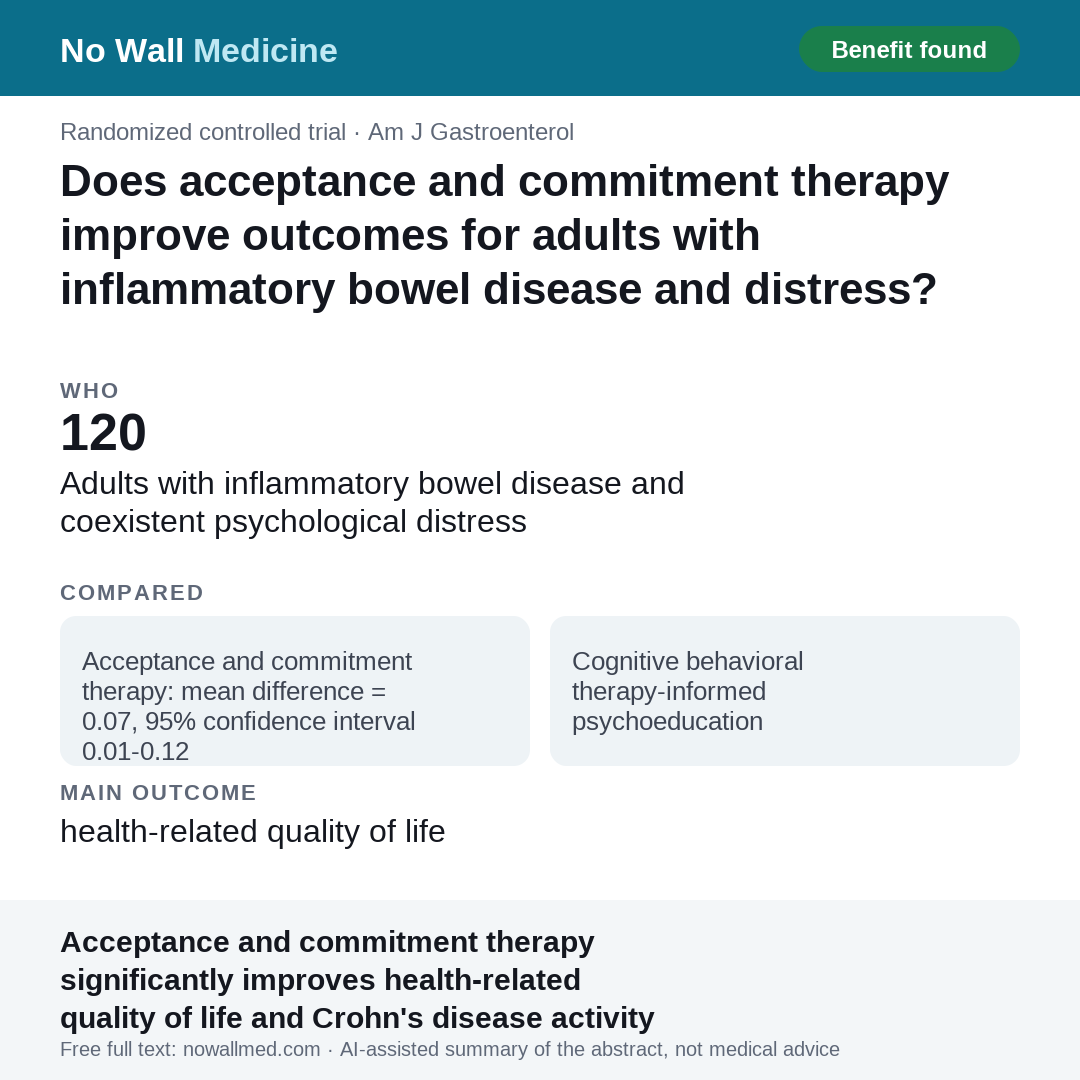
Clinical question: Does acceptance and commitment therapy improve outcomes for adults with inflammatory bowel disease and distress?
Why it matters: It is unknown if acceptance and commitment therapy provides additional benefits for biopsychosocial outcomes in people living with inflammatory bowel disease and psychological distress.
Key points
- Researchers randomized 120 adults with inflammatory bowel disease and psychological distress to either acceptance and commitment therapy or a cognitive behavioral therapy-informed psychoeducation program.
- The acceptance and commitment therapy group showed significantly greater improvements in health-related quality of life and Crohn's disease activity compared to the control group.
- Anxiety and pain improved only in the acceptance and commitment therapy group, while ulcerative colitis activity and stress symptoms improved only in the control group.
Headline and key points written with AI from the paper’s abstract, with every number checked against it. Read the paper before relying on them.
Topics
Cite this article
Naude C, Skvarc D, Maunick B, Evans S, Romano D, Chesterman S. Acceptance and Commitment Therapy for Adults Living With Inflammatory Bowel Disease and Distress: A Randomized Controlled Trial. Am J Gastroenterol. 2024. doi:10.14309/ajg.0000000000003032
Spotted a mistake? Suggest a correction
Top studies every Monday
The week’s key trials and guidelines in your specialties, plus any topics you follow. By email, free.
Get the weekly digest