Acceptance and Use of Home-Based Electronic Symptom Self-Reporting Systems in Patients With Cancer: Systematic Review
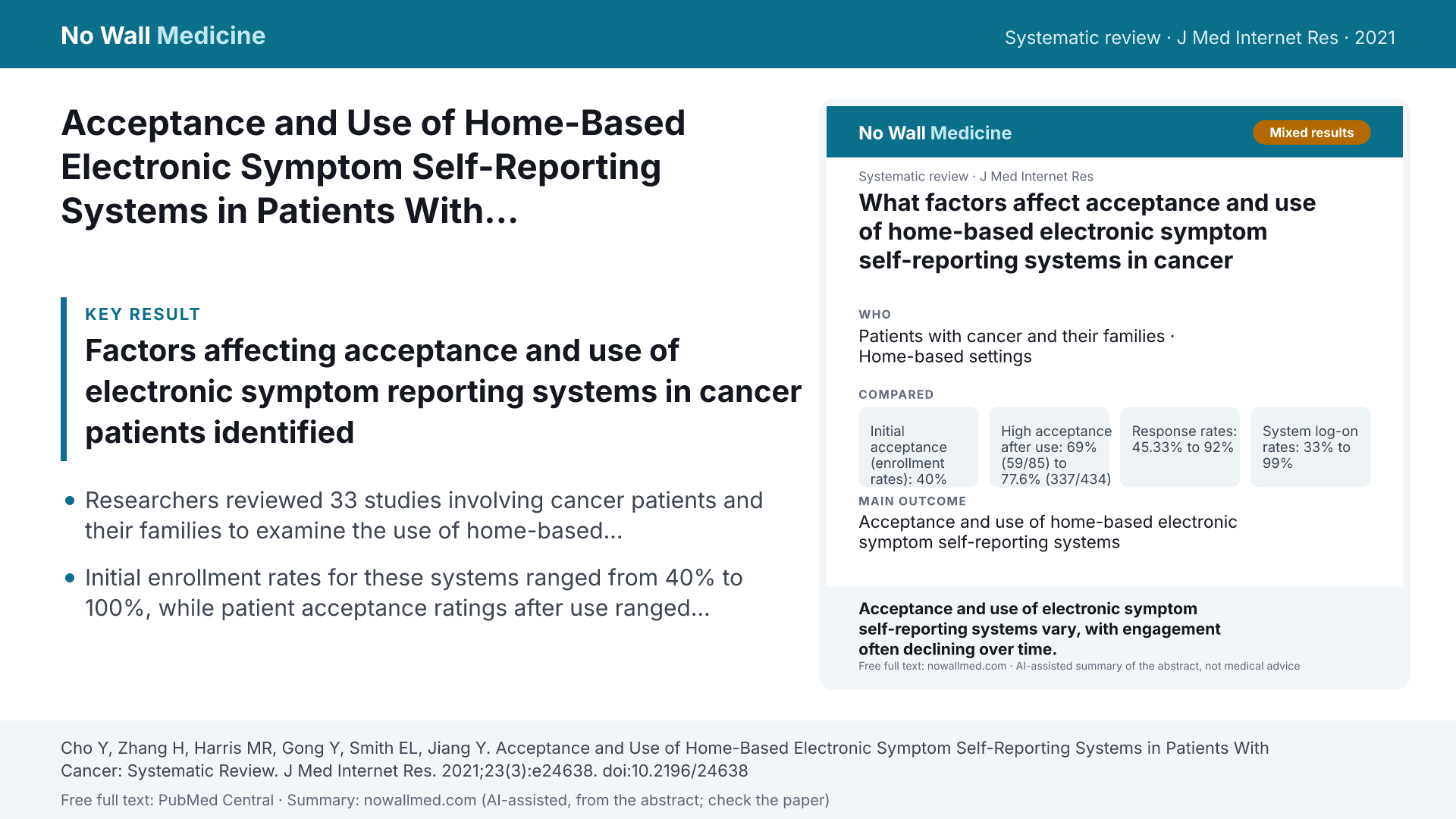
Key result: Factors affecting acceptance and use of electronic symptom reporting systems in cancer patients identified
Systematic reviewMixed results
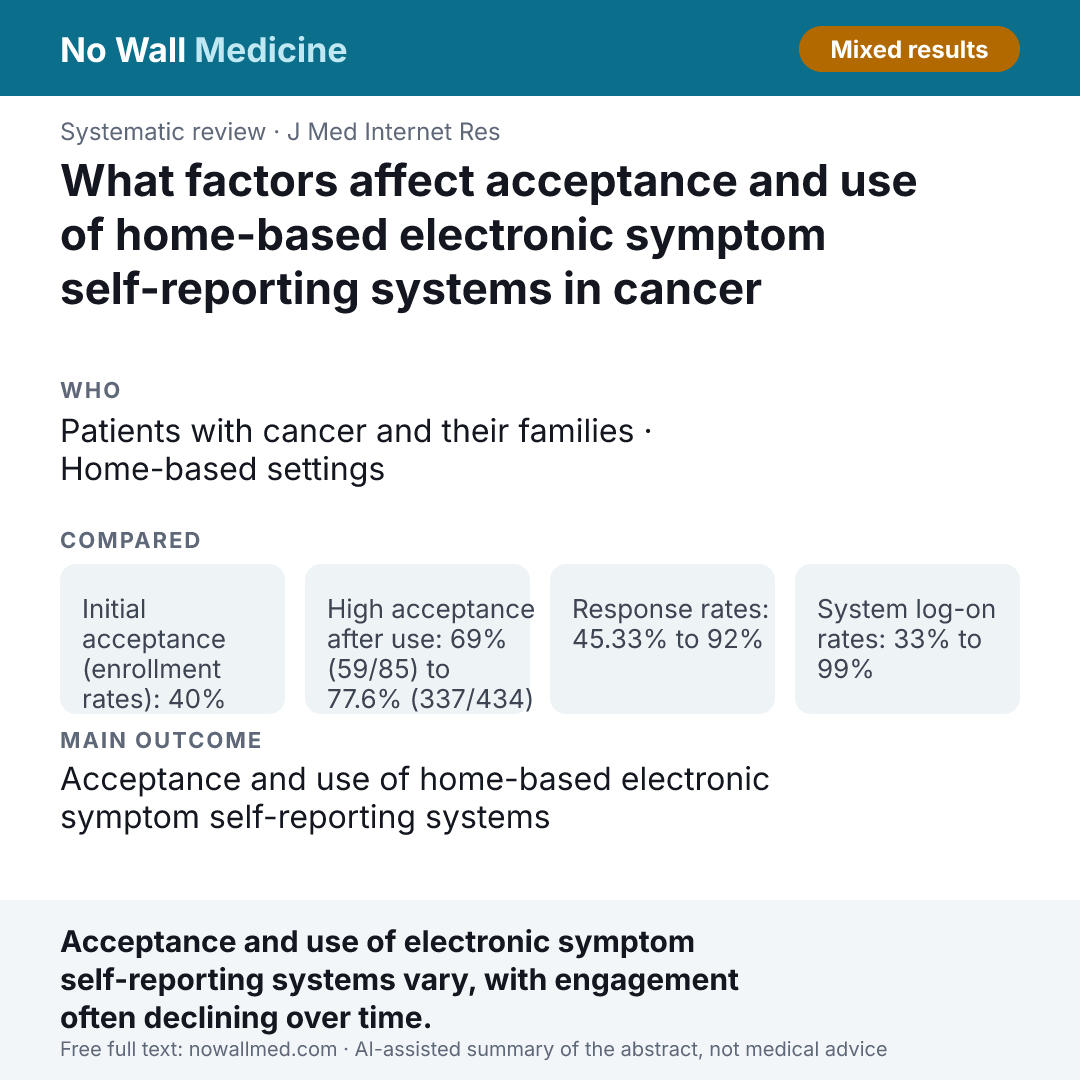
What factors affect acceptance and use of home-based electronic symptom self-reporting systems in cancer patients?
Who
Patients with cancer and their families · Home-based settings
Compared
Initial acceptance (enrollment rates): 40% (22/55) to 100% (100/100)
High acceptance after use: 69% (59/85) to 77.6% (337/434)
Response rates: 45.33% to 92%
System log-on rates: 33% to 99%
Main outcome
Acceptance and use of home-based electronic symptom self-reporting systems
Bottom line: Acceptance and use of electronic symptom self-reporting systems vary, with engagement often declining over time.
Limitation: More studies are needed to understand long-term use behavior patterns.
J Med Internet Res · 2021-03-12 · Save PNG
Key points
- Researchers reviewed 33 studies involving cancer patients and their families to examine the use of home-based electronic symptom self-reporting systems.
- Initial enrollment rates for these systems ranged from 40% to 100%, while patient acceptance ratings after use ranged from 69% to 77.6%.
- System use, measured by response or log-on rates, generally declined over time, with few studies reporting data beyond 6 months.
Discussion prompts
- Would these patients look like yours? Who was left out?
- Is the main outcome one that matters to patients?
- Is the difference large enough to change what you do?
Cite: Cho Y, Zhang H, Harris MR, Gong Y, Smith EL, Jiang Y. Acceptance and Use of Home-Based Electronic Symptom Self-Reporting Systems in Patients With Cancer: Systematic Review. J Med Internet Res. 2021. doi:10.2196/24638
Free full text: PubMed Central · Summary and visual abstract: nowallmed.com/a/acceptance-and-use-of-home-based-electronic-symptom-self-reporting-1x7h18g/ (AI-assisted from the abstract; check the paper before relying on it).