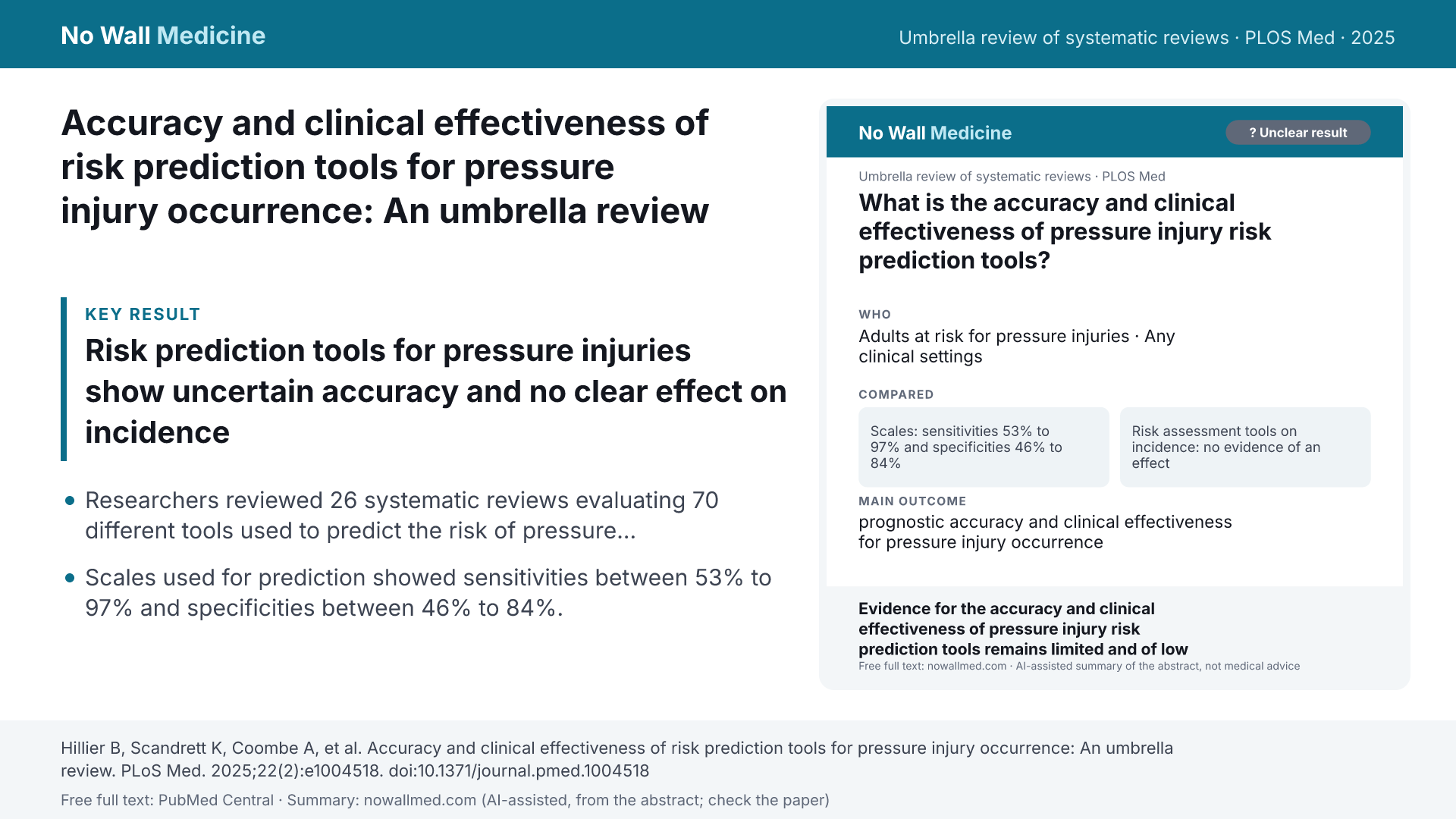
Risk prediction tools for pressure injuries show uncertain accuracy and no clear effect on incidence
Accuracy and clinical effectiveness of risk prediction tools for pressure injury occurrence: An umbrella review
General MedicineAdult and pediatric
Umbrella review of systematic reviewsUnclear result
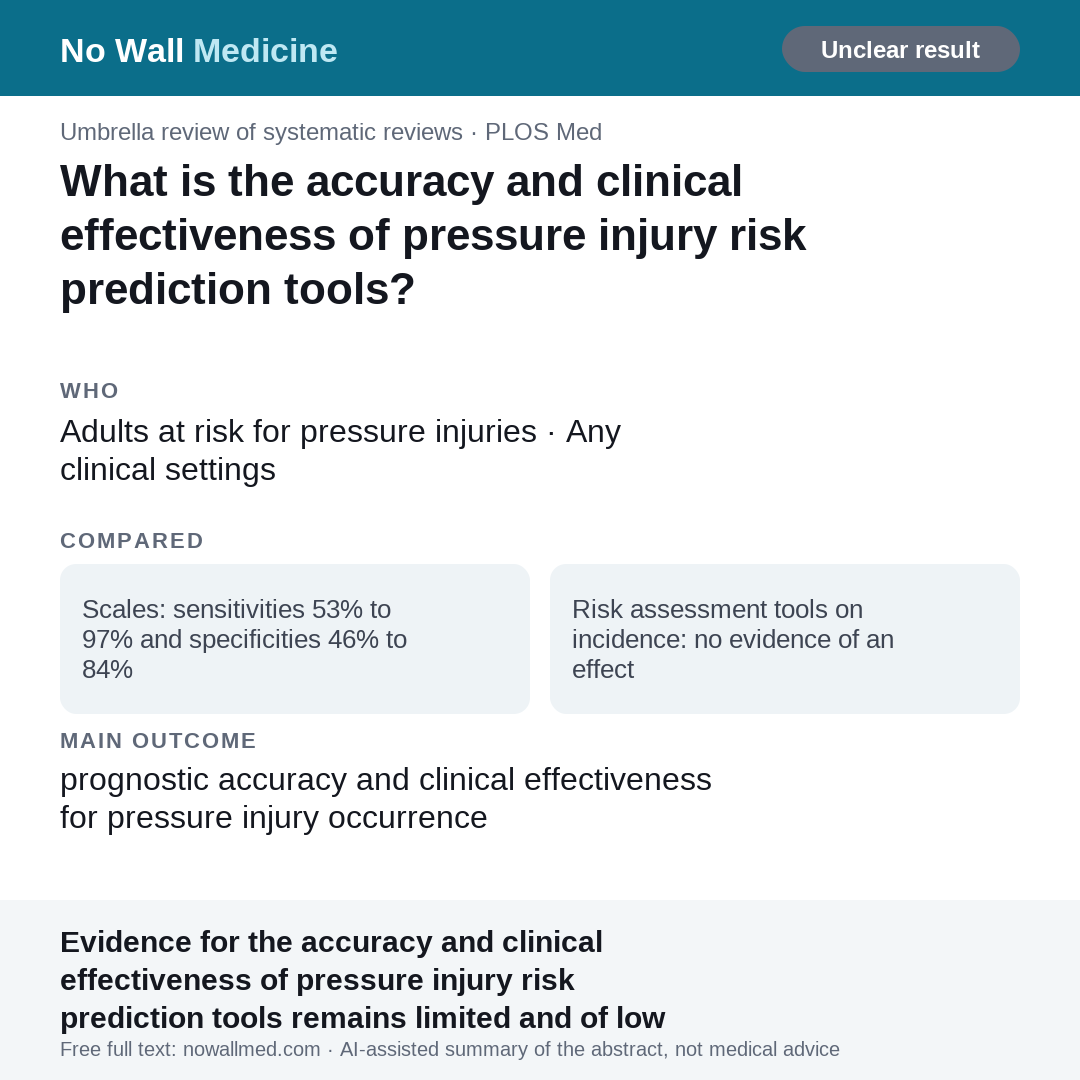
What is the accuracy and clinical effectiveness of pressure injury risk prediction tools?
Who
Adults at risk for pressure injuries · Any clinical settings
Compared
Scales: sensitivities 53% to 97% and specificities 46% to 84%
Risk assessment tools on incidence: no evidence of an effect
Main outcome
prognostic accuracy and clinical effectiveness for pressure injury occurrence
Bottom line: Evidence for the accuracy and clinical effectiveness of pressure injury risk prediction tools remains limited and of low quality.
Limitation: Poor reporting quality of systematic reviews and reliance on diagnostic test accuracy principles rather than prognostic modelling.
PLOS Med · 2025-02-06Download image
Clinical question: What is the accuracy and clinical effectiveness of pressure injury risk prediction tools?
Why it matters: It is unclear how accurately risk prediction tools identify patients at risk and whether using them leads to a reduction in pressure injury incidence.
Key points
- Researchers reviewed 26 systematic reviews evaluating 70 different tools used to predict the risk of pressure injuries in adults.
- Scales used for prediction showed sensitivities between 53% to 97% and specificities between 46% to 84%.
- Two randomized trials assessing the impact of these tools on pressure injury incidence found no evidence of an effect.
Limitation the authors note: The authors noted that systematic reviews relied heavily on diagnostic test accuracy principles rather than prognostic modelling approaches that account for temporal prediction.
Headline and key points written with AI from the paper’s abstract, with every number checked against it. Read the paper before relying on them.
Was this summary helpful?
Subject terms
Cite this article
Hillier B, Scandrett K, Coombe A, Hernandez-Boussard T, Steyerberg E, Takwoingi Y. Accuracy and clinical effectiveness of risk prediction tools for pressure injury occurrence: An umbrella review. PLOS Med. 2025. doi:10.1371/journal.pmed.1004518
Spotted a mistake? Suggest a correction
Top studies every Monday
The week’s key trials and guidelines in your specialties, plus any topics you follow. By email, free.
Get the weekly digest