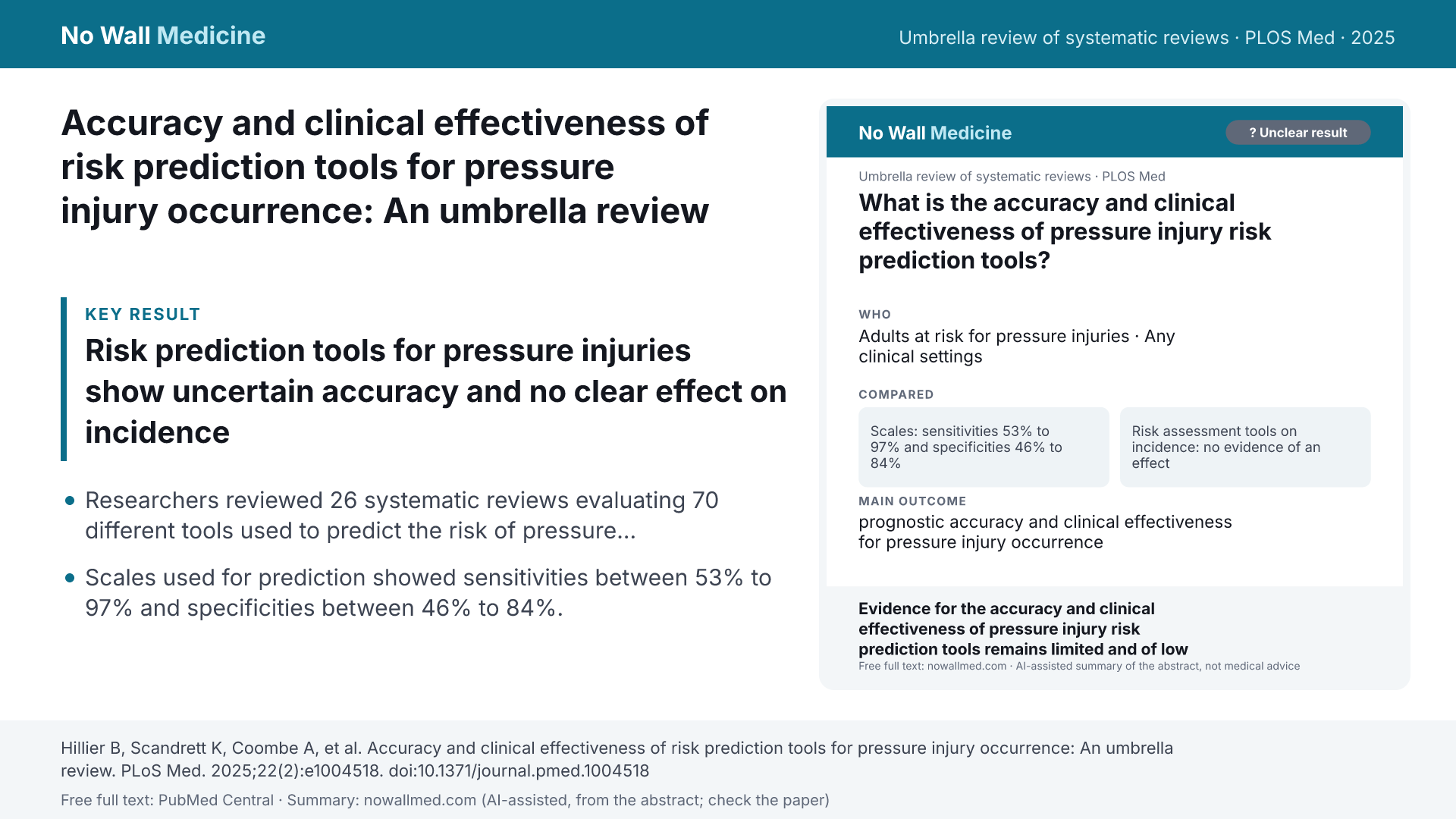
Accuracy and clinical effectiveness of risk prediction tools for pressure injury occurrence: An umbrella review
Key result: Risk prediction tools for pressure injuries show uncertain accuracy and no clear effect on incidence
Key points
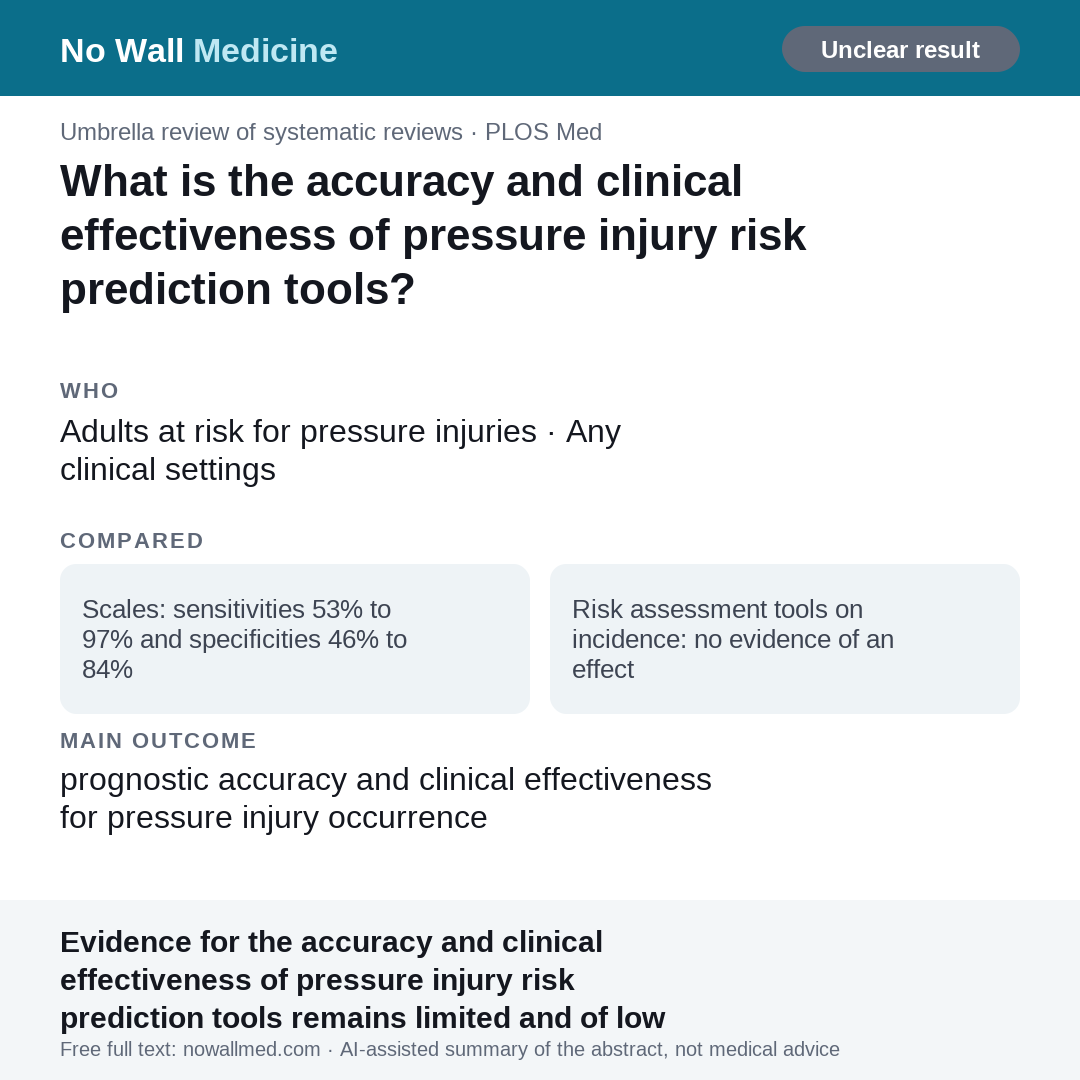
- Researchers reviewed 26 systematic reviews evaluating 70 different tools used to predict the risk of pressure injuries in adults.
- Scales used for prediction showed sensitivities between 53% to 97% and specificities between 46% to 84%.
- Two randomized trials assessing the impact of these tools on pressure injury incidence found no evidence of an effect.
Limitation the authors note: The authors noted that systematic reviews relied heavily on diagnostic test accuracy principles rather than prognostic modelling approaches that account for temporal prediction.
Discussion prompts
- Would these patients look like yours? Who was left out?
- Is the main outcome one that matters to patients?
- Is the difference large enough to change what you do?
Cite: Hillier B, Scandrett K, Coombe A, et al. Accuracy and clinical effectiveness of risk prediction tools for pressure injury occurrence: An umbrella review. PLoS Med. 2025;22(2):e1004518. doi:10.1371/journal.pmed.1004518
Free full text: PubMed Central · Summary and visual abstract: nowallmed.com/a/accuracy-and-clinical-effectiveness-of-risk-prediction-tools-for-p2w9yp/ (AI-assisted from the abstract; check the paper before relying on it).