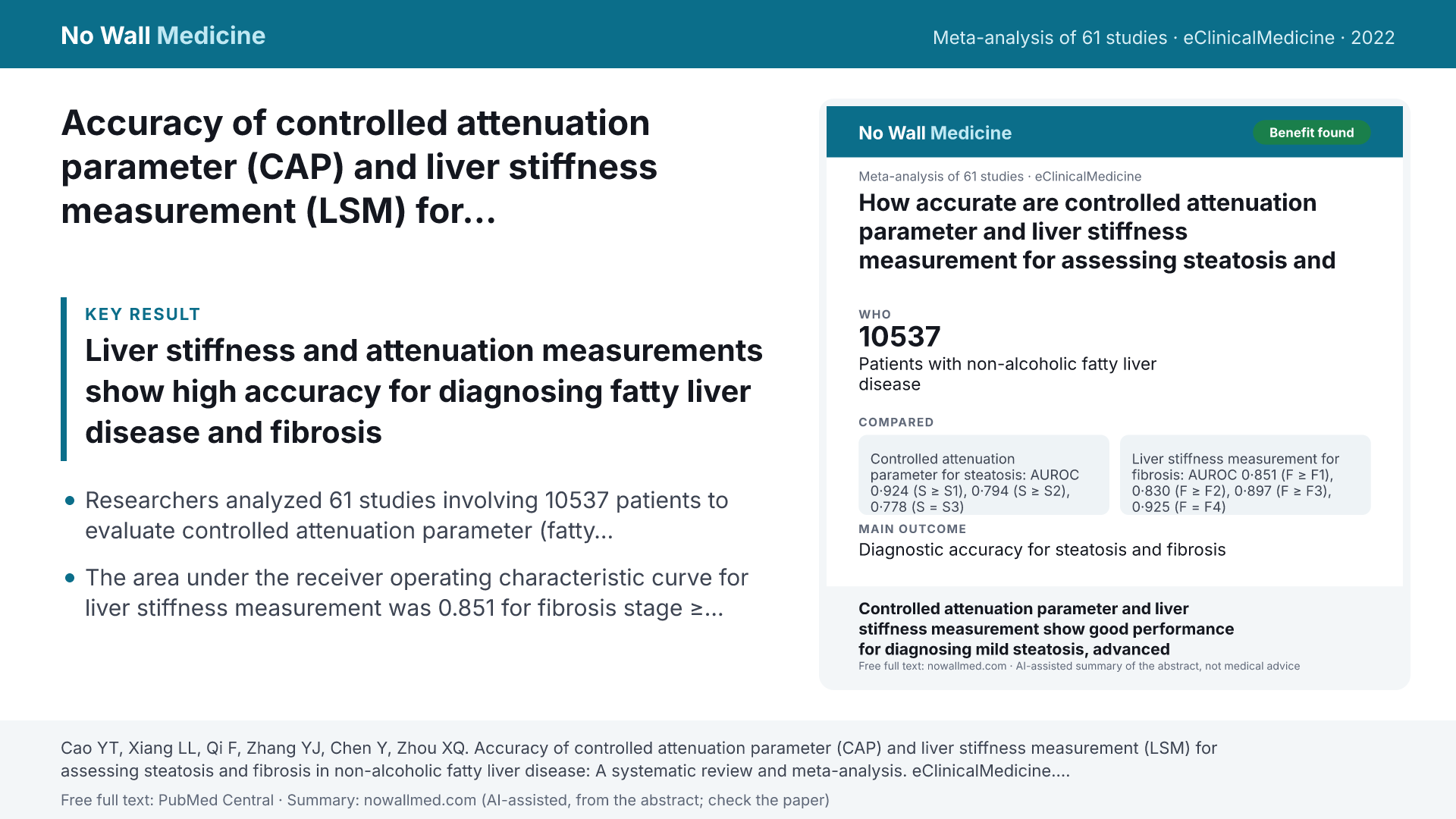
Liver stiffness and attenuation measurements show high accuracy for diagnosing fatty liver disease and fibrosis
Accuracy of controlled attenuation parameter (CAP) and liver stiffness measurement (LSM) for assessing steatosis and fibrosis in non-alcoholic fatty liver disease: A systematic review and meta-analysis
Meta-analysis of 61 studiesBenefit found
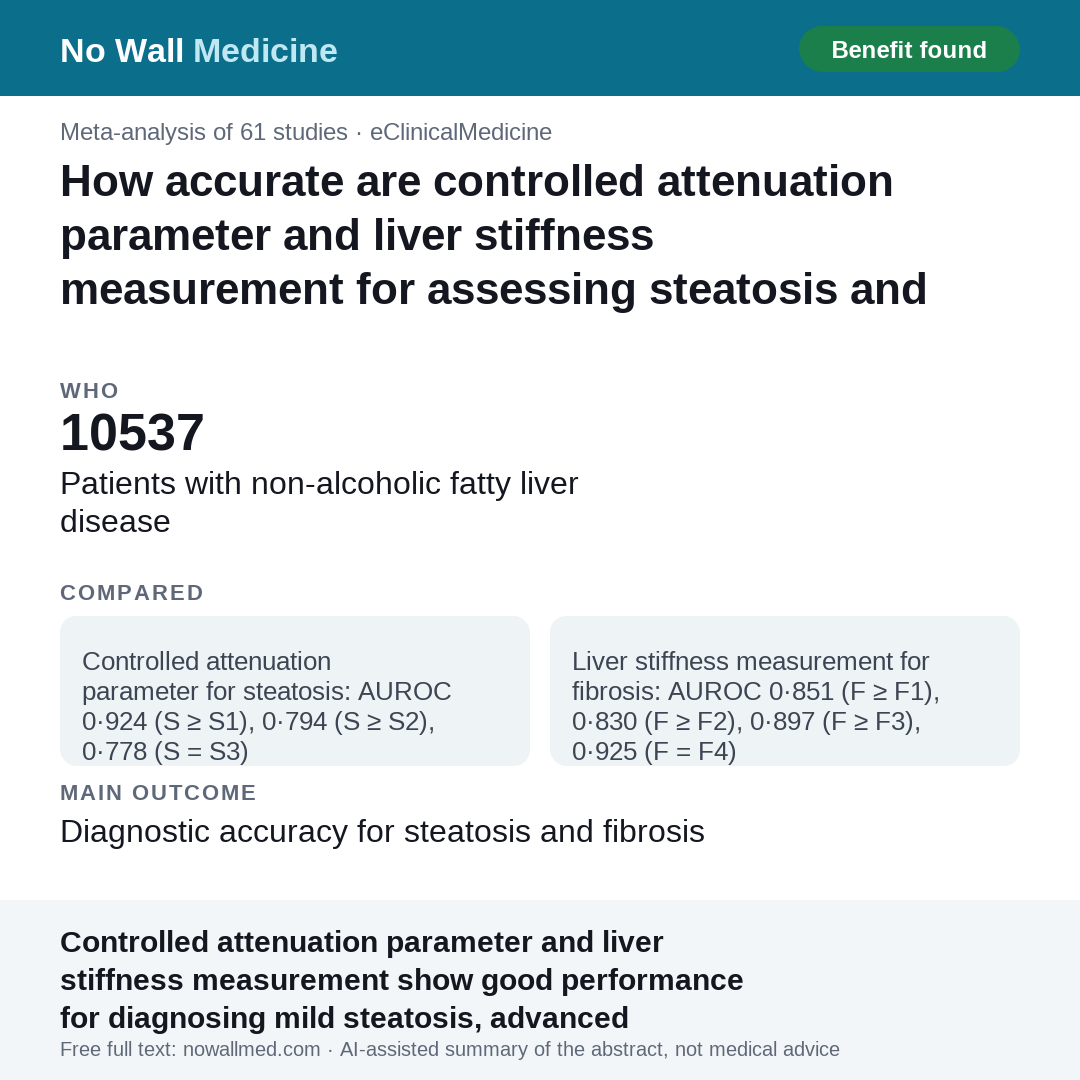
How accurate are controlled attenuation parameter and liver stiffness measurement for assessing steatosis and fibrosis?
Who
10537
Patients with non-alcoholic fatty liver disease
Compared
Controlled attenuation parameter for steatosis: AUROC 0·924 (S ≥ S1), 0·794 (S ≥ S2), 0·778 (S = S3)
Liver stiffness measurement for fibrosis: AUROC 0·851 (F ≥ F1), 0·830 (F ≥ F2), 0·897 (F ≥ F3), 0·925 (F = F4)
Main outcome
Diagnostic accuracy for steatosis and fibrosis
Bottom line: Controlled attenuation parameter and liver stiffness measurement show good performance for diagnosing mild steatosis, advanced fibrosis, and cirrhosis.
Limitation: Accuracy for obesity, moderate to severe steatosis, and low-grade fibrosis requires further validation and improvement.
Funded by: Priority Academic Program Development of Jiangsu Higher Education Institutions
eClinicalMedicine · 2022-07-10Download image
Clinical question: How accurate are controlled attenuation parameter and liver stiffness measurement for assessing steatosis and fibrosis?
Why it matters: The diagnostic accuracy of non-invasive tests for assessing fat accumulation and scarring in non-alcoholic fatty liver disease requires systematic evaluation.
Key points
- Researchers analyzed 61 studies involving 10537 patients to evaluate controlled attenuation parameter (fatty liver measurement) and liver stiffness measurement (fibrosis measurement).
- The area under the receiver operating characteristic curve for liver stiffness measurement was 0.851 for fibrosis stage ≥ F1, 0.830 for ≥ F2, 0.897 for ≥ F3, and 0.925 for cirrhosis.
- Accuracy for detecting fat in the liver was lower in patients with a body mass index of 30 kg/m² or higher compared to those with a lower body mass index.
Headline and key points written with AI from the paper’s abstract, with every number checked against it. Read the paper before relying on them.
Was this summary helpful?
Cite this article
Cao YT, Xiang LL, Qi F, Zhang YJ, Chen Y, Zhou XQ. Accuracy of controlled attenuation parameter (CAP) and liver stiffness measurement (LSM) for assessing steatosis and fibrosis in non-alcoholic fatty liver disease: A systematic review and meta-analysis. eClinicalMedicine. 2022. doi:10.1016/j.eclinm.2022.101547
Spotted a mistake? Suggest a correction