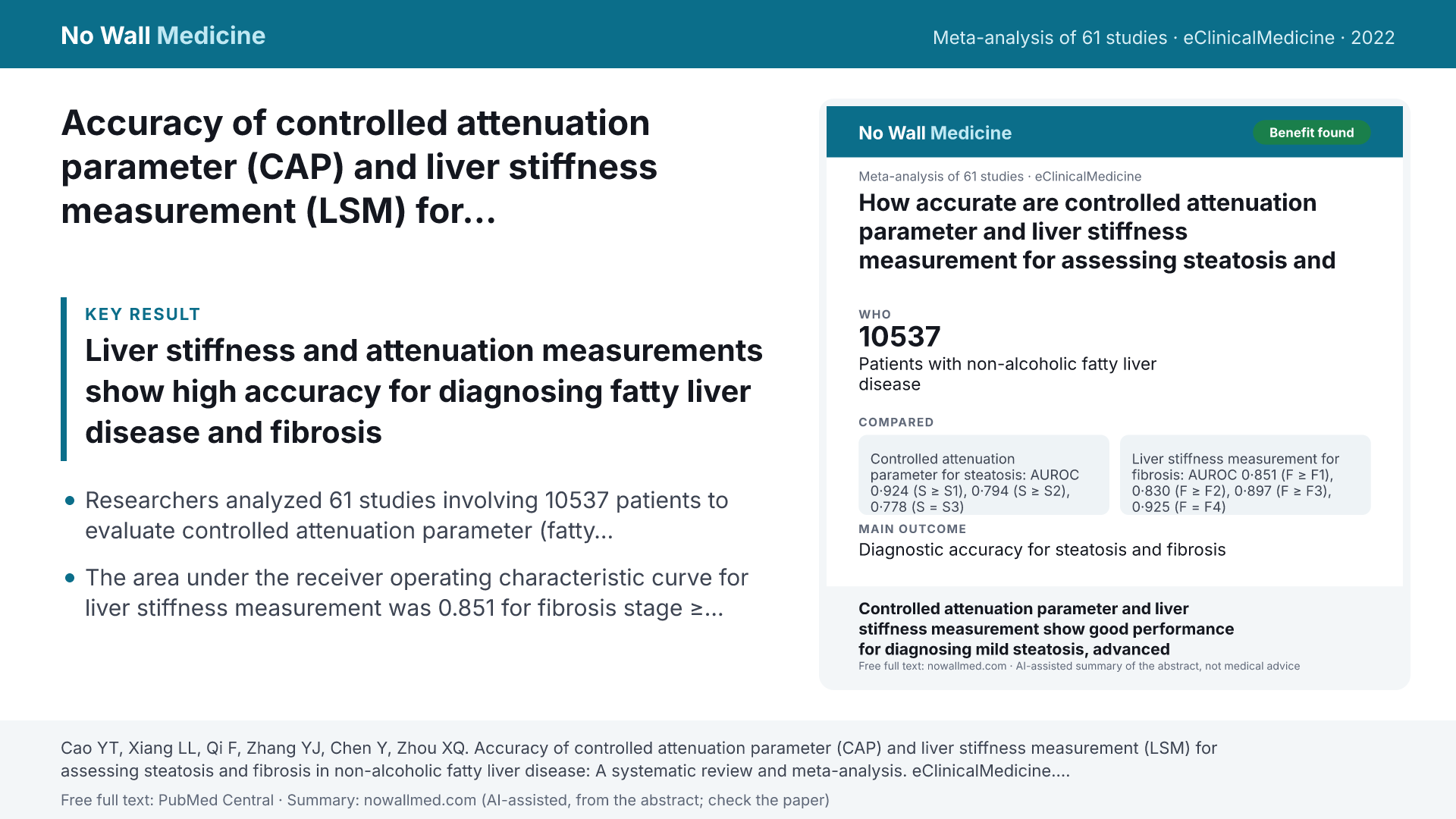
Accuracy of controlled attenuation parameter (CAP) and liver stiffness measurement (LSM) for assessing steatosis and fibrosis in non-alcoholic fatty liver disease: A systematic review and meta-analysis
Key result: Liver stiffness and attenuation measurements show high accuracy for diagnosing fatty liver disease and fibrosis
Key points
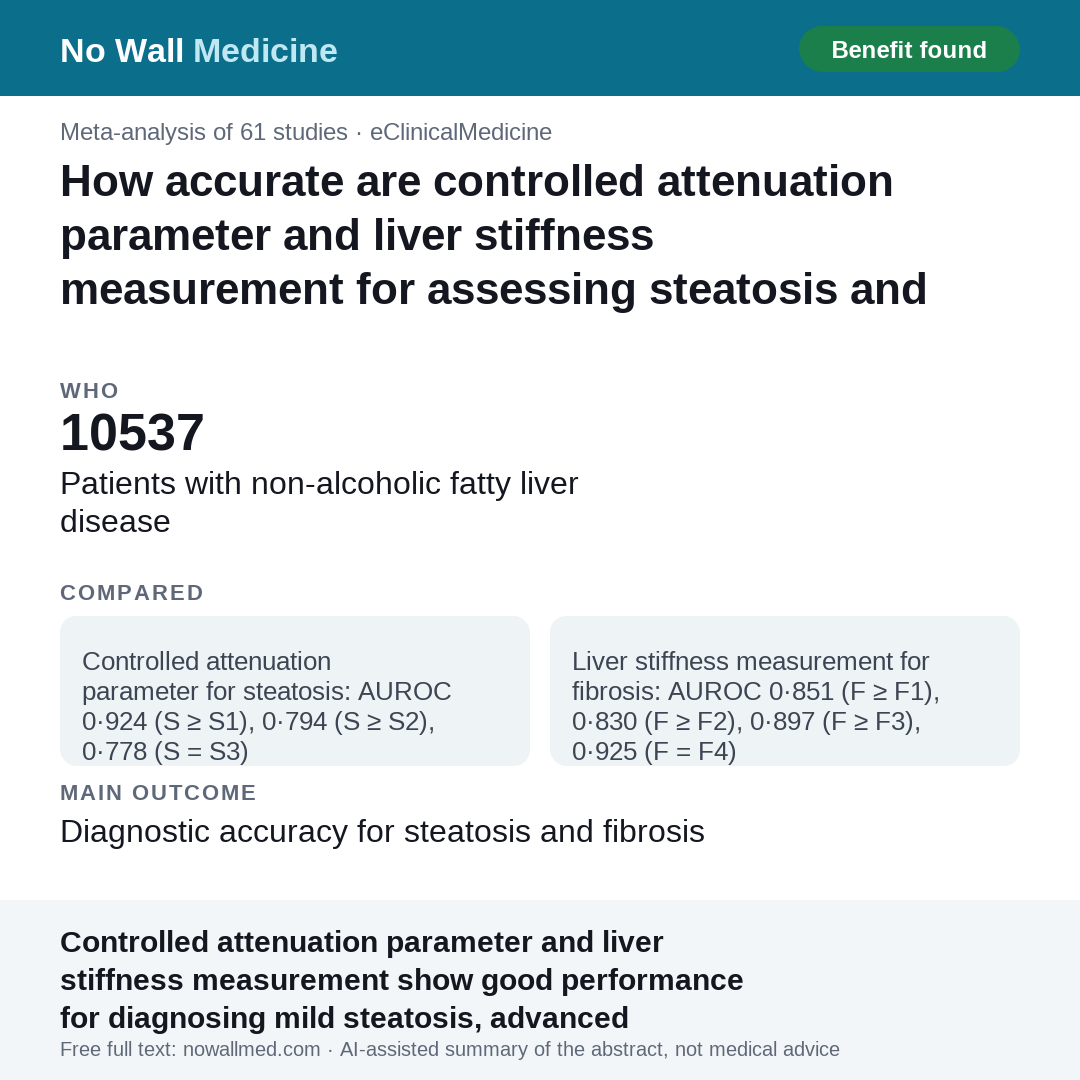
- Researchers analyzed 61 studies involving 10537 patients to evaluate controlled attenuation parameter (fatty liver measurement) and liver stiffness measurement (fibrosis measurement).
- The area under the receiver operating characteristic curve for liver stiffness measurement was 0.851 for fibrosis stage ≥ F1, 0.830 for ≥ F2, 0.897 for ≥ F3, and 0.925 for cirrhosis.
- Accuracy for detecting fat in the liver was lower in patients with a body mass index of 30 kg/m² or higher compared to those with a lower body mass index.
Why it matters: The diagnostic accuracy of non-invasive tests for assessing fat accumulation and scarring in non-alcoholic fatty liver disease requires systematic evaluation.
Discussion prompts
- Would these patients look like yours? Who was left out?
- Is the main outcome one that matters to patients?
- Is the difference large enough to change what you do?
Cite: Cao YT, Xiang LL, Qi F, Zhang YJ, Chen Y, Zhou XQ. Accuracy of controlled attenuation parameter (CAP) and liver stiffness measurement (LSM) for assessing steatosis and fibrosis in non-alcoholic fatty liver disease: A systematic review and meta-analysis. eClinicalMedicine. 2022. doi:10.1016/j.eclinm.2022.101547
Free full text: PubMed Central · Summary and visual abstract: nowallmed.com/a/accuracy-of-controlled-attenuation-parameter-cap-and-liver-stiffness-83lj8v/ (AI-assisted from the abstract; check the paper before relying on it).