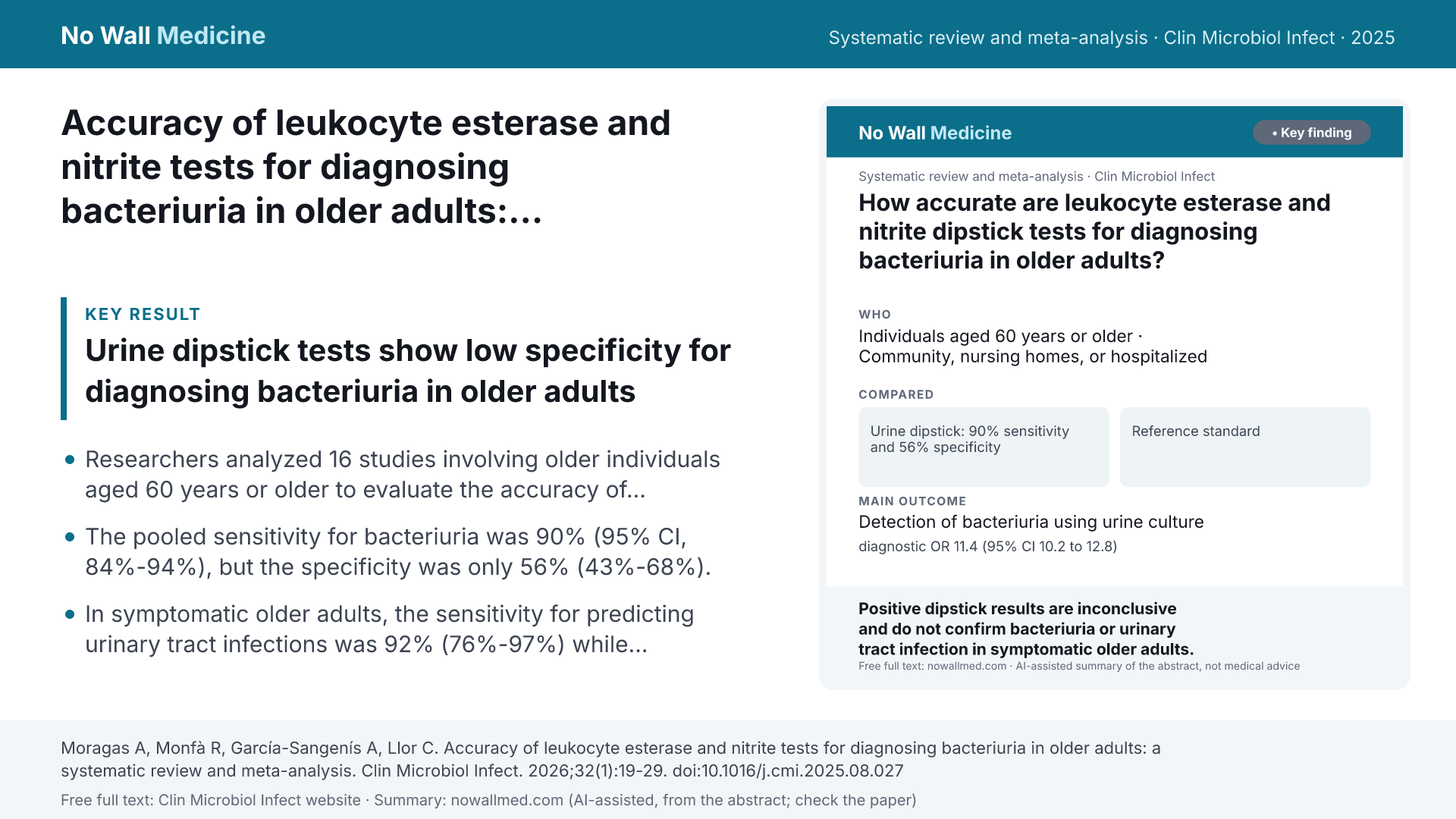
Accuracy of leukocyte esterase and nitrite tests for diagnosing bacteriuria in older adults: a systematic review and meta-analysis
Key result: Urine dipstick tests show low specificity for diagnosing bacteriuria in older adults

Key points
- Researchers analyzed 16 studies involving older individuals aged 60 years or older to evaluate the accuracy of leukocyte esterase and nitrite urine dipstick tests.
- The pooled sensitivity for bacteriuria was 90% (95% CI, 84%-94%), but the specificity was only 56% (43%-68%).
- In symptomatic older adults, the sensitivity for predicting urinary tract infections was 92% (76%-97%) while specificity was 39% (19%-62%).
Why it matters: The accuracy of leukocyte esterase and nitrite dipstick tests for diagnosing bacteriuria in older individuals remains uncertain due to high rates of asymptomatic bacteriuria.
Limitation the authors note: The included studies had a moderate risk of bias.
Discussion prompts
- Would these patients look like yours? Who was left out?
- Is the main outcome one that matters to patients?
- Is the difference large enough to change what you do?
Cite: Moragas A, Monfà R, García-Sangenís A, Llor C. Accuracy of leukocyte esterase and nitrite tests for diagnosing bacteriuria in older adults: a systematic review and meta-analysis. Clin Microbiol Infect. 2026;32(1):19-29. doi:10.1016/j.cmi.2025.08.027
Free full text: Clin Microbiol Infect website · Summary and visual abstract: nowallmed.com/a/accuracy-of-leukocyte-esterase-and-nitrite-tests-for-diagnosing-1unhp88/ (AI-assisted from the abstract; check the paper before relying on it).