Urine dipstick tests show low specificity for diagnosing bacteriuria in older adults
Accuracy of leukocyte esterase and nitrite tests for diagnosing bacteriuria in older adults: a systematic review and meta-analysis
Systematic review and meta-analysisHarm found
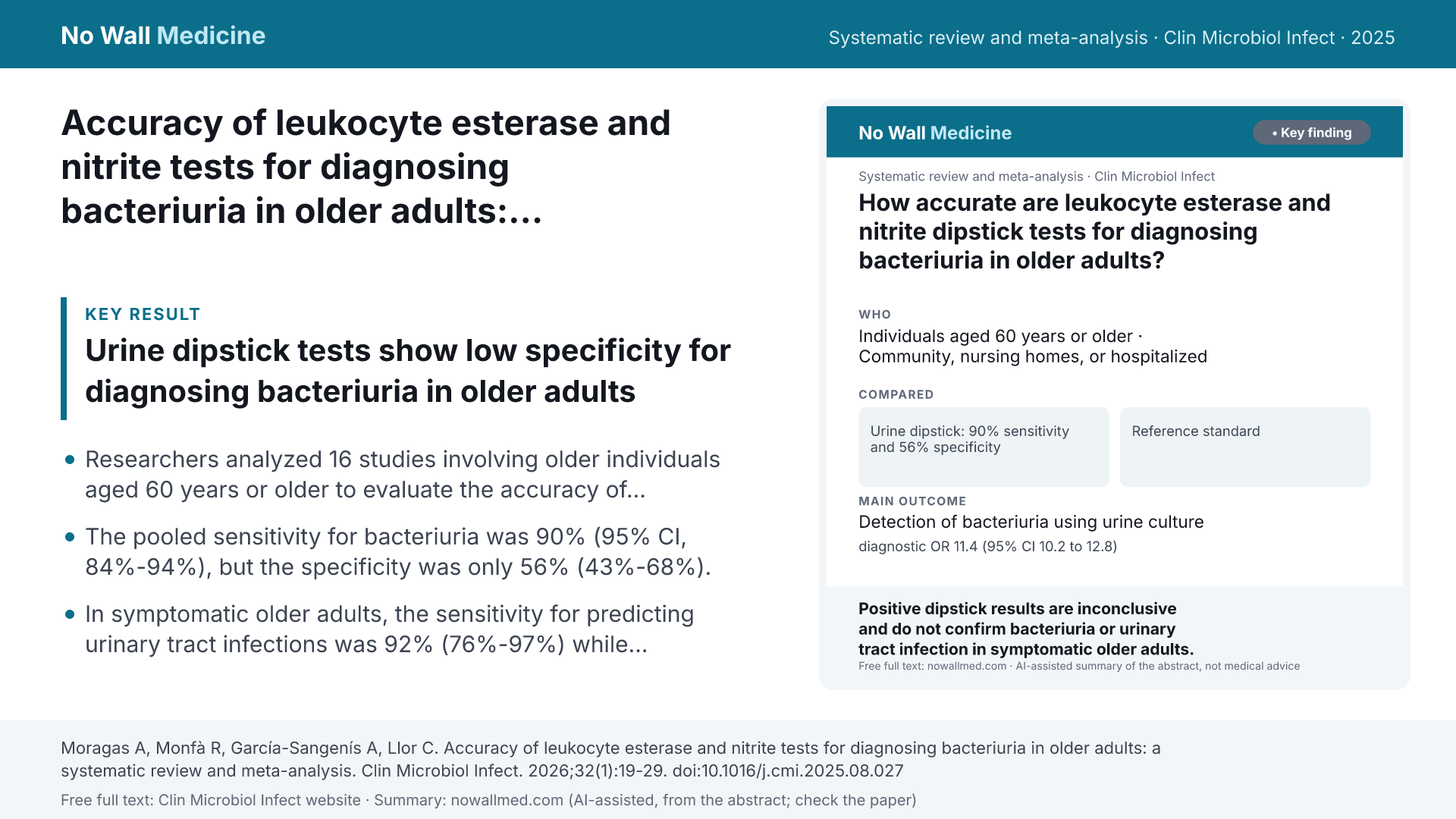
How accurate are leukocyte esterase and nitrite dipstick tests for diagnosing bacteriuria in older adults?
Who
Individuals aged 60 years or older · Community, nursing homes, or hospitalized
Compared
Urine dipstick: 90% sensitivity and 56% specificity
Reference standard
Main outcome
Detection of bacteriuria using urine culture
Result: diagnostic OR 11.4 (95% CI 10.2 to 12.8)
Bottom line: Positive dipstick results are inconclusive and do not confirm bacteriuria or urinary tract infection in symptomatic older adults.
Limitation: Included studies had a moderate risk of bias
Clin Microbiol Infect · 2025-09-03Download image

Clinical question: How accurate are leukocyte esterase and nitrite dipstick tests for diagnosing bacteriuria in older adults?
Why it matters: The accuracy of leukocyte esterase and nitrite dipstick tests for diagnosing bacteriuria in older individuals remains uncertain due to high rates of asymptomatic bacteriuria.
Key points
- Researchers analyzed 16 studies involving older individuals aged 60 years or older to evaluate the accuracy of leukocyte esterase and nitrite urine dipstick tests.
- The pooled sensitivity for bacteriuria was 90% (95% CI, 84%-94%), but the specificity was only 56% (43%-68%).
- In symptomatic older adults, the sensitivity for predicting urinary tract infections was 92% (76%-97%) while specificity was 39% (19%-62%).
Limitation the authors note: The included studies had a moderate risk of bias.
Headline and key points written with AI from the paper’s abstract, with every number checked against it. Read the paper before relying on them.
Was this summary helpful?
Subject terms
Cite this article
Moragas A, Monfà R, García-Sangenís A, Llor C. Accuracy of leukocyte esterase and nitrite tests for diagnosing bacteriuria in older adults: a systematic review and meta-analysis. Clin Microbiol Infect. 2025. doi:10.1016/j.cmi.2025.08.027
Spotted a mistake? Suggest a correction