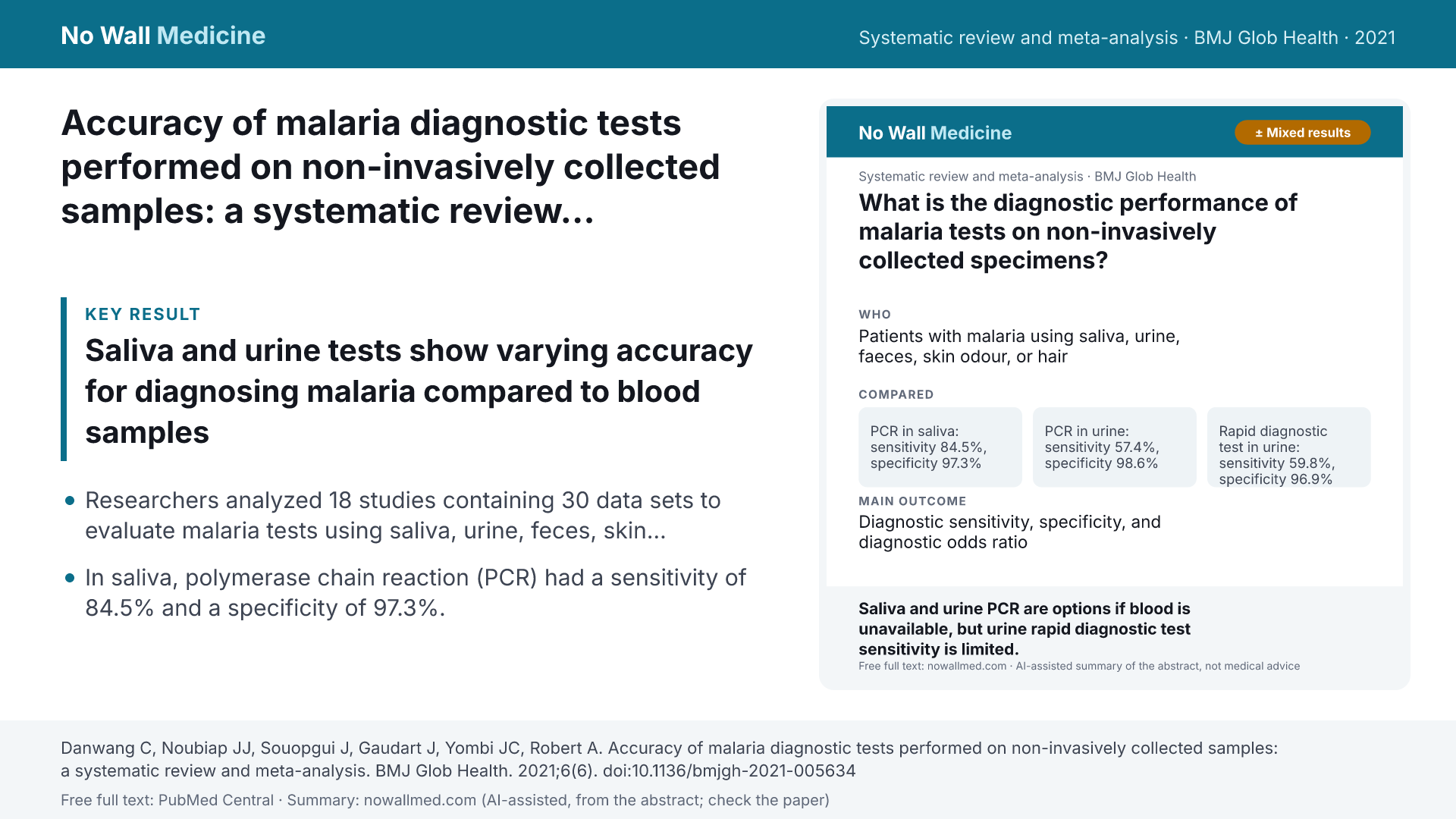
Saliva and urine tests show varying accuracy for diagnosing malaria compared to blood samples
Accuracy of malaria diagnostic tests performed on non-invasively collected samples: a systematic review and meta-analysis
Systematic review and meta-analysisMixed results
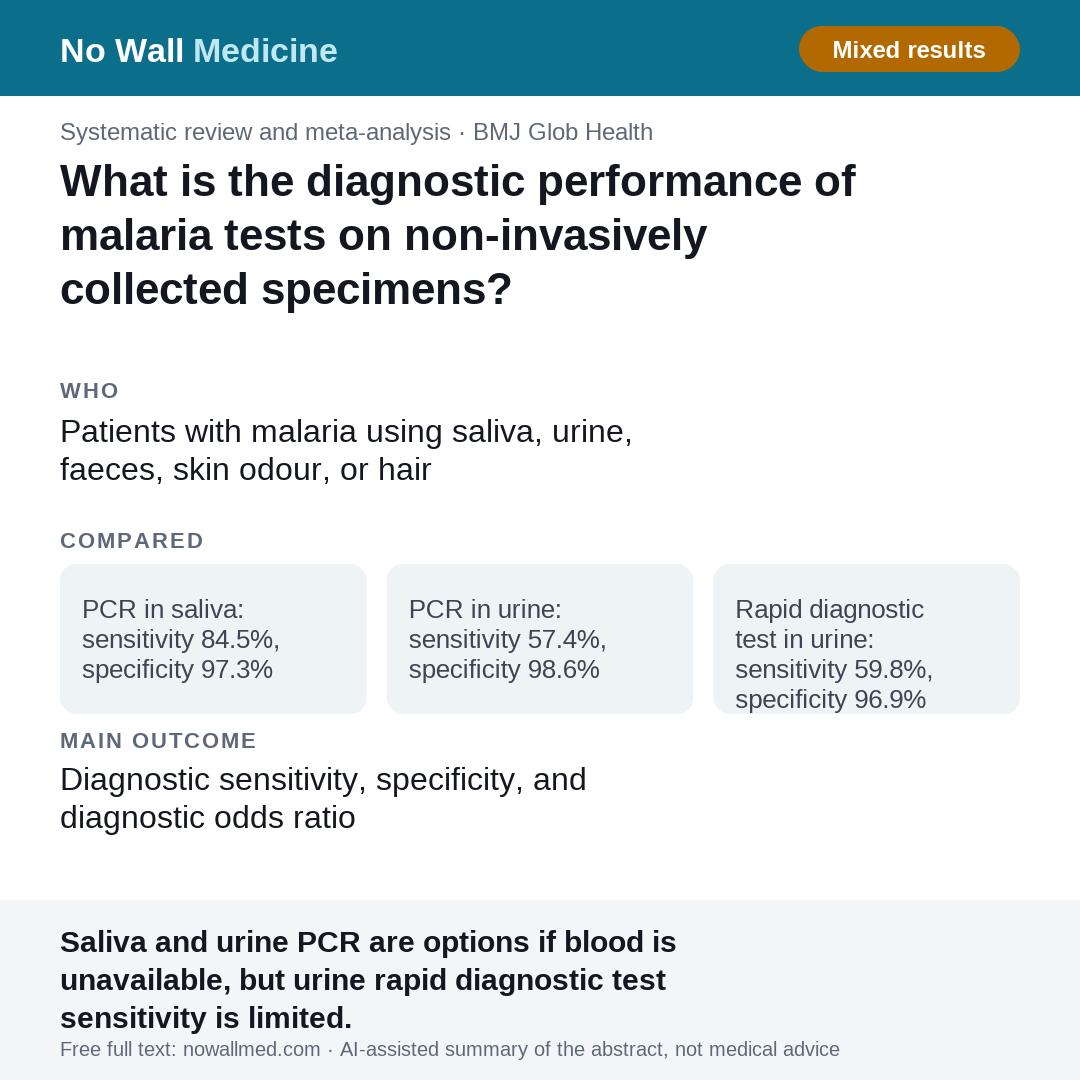
What is the diagnostic performance of malaria tests on non-invasively collected specimens?
Who
Patients with malaria using saliva, urine, faeces, skin odour, or hair
Compared
PCR in saliva: sensitivity 84.5%, specificity 97.3%
PCR in urine: sensitivity 57.4%, specificity 98.6%
Rapid diagnostic test in urine: sensitivity 59.8%, specificity 96.9%
Main outcome
Diagnostic sensitivity, specificity, and diagnostic odds ratio
Bottom line: Saliva and urine PCR are options if blood is unavailable, but urine rapid diagnostic test sensitivity is limited.
Limitation: Malaria testing on non-invasively collected specimen still needs substantial improvement.
BMJ Glob Health · 2021-06-03Download image
Clinical question: What is the diagnostic performance of malaria tests on non-invasively collected specimens?
Why it matters: The overall performance of malaria diagnostic tests using non-invasive specimens like saliva or urine has not been estimated through a systematic review.
Key points
- Researchers analyzed 18 studies containing 30 data sets to evaluate malaria tests using saliva, urine, feces, skin odor, and hair.
- In saliva, polymerase chain reaction (PCR) had a sensitivity of 84.5% and a specificity of 97.3%.
- In urine, PCR sensitivity was 57.4% and rapid diagnostic test sensitivity was 59.8%.
Headline and key points written with AI from the paper’s abstract, with every number checked against it. Read the paper before relying on them.
Was this summary helpful?
Abstract
Background
During the last decade, many studies have assessed the performance of malaria tests on non-invasively collected specimens, but no systematic review has hitherto estimated the overall performance of these tests. We report here the first meta-analysis estimating the diagnostic performance of malaria diagnostic tests performed on saliva, urine, faeces, skin odour ('sniff and tell') and hair, using either microscopy or PCR on blood sample as reference test. Methods
We searched on PubMed, EMBASE, African Journals Online and Cochrane Infectious Diseases from inception until 19 January 2021 for relevant primary studies. A random effects model was used to estimate the overall performance of various diagnostic methods on different types of specimen. Results
Eighteen studies providing 30 data sets were included in the meta-analysis. The overall sensitivity, specificity and diagnostic OR (DOR) of PCR were 84.5% (95% CI 79.3% to 88.6%), 97.3% (95% CI 95.3% to 98.5%) and 184.9 (95% CI 95.8 to 356.9) in saliva, respectively; 57.4% (95% CI 41.4% to 72.1%), 98.6% (95% CI 97.3% to 99.3%) and 47.2 (95% CI 22.1 to 101.1) in urine, respectively. The overall sensitivity, specificity and DOR of rapid diagnostic test for malaria in urine was 59.8% (95% CI 40.0% to 76.9%), 96.9% (95% CI 91.0% to 99.0%) and 30.8 (95% CI:23.5 to 40.4). Conclusion
In settings where PCR is available, saliva and urine samples should be considered for PCR-based malaria diagnosis only if blood samples cannot be collected. The performance of rapid diagnostic testing in the urine is limited, especially its sensitivity. Malaria testing on non-invasively collected specimen still needs substantial improvement.
Abstract reproduced under the article’s CC BY NC licence.
Subject terms
Cite this article
Danwang C, Noubiap JJ, Souopgui J, Gaudart J, Yombi JC, Robert A. Accuracy of malaria diagnostic tests performed on non-invasively collected samples: a systematic review and meta-analysis. BMJ Glob Health. 2021. doi:10.1136/bmjgh-2021-005634
Spotted a mistake? Suggest a correction