Accuracy of malaria diagnostic tests performed on non-invasively collected samples: a systematic review and meta-analysis
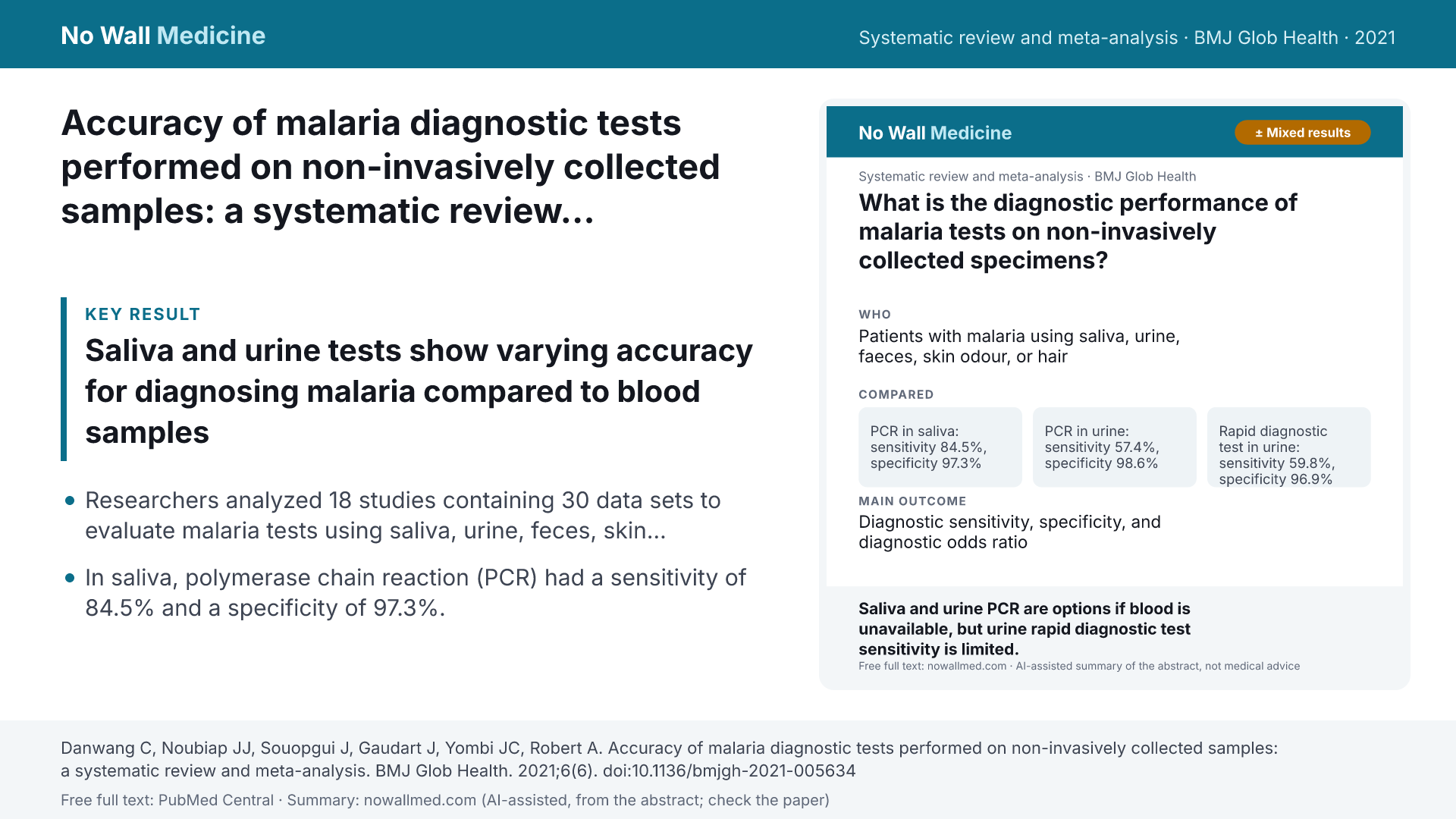
Key result: Saliva and urine tests show varying accuracy for diagnosing malaria compared to blood samples
Systematic review and meta-analysisMixed results
What is the diagnostic performance of malaria tests on non-invasively collected specimens?
Who
Patients with malaria using saliva, urine, faeces, skin odour, or hair
Compared
PCR in saliva: sensitivity 84.5%, specificity 97.3%
PCR in urine: sensitivity 57.4%, specificity 98.6%
Rapid diagnostic test in urine: sensitivity 59.8%, specificity 96.9%
Main outcome
Diagnostic sensitivity, specificity, and diagnostic odds ratio
Bottom line: Saliva and urine PCR are options if blood is unavailable, but urine rapid diagnostic test sensitivity is limited.
Limitation: Malaria testing on non-invasively collected specimen still needs substantial improvement.
BMJ Glob Health · 2021-06-03
Key points
- Researchers analyzed 18 studies containing 30 data sets to evaluate malaria tests using saliva, urine, feces, skin odor, and hair.
- In saliva, polymerase chain reaction (PCR) had a sensitivity of 84.5% and a specificity of 97.3%.
- In urine, PCR sensitivity was 57.4% and rapid diagnostic test sensitivity was 59.8%.
Why it matters: The overall performance of malaria diagnostic tests using non-invasive specimens like saliva or urine has not been estimated through a systematic review.
Discussion prompts
- Would these patients look like yours? Who was left out?
- Is the main outcome one that matters to patients?
- Is the difference large enough to change what you do?
Cite: Danwang C, Noubiap JJ, Souopgui J, Gaudart J, Yombi JC, Robert A. Accuracy of malaria diagnostic tests performed on non-invasively collected samples: a systematic review and meta-analysis. BMJ Glob Health. 2021;6(6). doi:10.1136/bmjgh-2021-005634
Free full text: PubMed Central · Summary and visual abstract: nowallmed.com/a/accuracy-of-malaria-diagnostic-tests-performed-on-non-invasively-1wimeo3/ (AI-assisted from the abstract; check the paper before relying on it).