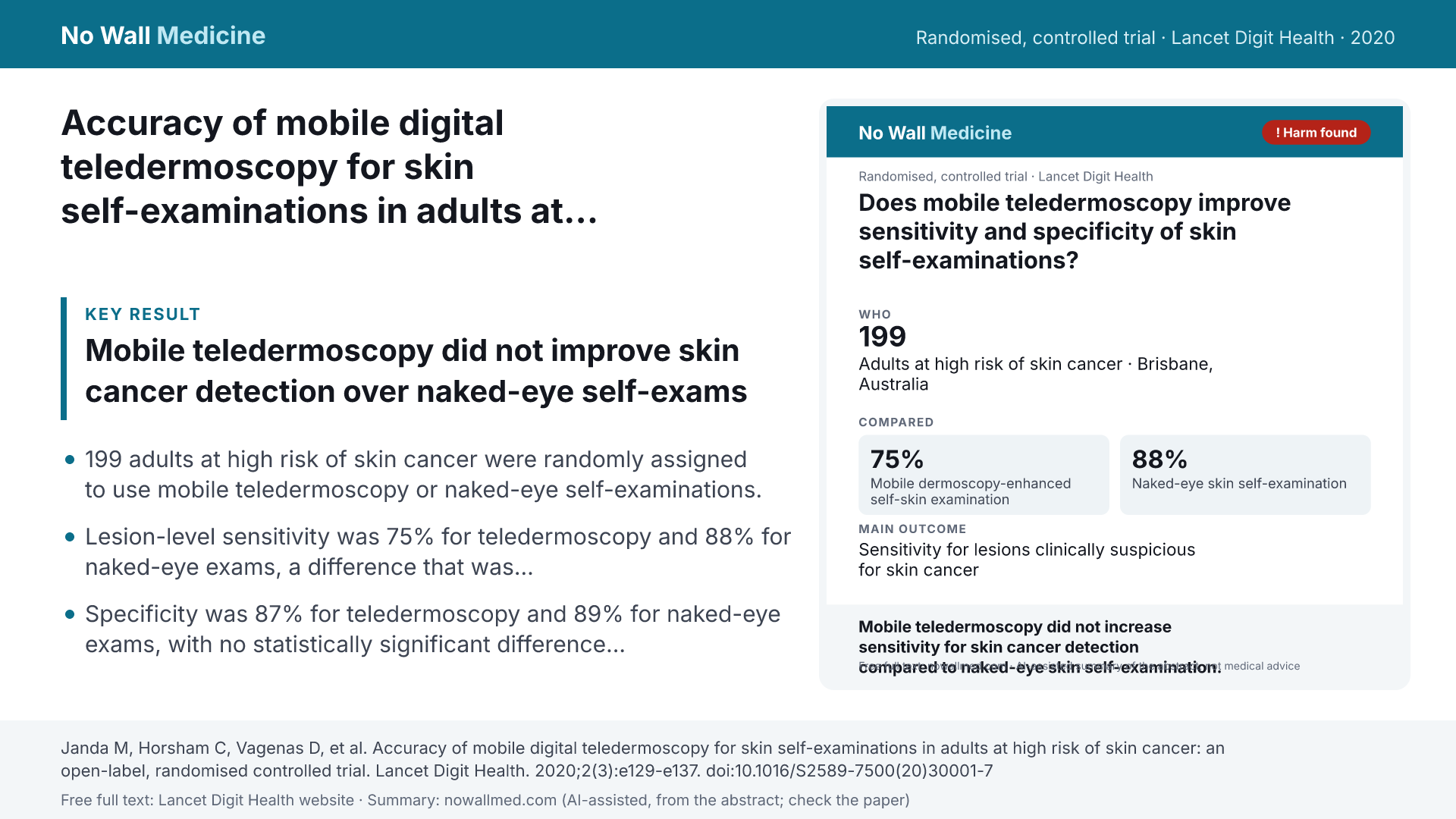
Mobile teledermoscopy did not improve skin cancer detection over naked-eye self-exams
Accuracy of mobile digital teledermoscopy for skin self-examinations in adults at high risk of skin cancer: an open-label, randomised controlled trial
Randomised, controlled trialHarm found
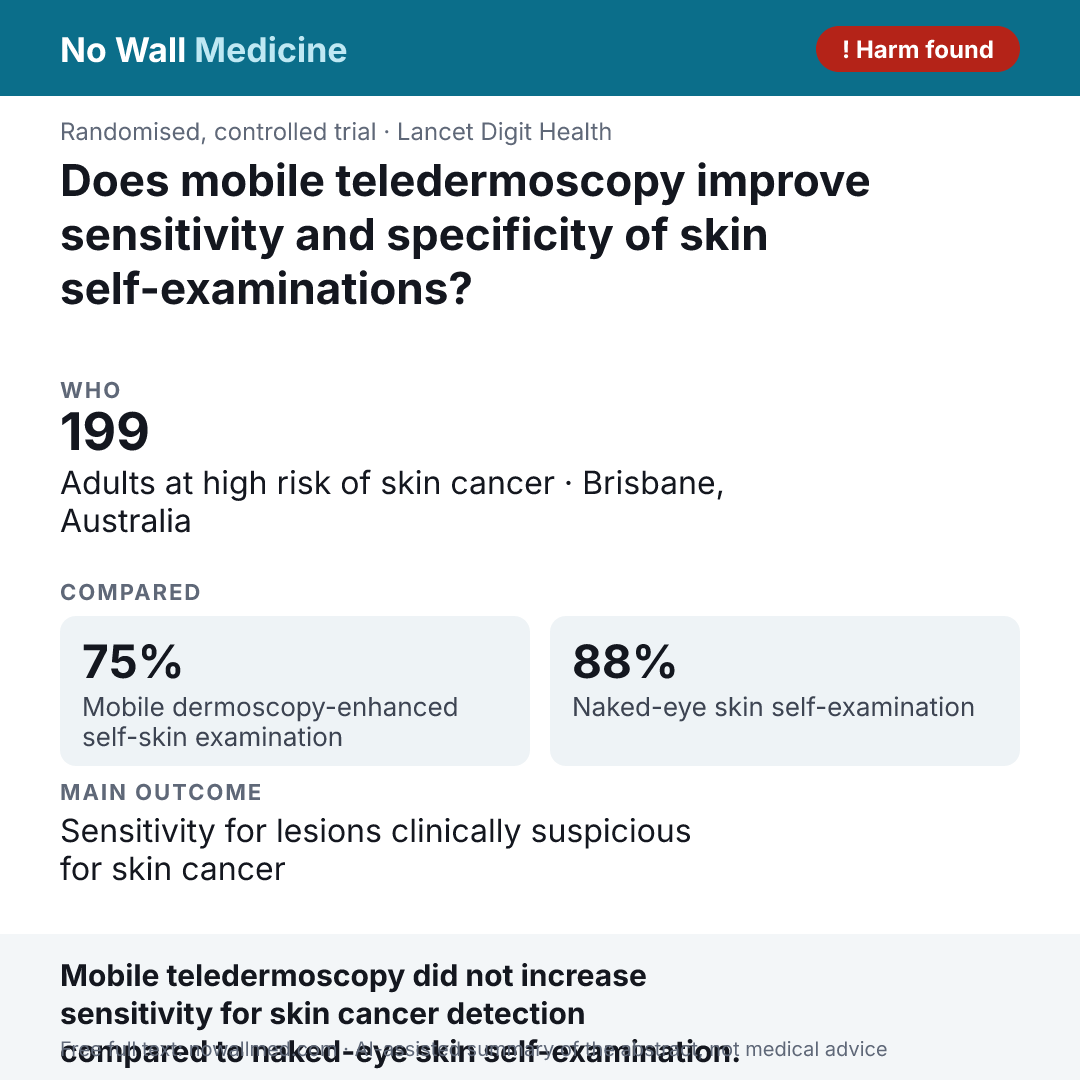
Does mobile teledermoscopy improve sensitivity and specificity of skin self-examinations?
Who
199
Adults at high risk of skin cancer · Brisbane, Australia
Compared
75%Mobile dermoscopy-enhanced self-skin examination (95% CI 63-84)
88%Naked-eye skin self-examination (95% CI 80-91)
Main outcome
Sensitivity for lesions clinically suspicious for skin cancer
Result: 75% (95% CI 63-84) vs 88% (95% CI 80-91)
Bottom line: Mobile teledermoscopy did not increase sensitivity for skin cancer detection compared to naked-eye skin self-examination.
Funded by: National Health and Medical Research Council (Australia)
Lancet Digit Health · 2020-02-20 · Save PNG
Clinical question: Does mobile teledermoscopy improve sensitivity and specificity of skin self-examinations?
Key points
- 199 adults at high risk of skin cancer were randomly assigned to use mobile teledermoscopy or naked-eye self-examinations.
- Lesion-level sensitivity was 75% for teledermoscopy and 88% for naked-eye exams, a difference that was statistically significant.
- Specificity was 87% for teledermoscopy and 89% for naked-eye exams, with no statistically significant difference between groups.
Headline and key points written with AI from the paper’s abstract, with every number checked against it. Read the paper before relying on them.
Was this summary helpful?
Abstract
Background
Skin self-examinations supplemented with mobile teledermoscopy might improve early detection of skin cancers compared with naked-eye skin self-examinations. We aimed to assess whether mobile teledermoscopy-enhanced skin self-examination can improve sensitivity and specificity of self-detection of skin cancers when compared with naked-eye skin self-examination. Methods
This randomised, controlled trial was done in Brisbane (QLD, Australia). Eligible participants (aged ≥18 years) had at least two skin cancer risk factors as self-reported in the eligibility survey and had to own or have access to an iPhone compatible with a dermatoscope attachment (iPhone versions 5-8). Participants were randomly assigned (1:1), via a computer-generated randomisation procedure, to the intervention group (mobile dermoscopy-enhanced self-skin examination) or the control group (naked-eye skin self-examination). Control group and intervention group participants received web-based instructions on how to complete a whole body skin self-examination. All participants completed skin examinations at baseline, 1 month, and 2 months; intervention group participants submitted photographs of suspicious lesions to a dermatologist for telediagnosis after each skin examination and control group participants noted lesions on a body chart that was sent to the research team after each skin examination. All participants had an in-person whole-body clinical skin examination within 3 months of their last skin self-examination. Primary outcomes were sensitivity and specificity of skin self-examination, patient selection of clinically atypical lesions suspicious for melanoma or keratinocyte skin cancers (body sites examined, number of lesions photographed, types of lesions, and lesions missed), and diagnostic concordance of telediagnosis versus in-person whole-body clinical skin examination diagnosis. All primary outcomes were analysed in the modified intention-to-treat population, which included all patients who had a clinical skin examination within 3 months of their last skin self-examination. This trial was registered with the Australian and New Zealand Clinical Trials Registry, ACTRN12616000989448. Findings
Between March 6, 2017, and June 7, 2018, 234 participants consented to enrol in the study, of whom 116 (50%) were assigned to the intervention group and 118 (50%) were assigned to the control group. 199 participants (98 participants in the intervention group and 101 participants in the control group) attended the clinical skin examination and thus were eligible for analyses. Participants in the intervention group submitted 615 lesions (median 6·0 per person; range 1-24) for telediagnosis and participants in the control group identified and recorded 673 lesions (median 6·0 per person; range 1-16). At the lesion level, sensitivity for lesions clinically suspicious for skin cancer was 75% (95% CI 63-84) in the intervention group and 88% (95% CI 80-91) in the control group (p=0·04). Specificity was 87% (95% CI 85-90) in the intervention group and 89% (95% CI 87-91) in the control group (p=0·42). At the individual level, the intervention group had a sensitivity of 87% (95% CI 76-99) compared with 97% (95% CI 91-100) in the control group (p=0·26), and a specificity of 95% (95% CI 90-100) compared with 96% (95% CI 91-100) in the control group. The overall diagnostic concordance between the telediagnosis and in-person clinical skin examination was 88%. Interpretation
The use of mobile teledermoscopy did not increase sensitivity for the detection of skin cancers compared with naked-eye skin self-examination; thus, further evidence is necessary for inclusion of skin self-examination technology for public health benefit. Funding
National Health and Medical Research Council (Australia).
Abstract reproduced under the article’s CC BY NC ND licence.
Subject terms
Headline, design, result, key points, caveat and citation as plain text.
Cite this article
Janda M, Horsham C, Vagenas D, et al. Accuracy of mobile digital teledermoscopy for skin self-examinations in adults at high risk of skin cancer: an open-label, randomised controlled trial. Lancet Digit Health. 2020;2(3):e129-e137. doi:10.1016/S2589-7500(20)30001-7
Spotted a mistake? Suggest a correction