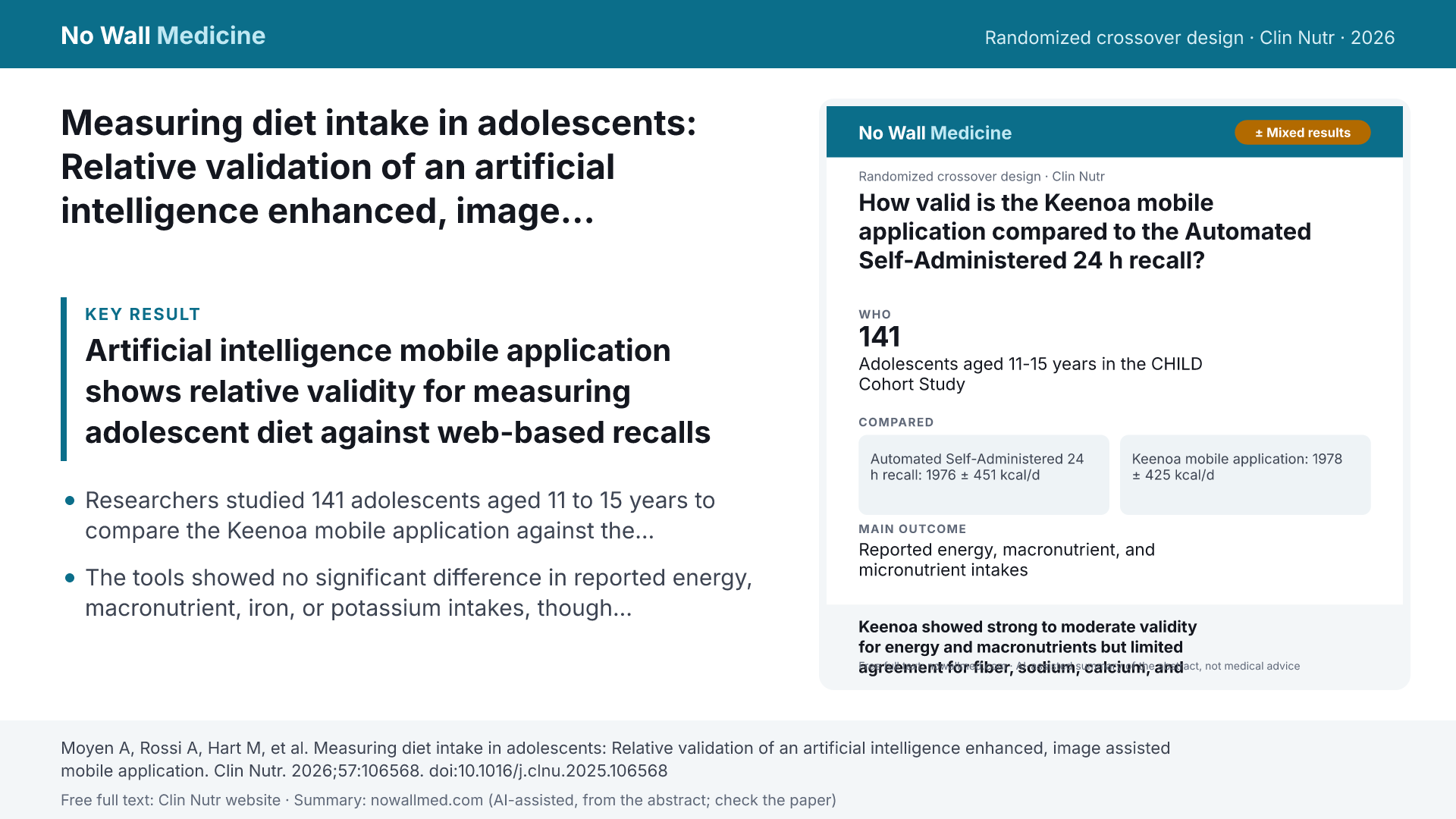
Artificial intelligence mobile application shows relative validity for measuring adolescent diet against web-based recalls
Measuring diet intake in adolescents: Relative validation of an artificial intelligence enhanced, image assisted mobile application
Randomized crossover designMixed results
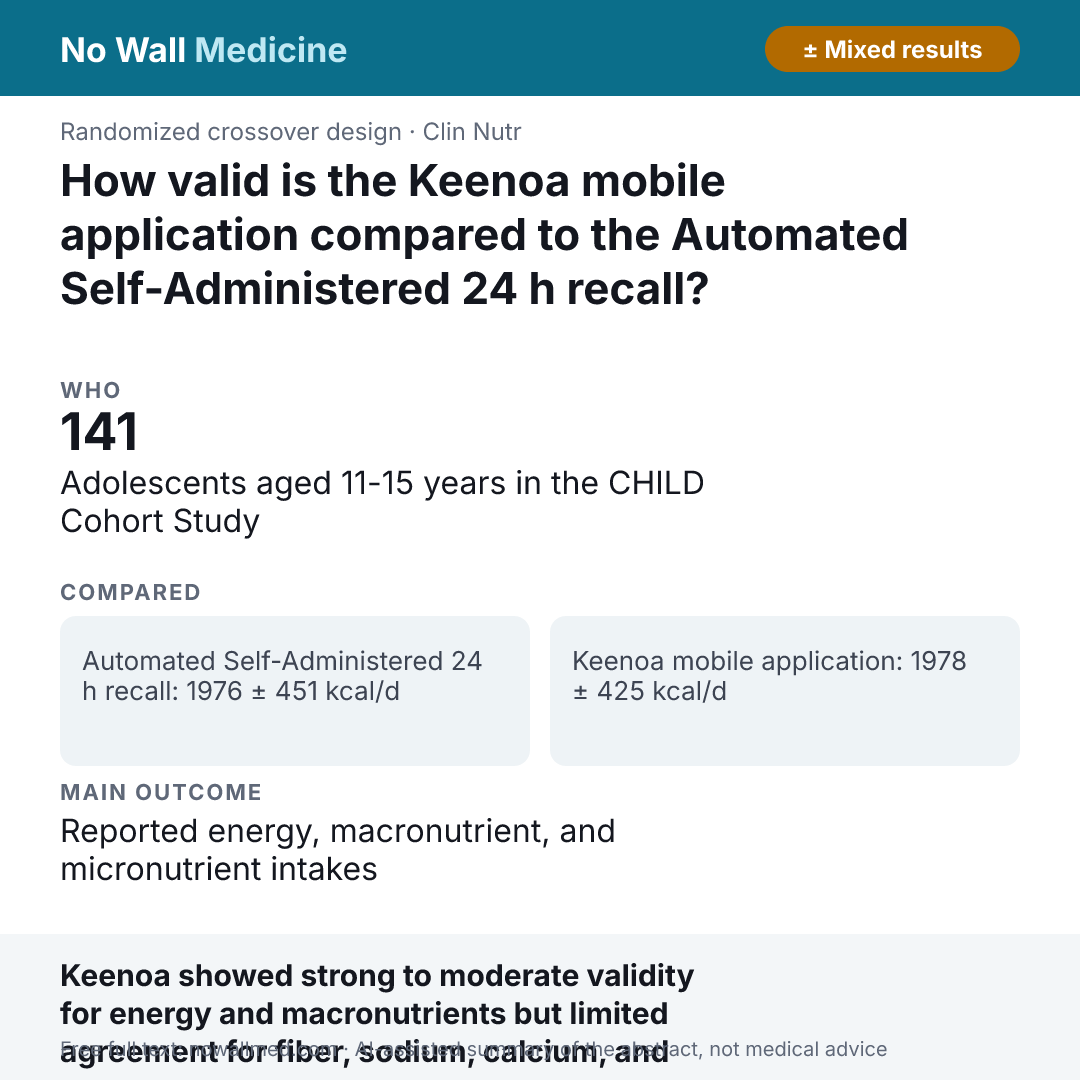
How valid is the Keenoa mobile application compared to the Automated Self-Administered 24 h recall?
Who
141
Adolescents aged 11-15 years in the CHILD Cohort Study
Compared
Automated Self-Administered 24 h recall: 1976 ± 451 kcal/d
Keenoa mobile application: 1978 ± 425 kcal/d
Main outcome
Reported energy, macronutrient, and micronutrient intakes
Bottom line: Keenoa showed strong to moderate validity for energy and macronutrients but limited agreement for fiber, sodium, calcium, and vitamin D.
Limitation: Future validation using objective biomarker measures is needed to establish true validity.
Clin Nutr · 2026-01-03 · Save PNG
Clinical question: How valid is the Keenoa mobile application compared to the Automated Self-Administered 24 h recall?
Why it matters: Current methods for measuring diet in large groups of adolescents have limitations that researchers aim to address with new digital tools.
Key points
- Researchers studied 141 adolescents aged 11 to 15 years to compare the Keenoa mobile application against the Automated Self-Administered 24 h recall web platform.
- The tools showed no significant difference in reported energy, macronutrient, iron, or potassium intakes, though fiber, sodium, calcium, and vitamin D showed limited agreement.
- Completion rates for all three requested days were 85.8% for the Keenoa application and 55.3% for the web-based platform.
Limitation the authors note: The authors state that future validation using objective biomarker measures is needed to help establish true validity.
Headline and key points written with AI from the paper’s abstract, with every number checked against it. Read the paper before relying on them.
Was this summary helpful?
Subject terms
Headline, design, result, key points, caveat and citation as plain text.
Cite this article
Moyen A, Rossi A, Hart M, et al. Measuring diet intake in adolescents: Relative validation of an artificial intelligence enhanced, image assisted mobile application. Clin Nutr. 2026;57:106568. doi:10.1016/j.clnu.2025.106568
Spotted a mistake? Suggest a correction