Validity and accuracy of artificial intelligence-based dietary intake assessment methods: a systematic review
Systematic reviewBenefit found
How valid and accurate are artificial intelligence-based dietary intake assessment methods?
Who
Studies evaluating artificial intelligence-based dietary intake assessment methods · Database search of EMBASE, PubMed, Scopus and Web of Science
Compared
Calories estimation: correlation coefficients of over 0·7 in six articles
Macronutrients: correlation above 0·7 in six studies
Micronutrients: correlation above 0·7 in four studies
Main outcome
Validity and accuracy of artificial intelligence-based dietary intake assessment
Bottom line: Artificial intelligence-based dietary intake assessment methods are promising, reliable, and valid alternatives for nutrient and food estimations.
Limitation: Need for more research comparing different populations and larger sample sizes.
Br J Nutr · 2025-04-10Download image
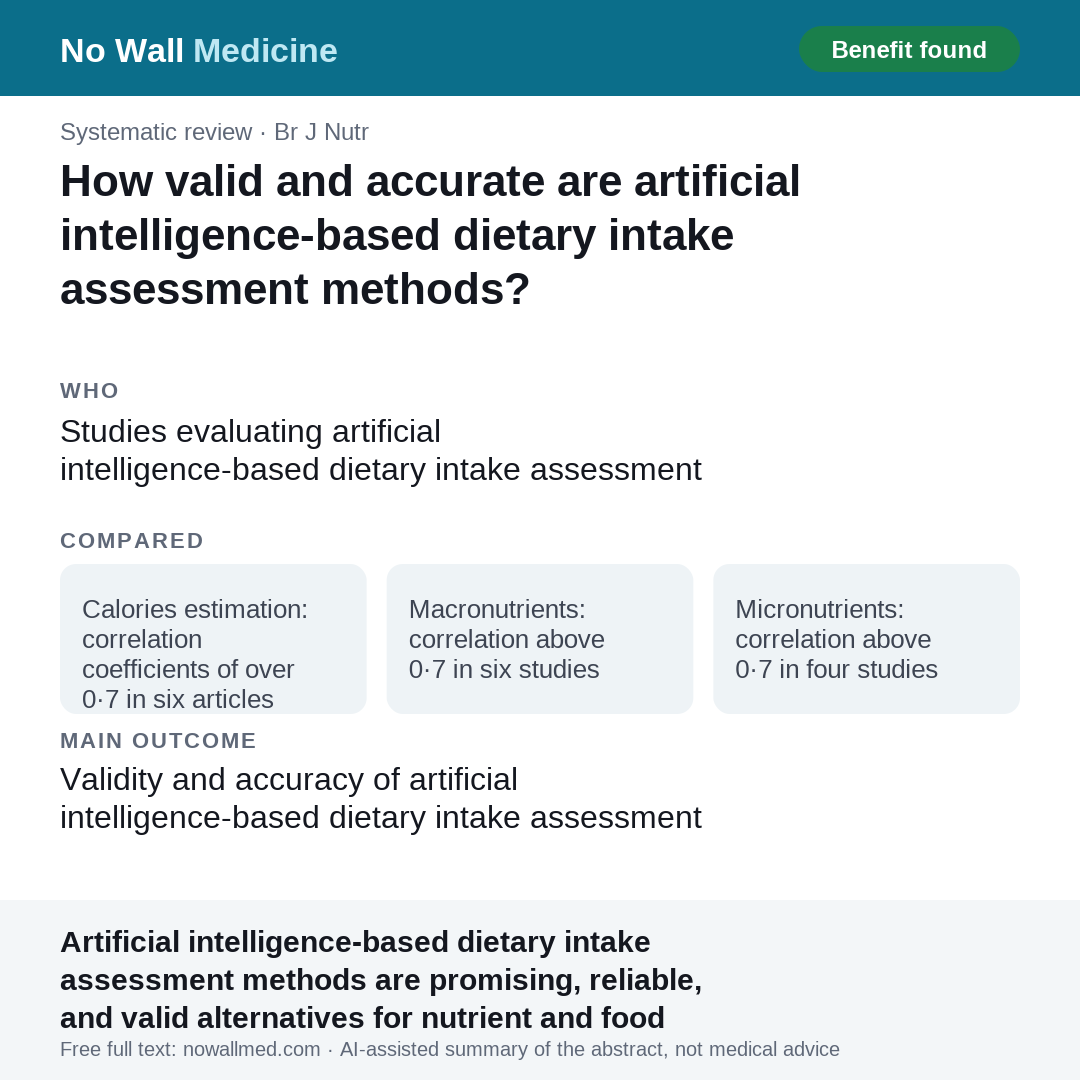
Clinical question: How valid and accurate are artificial intelligence-based dietary intake assessment methods?
Abstract
One of the most significant challenges in research related to nutritional epidemiology is the achievement of high accuracy and validity of dietary data to establish an adequate link between dietary exposure and health outcomes. Recently, the emergence of artificial intelligence (AI) in various fields has filled this gap with advanced statistical models and techniques for nutrient and food analysis. We aimed to systematically review available evidence regarding the validity and accuracy of AI-based dietary intake assessment methods (AI-DIA). In accordance with PRISMA guidelines, an exhaustive search of the EMBASE, PubMed, Scopus and Web of Science databases was conducted to identify relevant publications from their inception to 1 December 2024. Thirteen studies that met the inclusion criteria were included in this analysis. Of the studies identified, 61·5 % were conducted in preclinical settings. Likewise, 46·2 % used AI techniques based on deep learning and 15·3 % on machine learning. Correlation coefficients of over 0·7 were reported in six articles concerning the estimation of calories between the AI and traditional assessment methods. Similarly, six studies obtained a correlation above 0·7 for macronutrients. In the case of micronutrients, four studies achieved the correlation mentioned above. A moderate risk of bias was observed in 61·5 % (n 8) of the articles analysed, with confounding bias being the most frequently observed. AI-DIA methods are promising, reliable and valid alternatives for nutrient and food estimations. However, more research comparing different populations is needed, as well as larger sample sizes, to ensure the validity of the experimental designs.
Subject terms
Cite this article
Cofre S, Sanchez C, Quezada-Figueroa G, López-Cortés XA. Validity and accuracy of artificial intelligence-based dietary intake assessment methods: a systematic review. Br J Nutr. 2025. doi:10.1017/S0007114525000522
Spotted a mistake? Suggest a correction
Top studies every Monday
The week’s key trials and guidelines in your specialties, plus any topics you follow. By email, free.
Get the weekly digest