LaserSAFE fluorescence microscopy showed high accuracy for detecting positive surgical margins in prostatectomy specimens
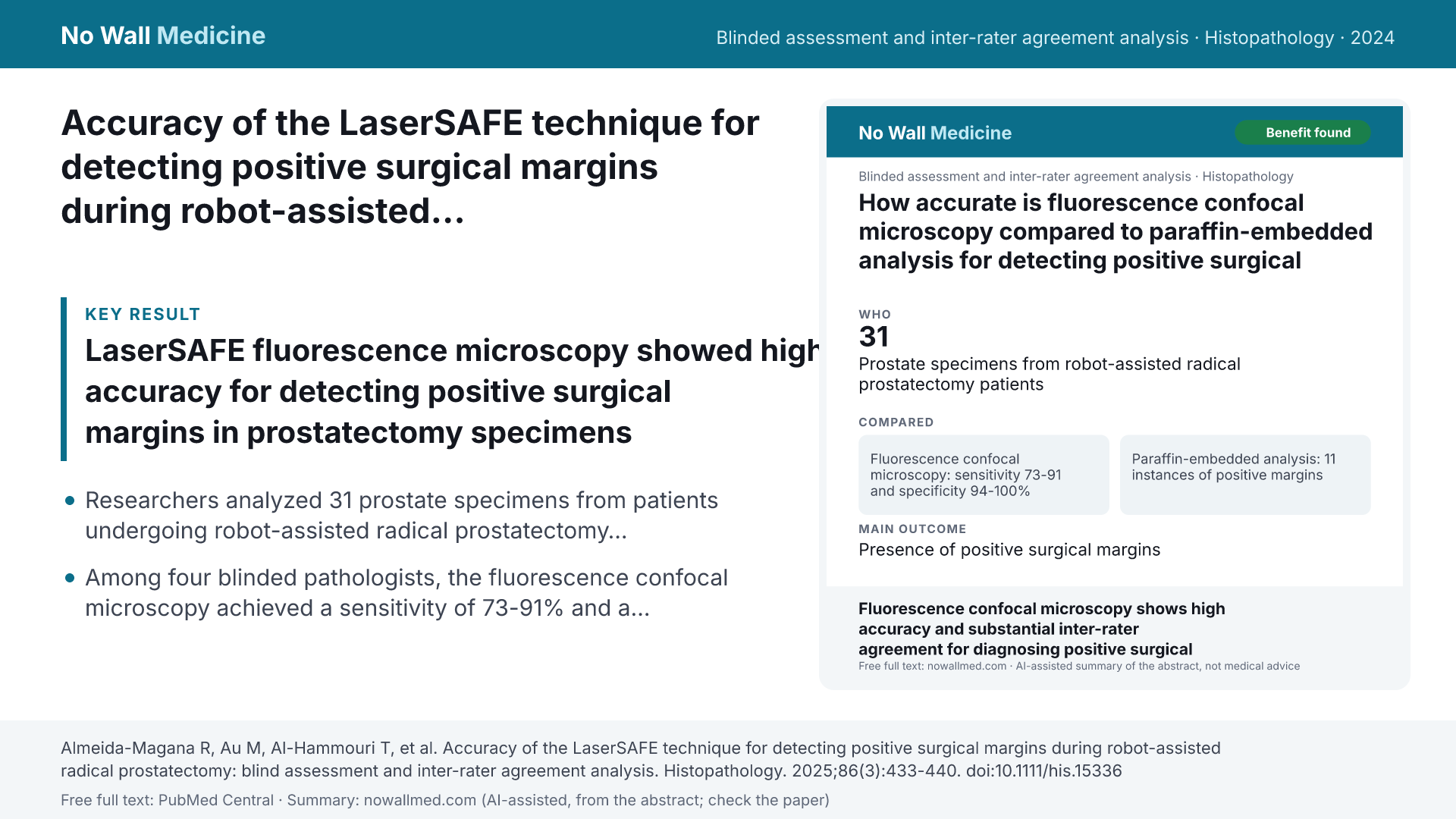
Accuracy of the LaserSAFE technique for detecting positive surgical margins during robot-assisted radical prostatectomy: blind assessment and inter-rater agreement analysis
Blinded assessment and inter-rater agreement analysisBenefit found
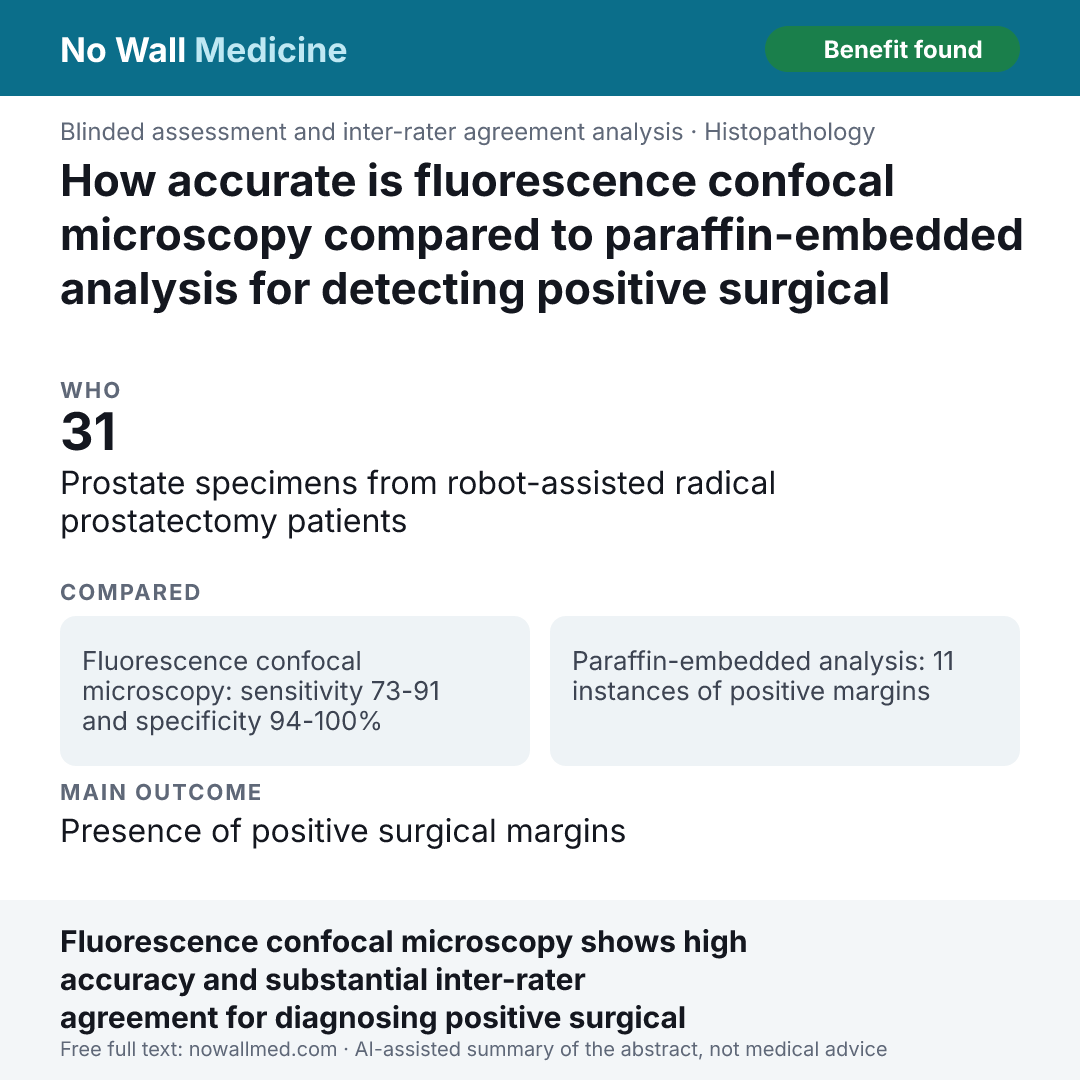
How accurate is fluorescence confocal microscopy compared to paraffin-embedded analysis for detecting positive surgical margins?
Who
31
Prostate specimens from robot-assisted radical prostatectomy patients
Compared
Fluorescence confocal microscopy: sensitivity 73-91 and specificity 94-100%
Paraffin-embedded analysis: 11 instances of positive margins
Main outcome
Presence of positive surgical margins
Result: Fleiss' Kappa 0.78 (95% confidence interval 0.64-0.92)
Bottom line: Fluorescence confocal microscopy shows high accuracy and substantial inter-rater agreement for diagnosing positive surgical margins.
Histopathology · 2024-10-15 · Save PNG
Same trial (NCT03317990)
Papers we list that report this registered trial, oldest first. Read a secondary analysis alongside the main results.
- Secondary analysis Benefit found
This paper Histopathology 2024-10 - Main results Benefit found
NeuroSAFE guidance during prostate cancer surgery improved erectile function and early urinary continence Lancet Oncol 2025-03
Clinical question: How accurate is fluorescence confocal microscopy compared to paraffin-embedded analysis for detecting positive surgical margins?
Key points
- Researchers analyzed 31 prostate specimens from patients undergoing robot-assisted radical prostatectomy using fluorescence confocal microscopy compared to paraffin-embedded analysis.
- Among four blinded pathologists, the fluorescence confocal microscopy achieved a sensitivity of 73-91% and a specificity of 94-100% for detecting positive surgical margins.
- The inter-rater agreement among the four pathologists was substantial, with a Fleiss' Kappa score of 0.78 (95% confidence interval 0.64-0.92).
Headline and key points written with AI from the paper’s abstract, with every number checked against it. Read the paper before relying on them.
Was this summary helpful?
Subject terms
Headline, design, result, key points, caveat and citation as plain text.
Cite this article
Almeida-Magana R, Au M, Al-Hammouri T, et al. Accuracy of the LaserSAFE technique for detecting positive surgical margins during robot-assisted radical prostatectomy: blind assessment and inter-rater agreement analysis. Histopathology. 2025;86(3):433-440. doi:10.1111/his.15336
Spotted a mistake? Suggest a correction