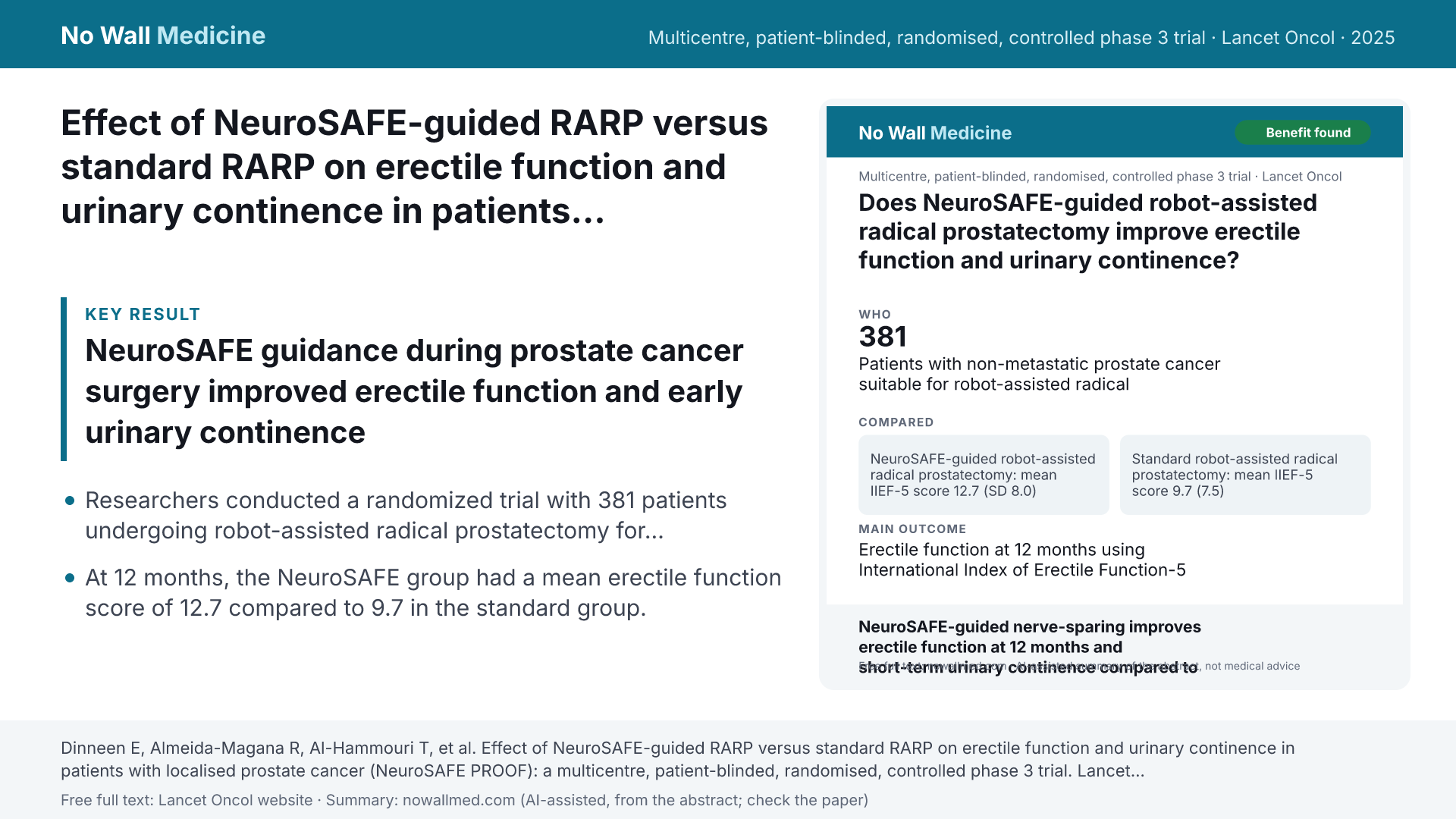
NeuroSAFE guidance during prostate cancer surgery improved erectile function and early urinary continence
Effect of NeuroSAFE-guided RARP versus standard RARP on erectile function and urinary continence in patients with localised prostate cancer (NeuroSAFE PROOF): a multicentre, patient-blinded, randomised, controlled phase 3 trial
Multicentre, patient-blinded, randomised, controlled phase 3 trialBenefit found
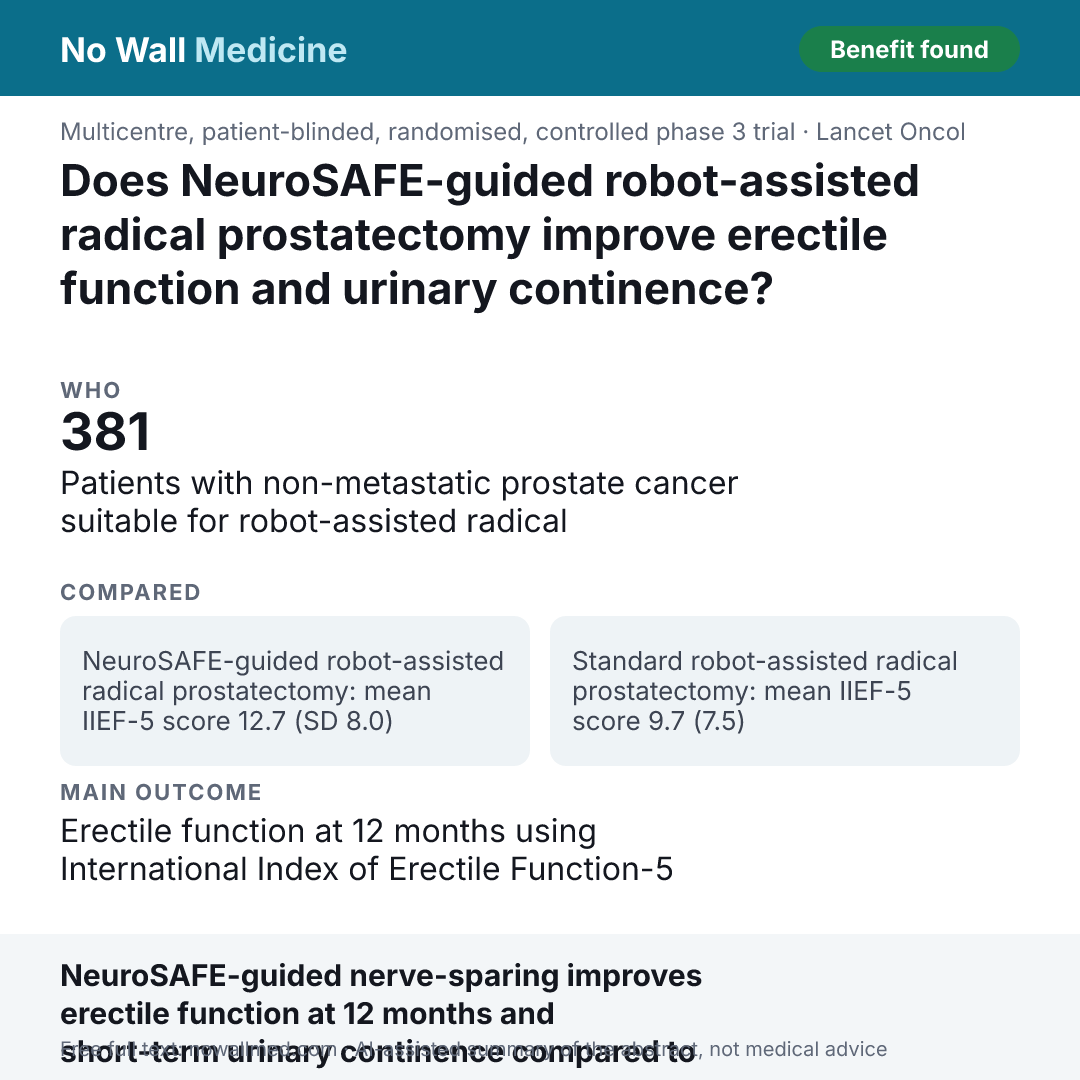
Does NeuroSAFE-guided robot-assisted radical prostatectomy improve erectile function and urinary continence?
Who
381
Patients with non-metastatic prostate cancer suitable for robot-assisted radical prostatectomy · Five National Health Service hospitals in the UK
Compared
NeuroSAFE-guided robot-assisted radical prostatectomy: mean IIEF-5 score 12.7 (SD 8.0)
Standard robot-assisted radical prostatectomy: mean IIEF-5 score 9.7 (7.5)
Main outcome
Erectile function at 12 months using International Index of Erectile Function-5
Result: adjusted mean difference 3.18 (95% CI 1.62 to 4.75)
Bottom line: NeuroSAFE-guided nerve-sparing improves erectile function at 12 months and short-term urinary continence compared to standard practice.
Limitation: Operating teams were aware of treatment group due to the nature of the intervention.
Lancet Oncol · 2025-03-24 · Save PNG
Same trial (NCT03317990)
Papers we list that report this registered trial, oldest first. Read a secondary analysis alongside the main results.
- Secondary analysis Benefit found
LaserSAFE fluorescence microscopy showed high accuracy for detecting positive surgical margins in prostatectomy specimens Histopathology 2024-10 - Main results Benefit found
This paper Lancet Oncol 2025-03
Clinical question: Does NeuroSAFE-guided robot-assisted radical prostatectomy improve erectile function and urinary continence?
Key points
- Researchers conducted a randomized trial with 381 patients undergoing robot-assisted radical prostatectomy for prostate cancer.
- At 12 months, the NeuroSAFE group had a mean erectile function score of 12.7 compared to 9.7 in the standard group.
- The NeuroSAFE group showed significantly lower urinary incontinence scores at 3 months, though no significant difference was seen at 6 months.
Headline and key points written with AI from the paper’s abstract, with every number checked against it. Read the paper before relying on them.
Was this summary helpful?
Abstract
Background
Sparing the periprostatic neurovascular bundles during robot-assisted radical prostatectomy (RARP) improves postoperative erectile function and early urinary continence recovery. The NeuroSAFE technique, a standardised frozen section analysis, enables accurate real-time detection of positive surgical margins during nerve-sparing, increasing the likelihood of successful nerve preservation. However, the impact of the technique on patient outcomes remains uncertain. We aimed to assess the effect of NeuroSAFE-guided RARP versus standard RARP on erectile function and urinary continence. Methods
NeuroSAFE PROOF was a multicentre, patient-blinded, randomised, controlled phase 3 trial done at five National Health Service hospitals in the UK. Key eligibility criteria were a diagnosis of non-metastatic prostate cancer deemed suitable to undergo RARP, good erectile function (defined as a score of ≥22 on the first 5 items of the International Index of Erectile Function [IIEF]) without medical erectile function assistance, and no previous prostate cancer treatment. No age limits were applied. Participants were randomly assigned (1:1) to standard RARP or NeuroSAFE-guided RARP using block randomisation, stratified by site. Masking of participants to allocation was maintained throughout, but patients were informed of their nerve-sparing status after the operation. Due to the nature of the intervention, operating teams were aware of treatment group. Nerve-sparing was guided by a preoperative plan in the standard RARP group and by intraoperative NeuroSAFE assessment in the NeuroSAFE group. The primary outcome was erectile function at 12 months, assessed using the IIEF-5 score, in the modified intention-to-treat population, which included all randomly assigned participants who had surgery. Secondary endpoints were urinary continence scores at 3 and 6 months, evaluated using the International Consultation on Incontinence Questionnaire (ICIQ), and the erectile function domain of the IIEF (IIEF-6) scores at 12 months. The trial is registered at ClinicalTrials.gov, NCT03317990. Findings
Between Jan 6, 2019, and Dec 6, 2022, 407 patients were recruited, of whom 381 had surgery (190 participants in the NeuroSAFE group and 191 participants in the standard RARP group), and were included in the modified intention-to-treat population. Data for the primary outcome (IIEF-5 score at 12 months) were available for 344 participants (173 in the NeuroSAFE group and 171 participants in the standard RARP group). Median follow-up was 12·3 months (IQR 11·8-12·7). At 12 months, the mean IIEF-5 score was 12·7 (SD 8·0) in the NeuroSAFE group versus 9·7 (7·5) in the standard RARP group (adjusted mean difference 3·18 [95% CI 1·62 to 4·75]; p<0·0001). At 3 months, the ICIQ score was significantly lower in the NeuroSAFE group than the standard RARP group (adjusted mean difference -1·41 [95% CI -2·42 to -0·41]; p=0·006). At 6 months, no significant difference in ICIQ score was observed between groups (adjusted mean difference -0·37 [95% CI -1·35 to 0·62]; p=0·46). At 12 months, the mean IIEF-6 score was higher in the NeuroSAFE group than in the standard RARP group (15·3 [SD 9·7] vs 11·5 [SD 9·0]; adjusted mean difference 3·92 [95% CI 2·01 to 5·83]; p<0·0001). Serious adverse events occurred in six (3%) of 190 patients in the NeuroSAFE group, and and in five (3%) of 191 patients in the standard RARP group. All adverse events were postoperative complications; no serious adverse events or deaths were attributed to the study intervention. Interpretation
The use of NeuroSAFE to guide nerve-sparing during RARP improves patient-reported IIEF-5 scores at 12 months and short-term urinary continence. The erectile function benefit is enhanced in patients who would not otherwise have undergone bilateral nerve-sparing by standard practice. Funding
National Institute of Healthcare Research, JP Moulton Charitable Foundation, UCLH Charity, St Peters Trust, and Rosetrees Trust.
Abstract reproduced under the article’s CC BY licence.
Subject terms
Headline, design, result, key points, caveat and citation as plain text.
Cite this article
Dinneen E, Almeida-Magana R, Al-Hammouri T, et al. Effect of NeuroSAFE-guided RARP versus standard RARP on erectile function and urinary continence in patients with localised prostate cancer (NeuroSAFE PROOF): a multicentre, patient-blinded, randomised, controlled phase 3 trial. Lancet Oncol. 2025;26(4):447-458. doi:10.1016/S1470-2045(25)00091-9
Spotted a mistake? Suggest a correction