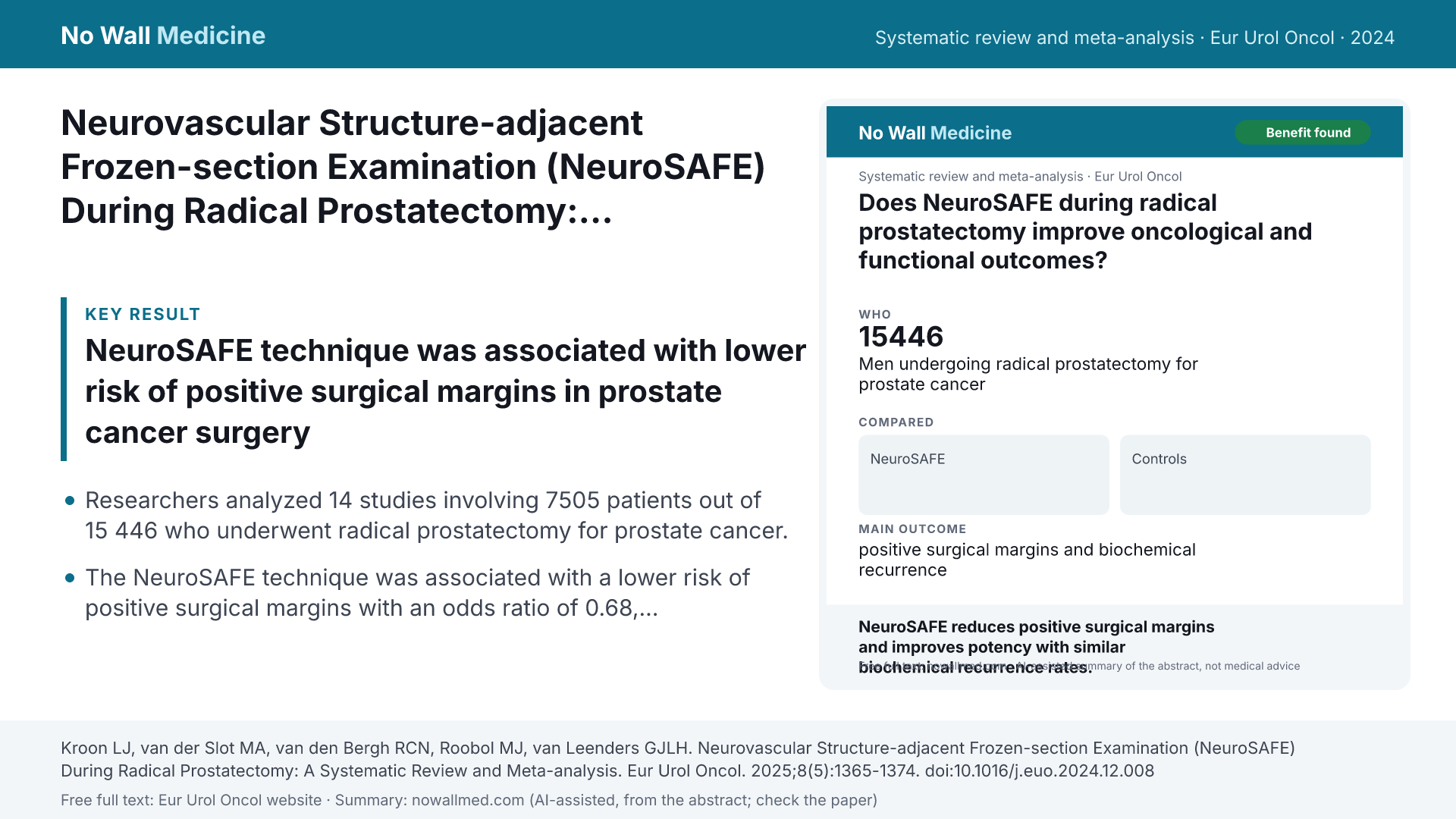
NeuroSAFE technique was associated with lower risk of positive surgical margins in prostate cancer surgery
Neurovascular Structure-adjacent Frozen-section Examination (NeuroSAFE) During Radical Prostatectomy: A Systematic Review and Meta-analysis
Systematic review and meta-analysisBenefit found
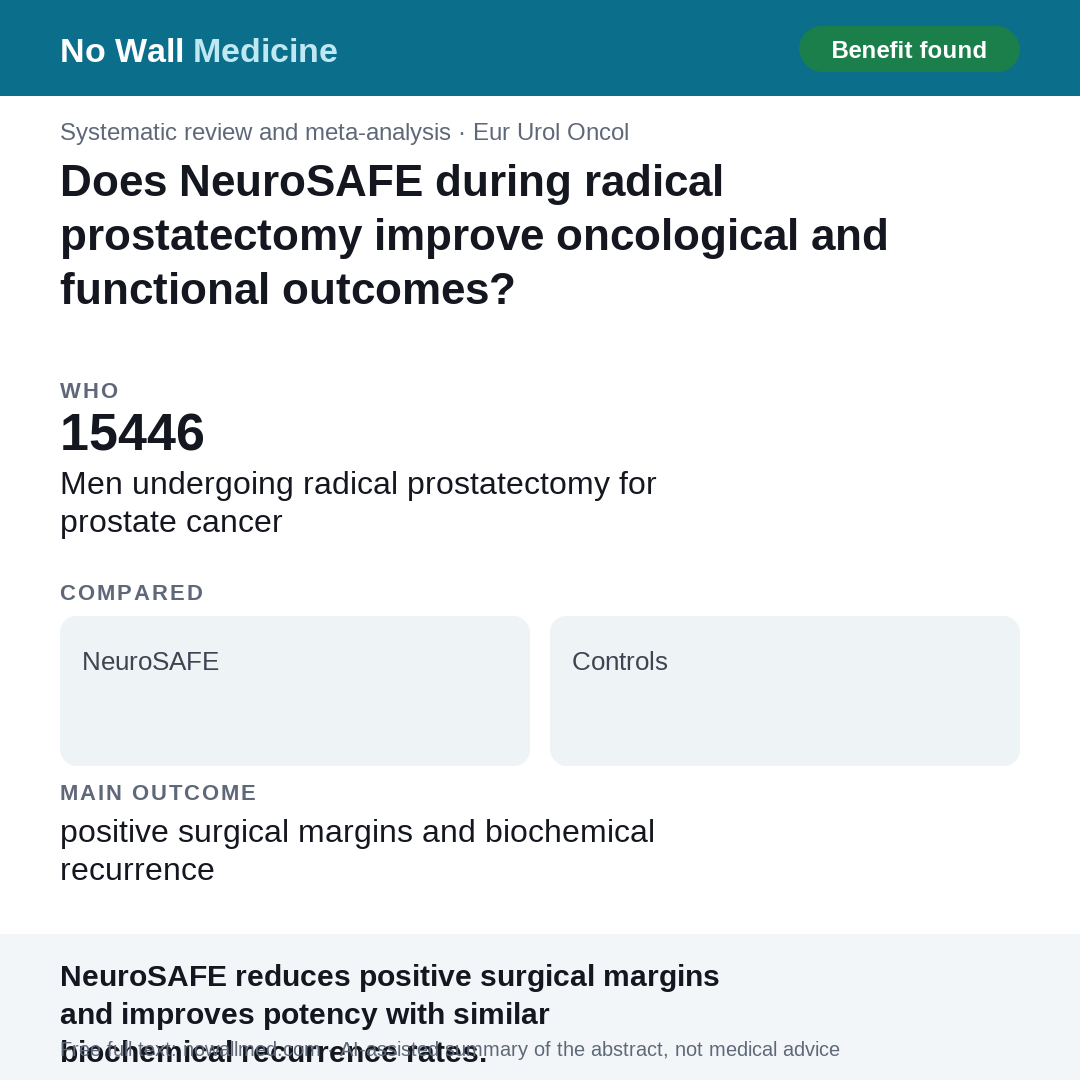
Does NeuroSAFE during radical prostatectomy improve oncological and functional outcomes?
Who
15446
Men undergoing radical prostatectomy for prostate cancer
Compared
NeuroSAFE
Controls
Main outcome
positive surgical margins and biochemical recurrence
Result: odds ratio 0.68 (95% CI 0.51-0.91)
Bottom line: NeuroSAFE reduces positive surgical margins and improves potency with similar biochemical recurrence rates.
Limitation: Lack of randomization resulting in selection bias and varying risk of bias.
Eur Urol Oncol · 2024-12-26Download image
Clinical question: Does NeuroSAFE during radical prostatectomy improve oncological and functional outcomes?
Why it matters: It was unknown how the NeuroSAFE intraoperative frozen-section technique affects oncological and functional outcomes during radical prostatectomy.
Key points
- Researchers analyzed 14 studies involving 7505 patients out of 15 446 who underwent radical prostatectomy for prostate cancer.
- The NeuroSAFE technique was associated with a lower risk of positive surgical margins with an odds ratio of 0.68, but showed no difference in 2-yr biochemical recurrence.
- NeuroSAFE was associated with higher potency rates and higher nerve-sparing rates, though no significant difference in continence rates was reported.
Limitation the authors note: The studies lacked randomization, which resulted in selection bias and an overall risk of bias ranging from low to serious.
Headline and key points written with AI from the paper’s abstract, with every number checked against it. Read the paper before relying on them.
Was this summary helpful?
Subject terms
Cite this article
Kroon LJ, van der Slot MA, van den Bergh RCN, Roobol MJ, van Leenders GJLH. Neurovascular Structure-adjacent Frozen-section Examination (NeuroSAFE) During Radical Prostatectomy: A Systematic Review and Meta-analysis. Eur Urol Oncol. 2024. doi:10.1016/j.euo.2024.12.008
Spotted a mistake? Suggest a correction
Top studies every Monday
The week’s key trials and guidelines in your specialties, plus any topics you follow. By email, free.
Get the weekly digest