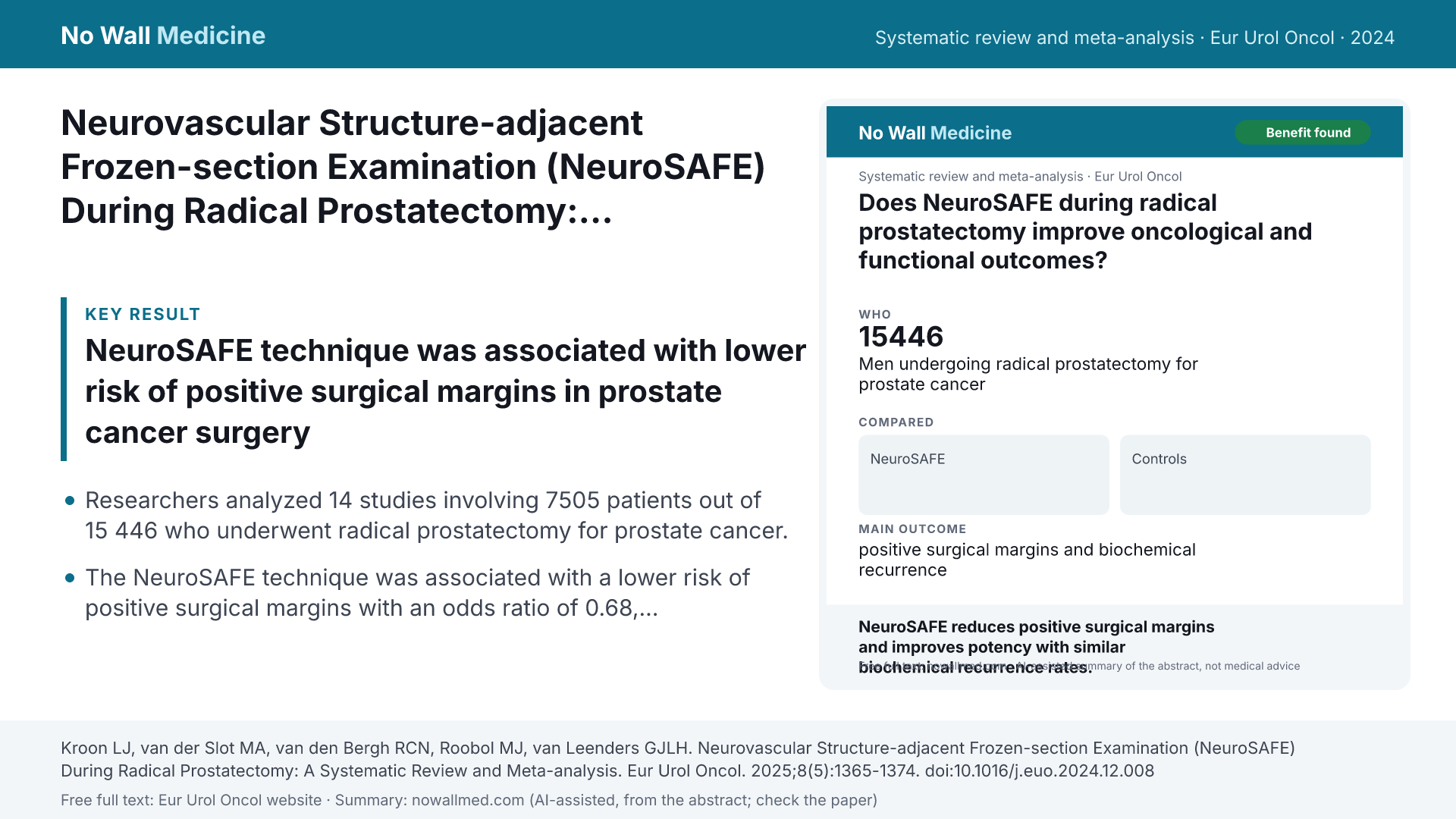
Neurovascular Structure-adjacent Frozen-section Examination (NeuroSAFE) During Radical Prostatectomy: A Systematic Review and Meta-analysis
Key result: NeuroSAFE technique was associated with lower risk of positive surgical margins in prostate cancer surgery
Key points
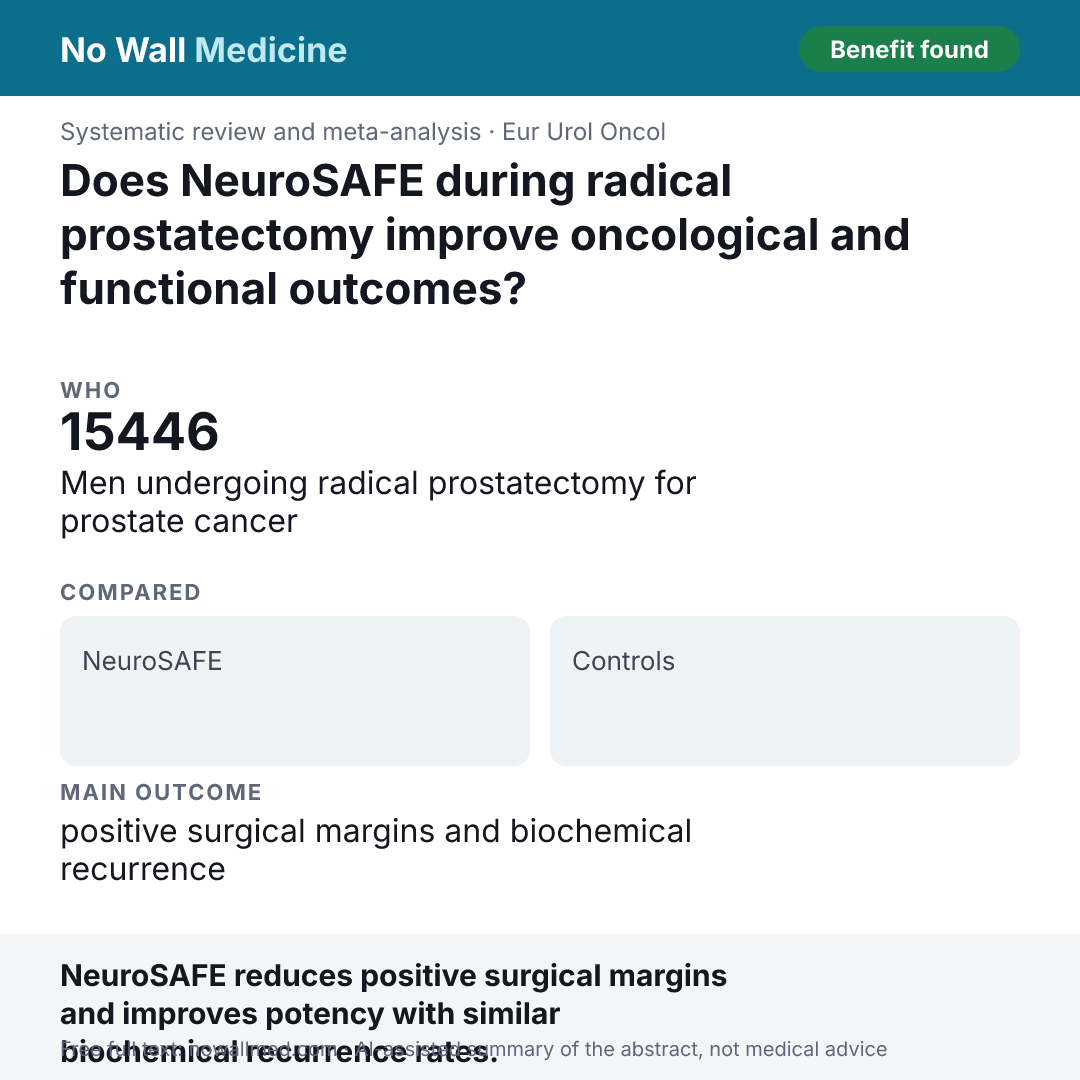
- Researchers analyzed 14 studies involving 7505 patients out of 15 446 who underwent radical prostatectomy for prostate cancer.
- The NeuroSAFE technique was associated with a lower risk of positive surgical margins with an odds ratio of 0.68, but showed no difference in 2-yr biochemical recurrence.
- NeuroSAFE was associated with higher potency rates and higher nerve-sparing rates, though no significant difference in continence rates was reported.
Limitation the authors note: The studies lacked randomization, which resulted in selection bias and an overall risk of bias ranging from low to serious.
Discussion prompts
- Would these patients look like yours? Who was left out?
- Is the main outcome one that matters to patients?
- Is the difference large enough to change what you do?
Cite: Kroon LJ, van der Slot MA, van den Bergh RCN, Roobol MJ, van Leenders GJLH. Neurovascular Structure-adjacent Frozen-section Examination (NeuroSAFE) During Radical Prostatectomy: A Systematic Review and Meta-analysis. Eur Urol Oncol. 2025;8(5):1365-1374. doi:10.1016/j.euo.2024.12.008
Free full text: Eur Urol Oncol website · Summary and visual abstract: nowallmed.com/a/neurovascular-structure-adjacent-frozen-section-examination-neurosafe-qiiq1h/ (AI-assisted from the abstract; check the paper before relying on it).