Five year patient reports show similar urinary and bowel outcomes for two types of prostate radiation
Patient-reported Outcomes After Prostate Stereotactic Body Radiotherapy at 5 yr: Results from the PACE-B Trial
Phase 3, international randomized trialNo clear difference
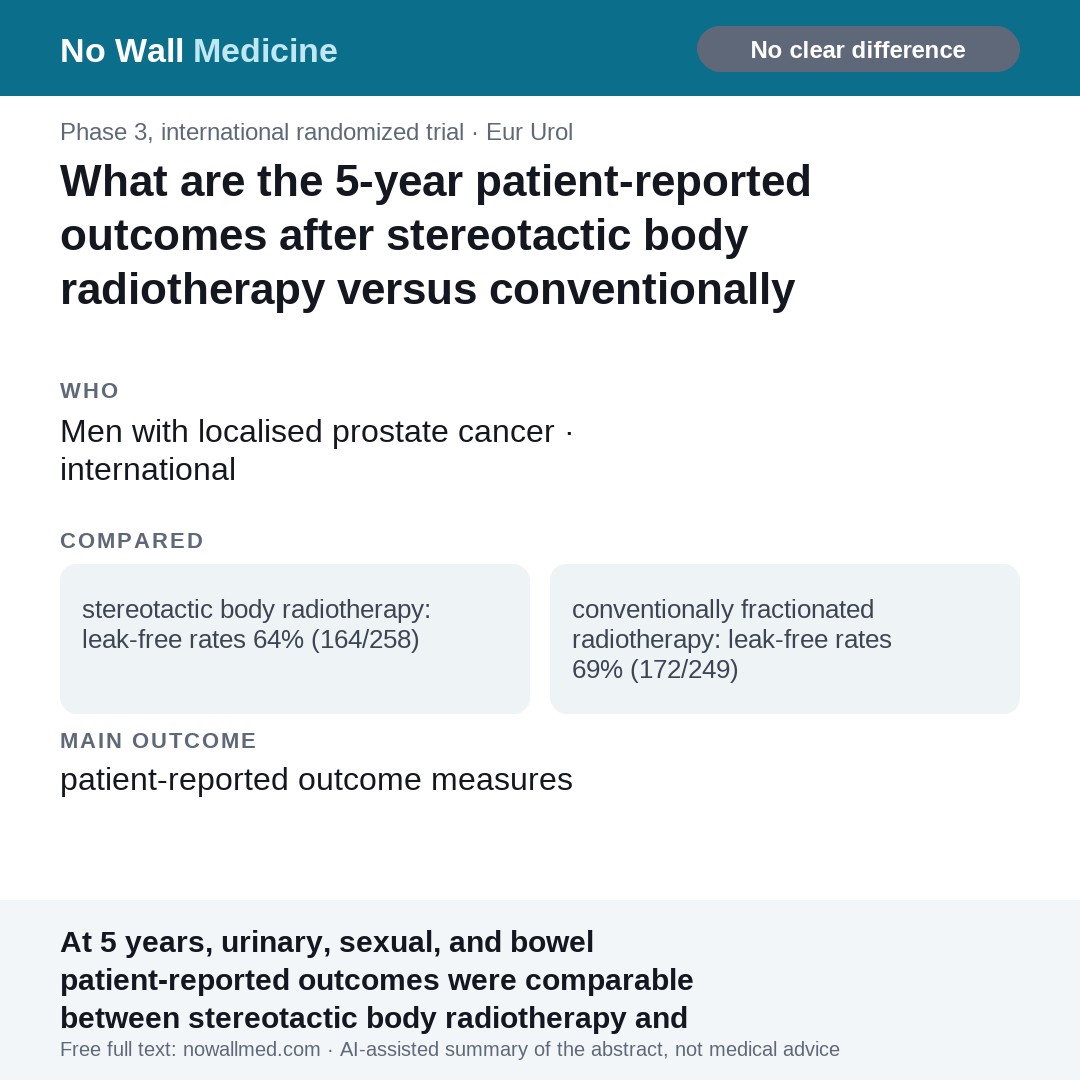
What are the 5-year patient-reported outcomes after stereotactic body radiotherapy versus conventionally fractionated radiotherapy?
Who
Men with localised prostate cancer · international
Compared
stereotactic body radiotherapy: leak-free rates 64% (164/258)
conventionally fractionated radiotherapy: leak-free rates 69% (172/249)
Main outcome
patient-reported outcome measures
Bottom line: At 5 years, urinary, sexual, and bowel patient-reported outcomes were comparable between stereotactic body radiotherapy and conventionally fractionated radiotherapy.
Eur Urol · 2026-07-20Download image
Clinical question: What are the 5-year patient-reported outcomes after stereotactic body radiotherapy versus conventionally fractionated radiotherapy?
Why it matters: Patient-reported outcome measures are needed to complement oncological endpoints by capturing what matters most to patients undergoing prostate cancer treatment.
Key points
- Researchers compared men with localized prostate cancer receiving stereotactic body radiotherapy (a precise form of radiation) to those receiving conventionally fractionated radiotherapy (standard radiation) over five years.
- At five years, leak-free rates were 64% (164/258) for stereotactic body radiotherapy and 69% (172/249) for conventional radiotherapy, while pad-free rates were 91% (233/257) and 90% (225/250) respectively.
- Intercourse-adequate erections declined in both groups from baseline to five years, falling to 17% (43/250) for stereotactic body radiotherapy and 20% (47/240) for conventional radiotherapy.
Headline and key points written with AI from the paper’s abstract, with every number checked against it. Read the paper before relying on them.
Topics
Spotted a mistake? Suggest a correction
More in Urology
Checkpoint inhibitor regimens benefit renal cell carcinoma patients with poor prognosis most
Which Patients with Advanced Clear Cell Renal Cell Carcinoma Benefit Most from First-line Checkpoint Inhibitor Combination Regimens: A Meta-analysis of Individual Patient Data and Aggregate Data from Randomised Trials
Male factor infertility is influenced by genetics, environment, and lifestyle choices
Key Determinants and Clinical Impact of Male Factor Infertility: From Etiology to Treatment
Nectin-4-targeted PET/CT compared to FDG PET/CT for urothelial carcinoma staging
Diagnostic Performance of Nectin-4-targeted [68Ga]Ga-DOTA-N188 PET/CT versus [18F]-FDG PET/CT for Staging of Locally Advanced and Metastatic Urothelial Carcinoma: A Prospective, Single-center, Phase 2 Feasibility Trial
Robotic surgery worked as well as open surgery for Wilms tumor in selected cases
Exploring the Limits of Robotic Surgery for Wilms Tumor: A Descriptive Analysis