Actigraphically measured psychomotor slowing in depression: systematic review and meta-analysis
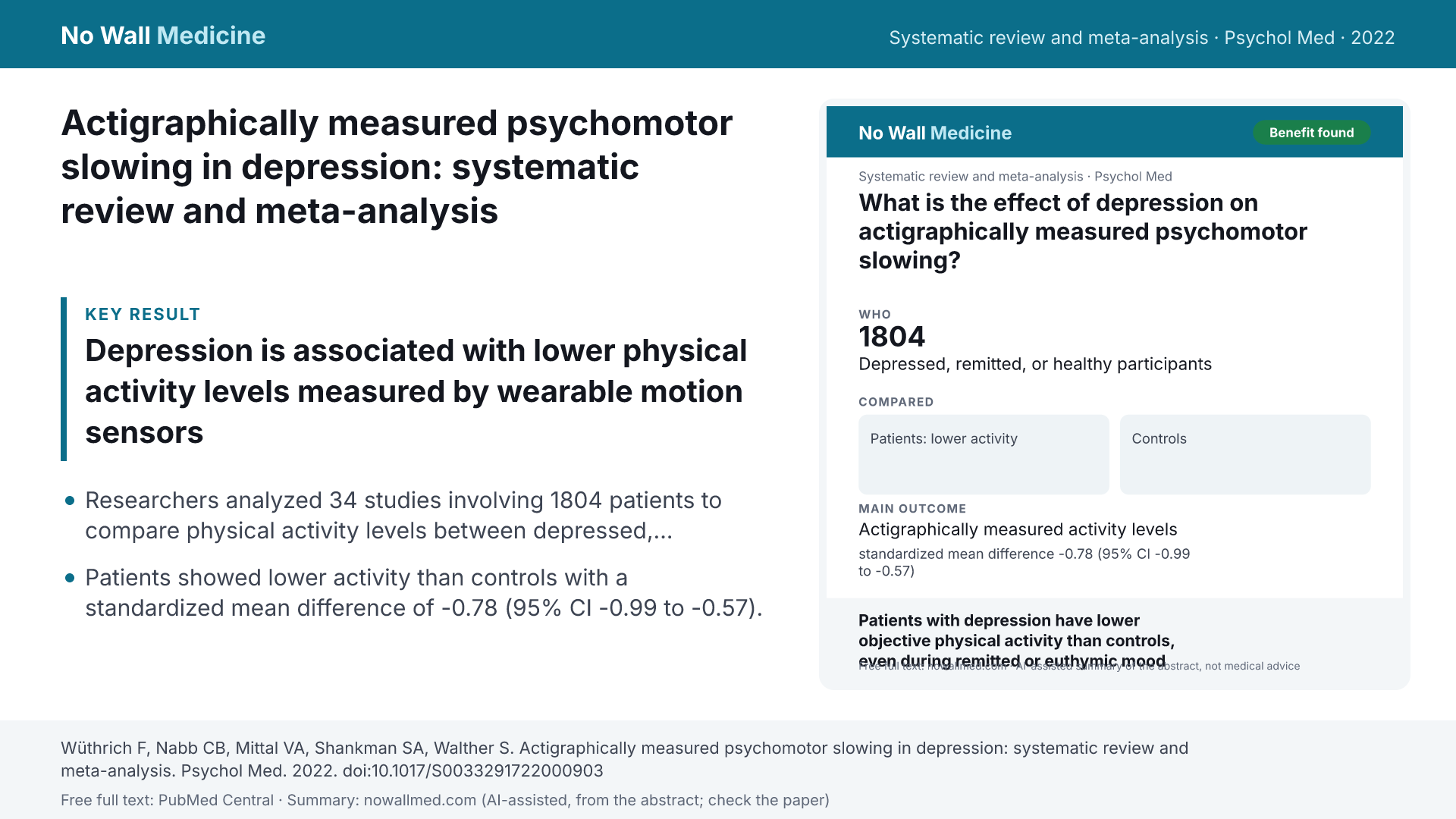
Key result: Depression is associated with lower physical activity levels measured by wearable motion sensors
Systematic review and meta-analysisBenefit found
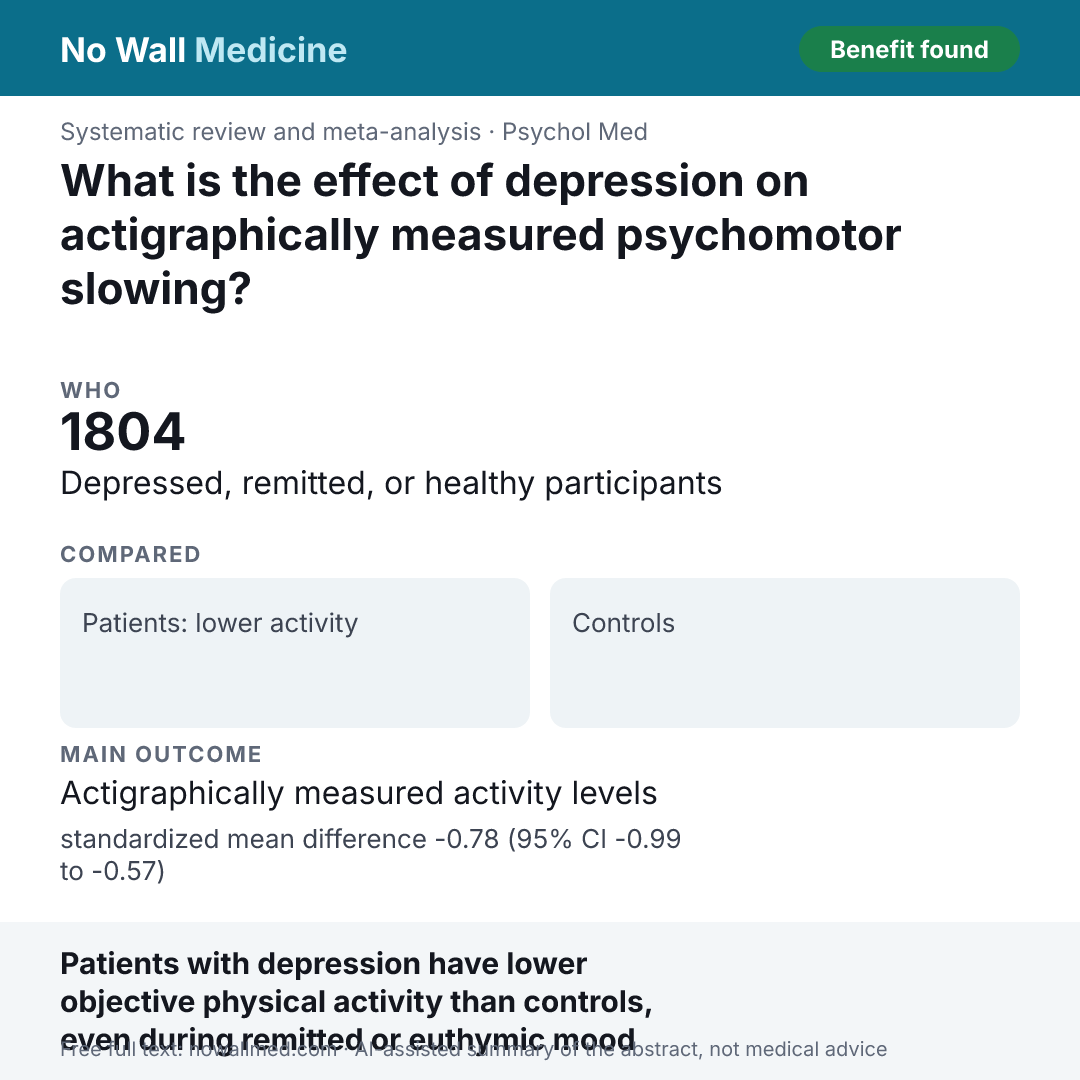
What is the effect of depression on actigraphically measured psychomotor slowing?
Who
1804
Depressed, remitted, or healthy participants
Compared
Patients: lower activity
Controls
Main outcome
Actigraphically measured activity levels
Result: standardized mean difference -0.78 (95% CI -0.99 to -0.57)
Bottom line: Patients with depression have lower objective physical activity than controls, even during remitted or euthymic mood states.
Psychol Med · 2022-05-13 · Save PNG
Key points
- Researchers analyzed 34 studies involving 1804 patients to compare physical activity levels between depressed, remitted, or healthy individuals using actigraphy, which is objective motion tracking.
- Patients showed lower activity than controls with a standardized mean difference of -0.78 (95% CI -0.99 to -0.57).
- Lower activity was associated with both unipolar and bipolar disorders during depressed states and remitted or stable mood states.
Discussion prompts
- Would these patients look like yours? Who was left out?
- Is the main outcome one that matters to patients?
- Is the difference large enough to change what you do?
Cite: Wüthrich F, Nabb CB, Mittal VA, Shankman SA, Walther S. Actigraphically measured psychomotor slowing in depression: systematic review and meta-analysis. Psychol Med. 2022. doi:10.1017/S0033291722000903
Free full text: PubMed Central · Summary and visual abstract: nowallmed.com/a/actigraphically-measured-psychomotor-slowing-in-depression-systematic-1kzcb4w/ (AI-assisted from the abstract; check the paper before relying on it).