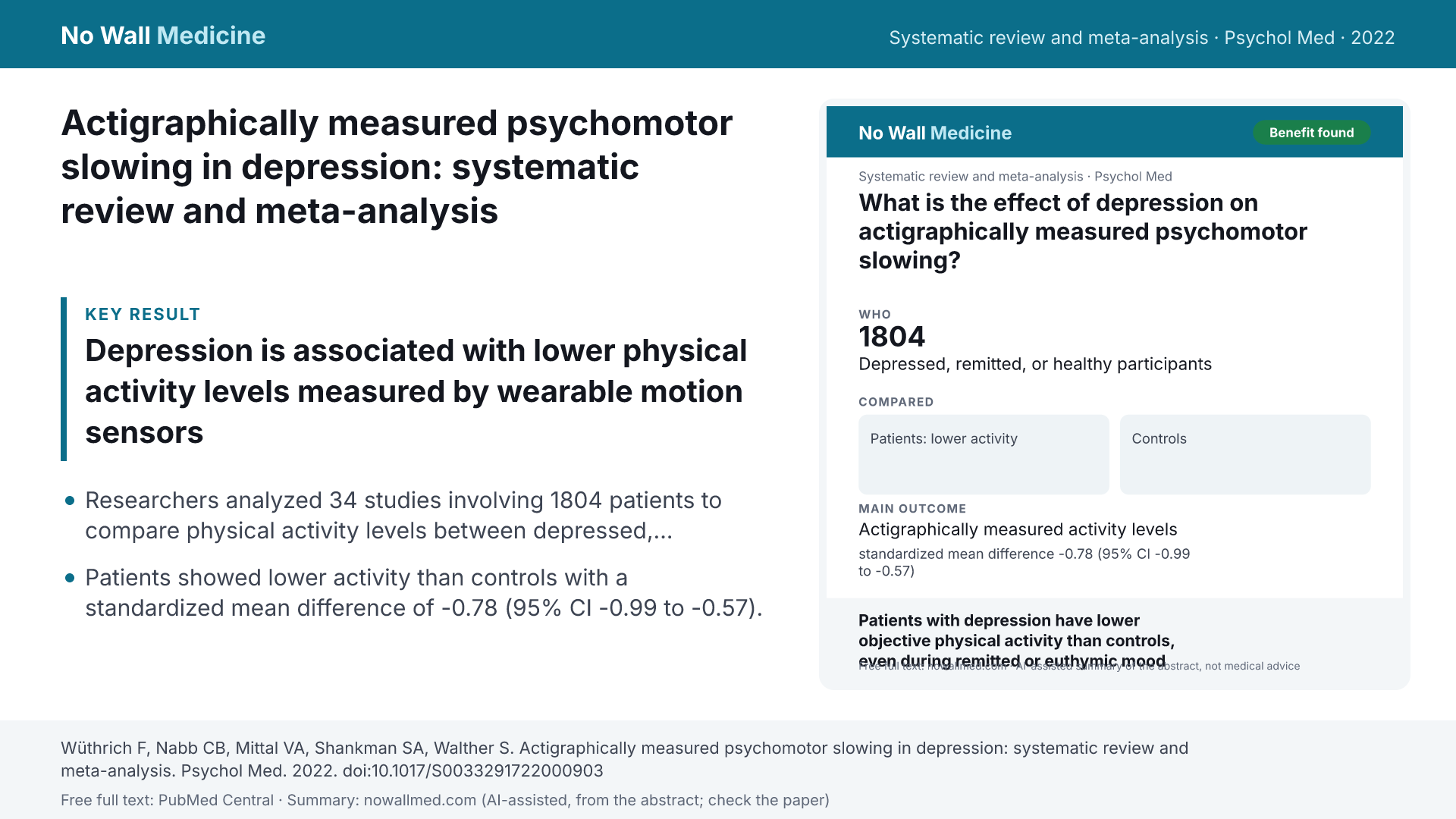
Depression is associated with lower physical activity levels measured by wearable motion sensors
Actigraphically measured psychomotor slowing in depression: systematic review and meta-analysis
Systematic review and meta-analysisBenefit found
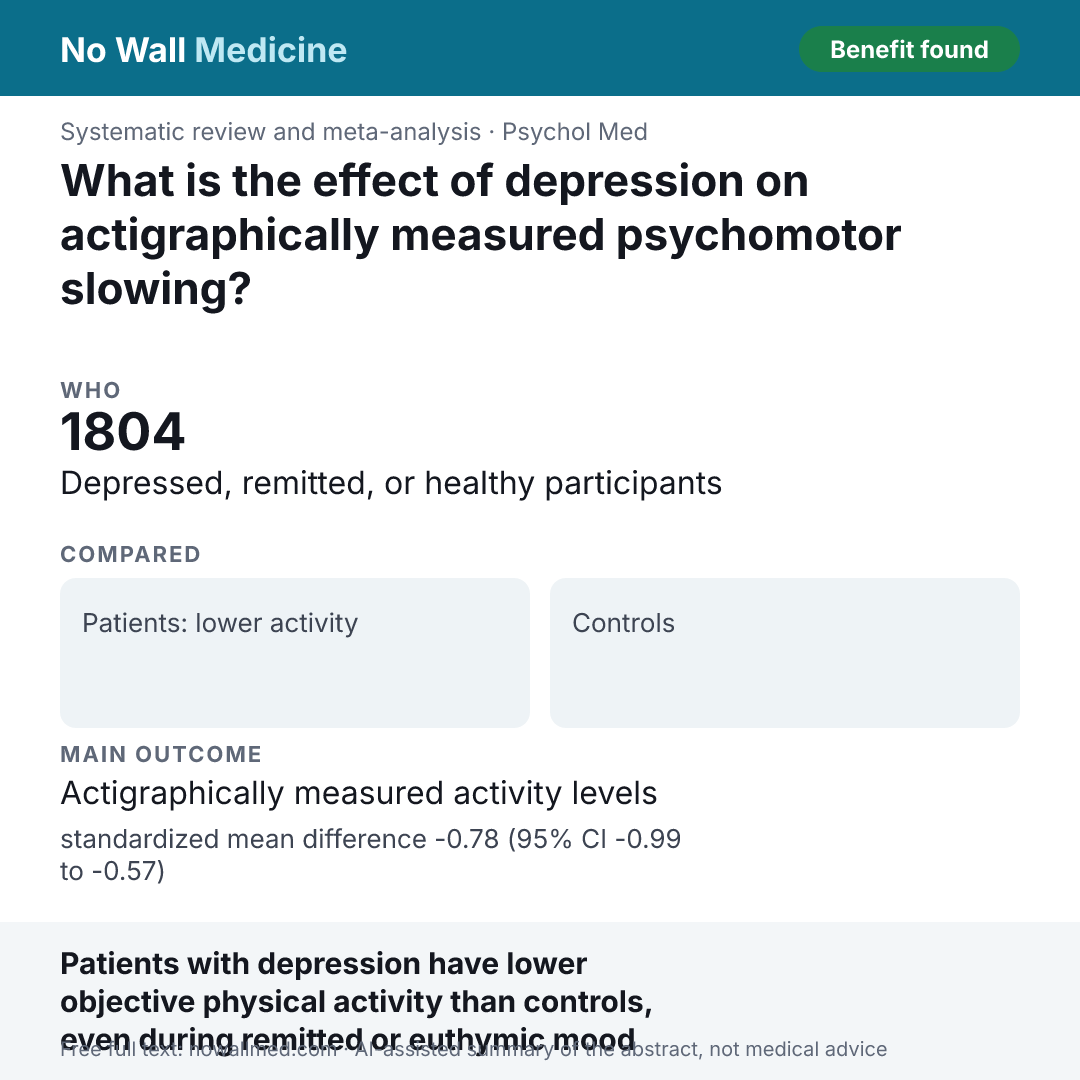
What is the effect of depression on actigraphically measured psychomotor slowing?
Who
1804
Depressed, remitted, or healthy participants
Compared
Patients: lower activity
Controls
Main outcome
Actigraphically measured activity levels
Result: standardized mean difference -0.78 (95% CI -0.99 to -0.57)
Bottom line: Patients with depression have lower objective physical activity than controls, even during remitted or euthymic mood states.
Psychol Med · 2022-05-13 · Save PNG
Clinical question: What is the effect of depression on actigraphically measured psychomotor slowing?
Key points
- Researchers analyzed 34 studies involving 1804 patients to compare physical activity levels between depressed, remitted, or healthy individuals using actigraphy, which is objective motion tracking.
- Patients showed lower activity than controls with a standardized mean difference of -0.78 (95% CI -0.99 to -0.57).
- Lower activity was associated with both unipolar and bipolar disorders during depressed states and remitted or stable mood states.
Headline and key points written with AI from the paper’s abstract, with every number checked against it. Read the paper before relying on them.
Was this summary helpful?
Subject terms
Headline, design, result, key points, caveat and citation as plain text.
Cite this article
Wüthrich F, Nabb CB, Mittal VA, Shankman SA, Walther S. Actigraphically measured psychomotor slowing in depression: systematic review and meta-analysis. Psychol Med. 2022. doi:10.1017/S0033291722000903
Spotted a mistake? Suggest a correction