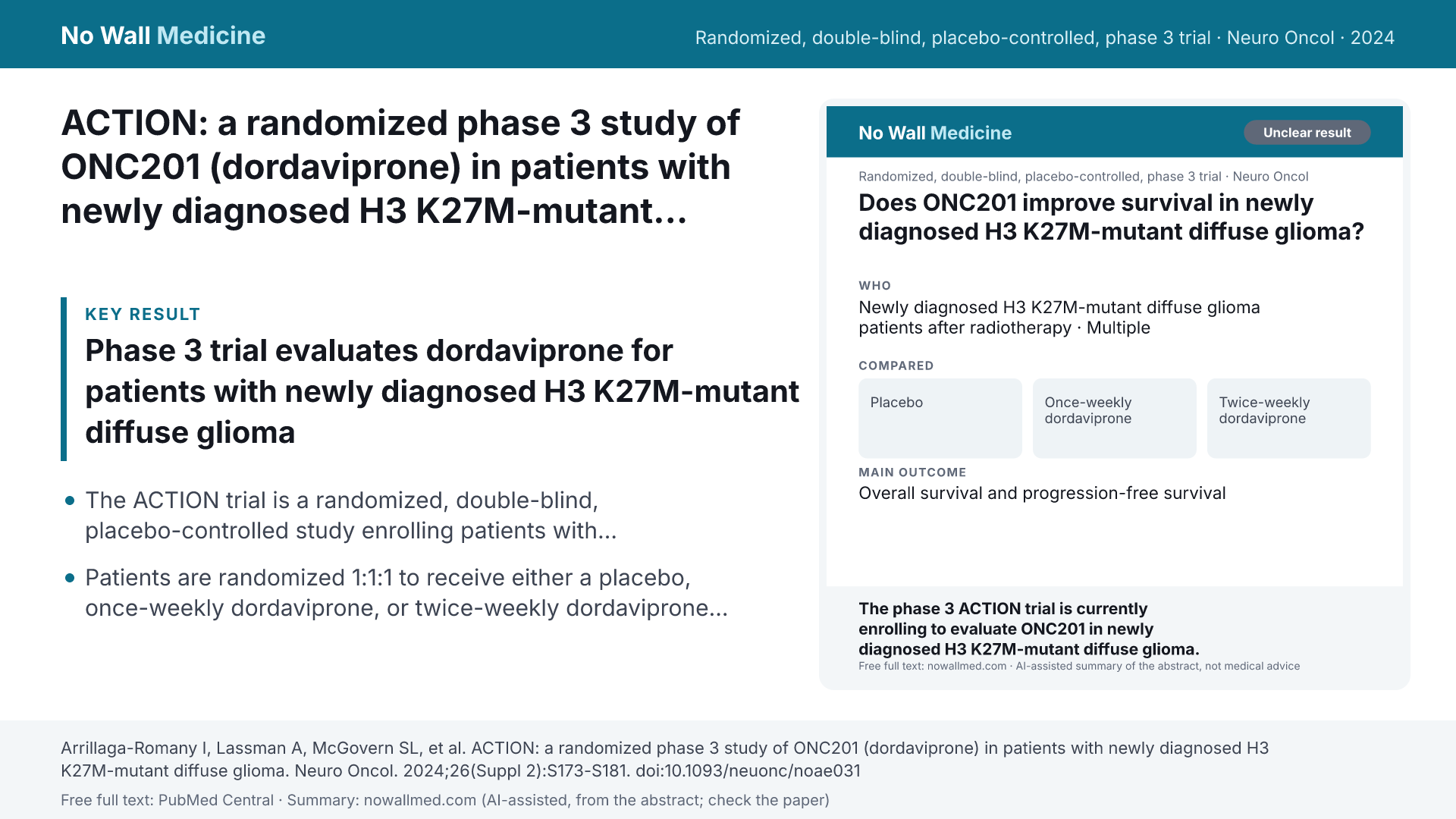
Phase 3 trial evaluates dordaviprone for patients with newly diagnosed H3 K27M-mutant diffuse glioma
ACTION: a randomized phase 3 study of ONC201 (dordaviprone) in patients with newly diagnosed H3 K27M-mutant diffuse glioma
NeurosurgeryAdult and pediatric
Randomized, double-blind, placebo-controlled, phase 3 trialUnclear result
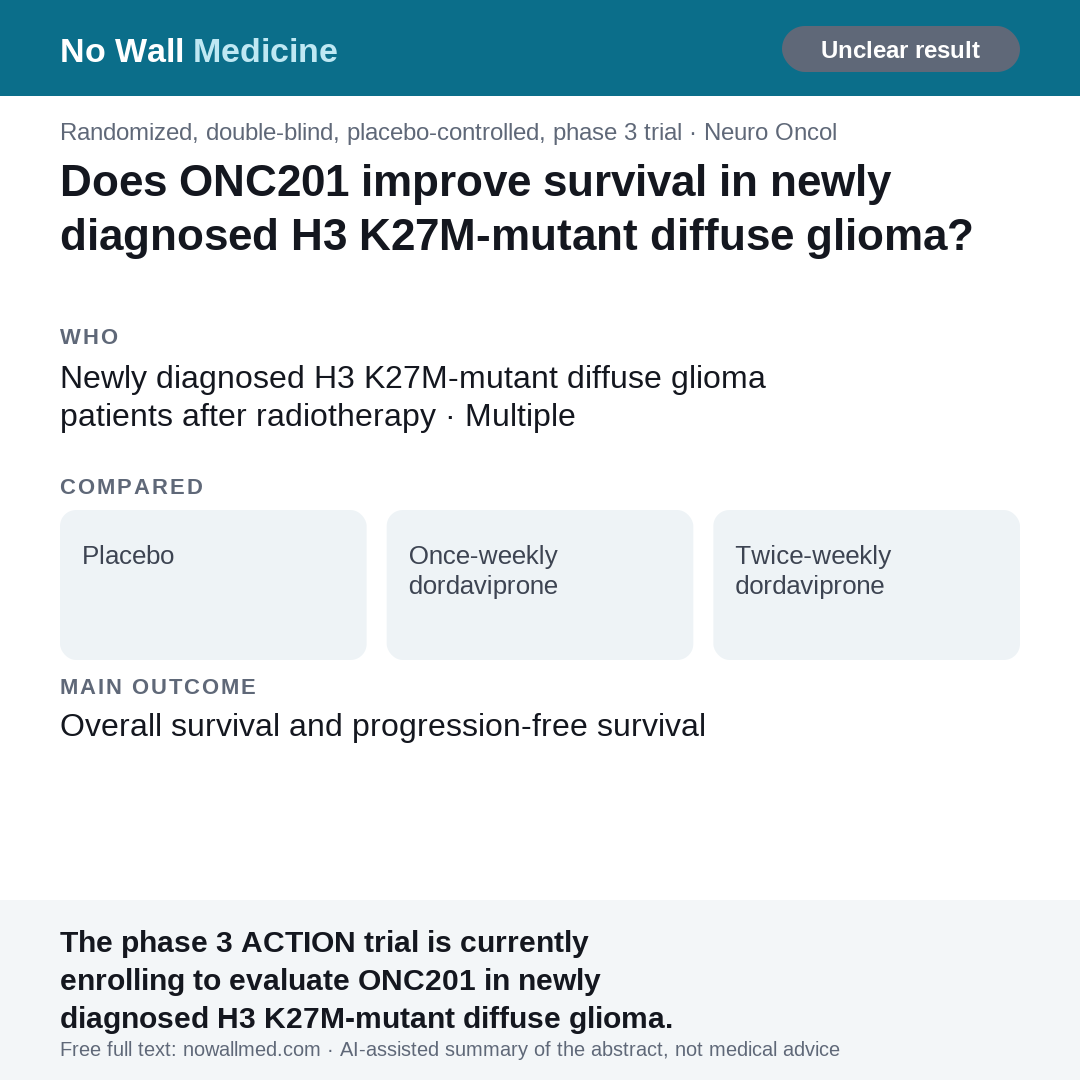
Does ONC201 improve survival in newly diagnosed H3 K27M-mutant diffuse glioma?
Who
Newly diagnosed H3 K27M-mutant diffuse glioma patients after radiotherapy · Multiple international sites
Compared
Placebo
Once-weekly dordaviprone
Twice-weekly dordaviprone
Main outcome
Overall survival and progression-free survival
Bottom line: The phase 3 ACTION trial is currently enrolling to evaluate ONC201 in newly diagnosed H3 K27M-mutant diffuse glioma.
Limitation: The study is currently enrolling and results are not yet reported.
Neuro Oncol · 2024-03-06Download image
Clinical question: Does ONC201 improve survival in newly diagnosed H3 K27M-mutant diffuse glioma?
Why it matters: No effective systemic therapy is currently available for patients with H3 K27M-mutant diffuse glioma, a condition primarily affecting children and young adults.
Key points
- The ACTION trial is a randomized, double-blind, placebo-controlled study enrolling patients with newly diagnosed H3 K27M-mutant diffuse glioma who have finished standard radiotherapy.
- Patients are randomized 1:1:1 to receive either a placebo, once-weekly dordaviprone, or twice-weekly dordaviprone to measure overall survival and progression-free survival.
- The study measures progression-free survival using response assessment in neuro-oncology high-grade glioma criteria, which is a standardized way to evaluate tumor changes.
Headline and key points written with AI from the paper’s abstract, with every number checked against it. Read the paper before relying on them.
Was this summary helpful?
Subject terms
Cite this article
Arrillaga-Romany I, Lassman A, McGovern SL, Mueller S, Nabors B, van den Bent M. ACTION: a randomized phase 3 study of ONC201 (dordaviprone) in patients with newly diagnosed H3 K27M-mutant diffuse glioma. Neuro Oncol. 2024. doi:10.1093/neuonc/noae031
Spotted a mistake? Suggest a correction
Top studies every Monday
The week’s key trials and guidelines in your specialties, plus any topics you follow. By email, free.
Get the weekly digest