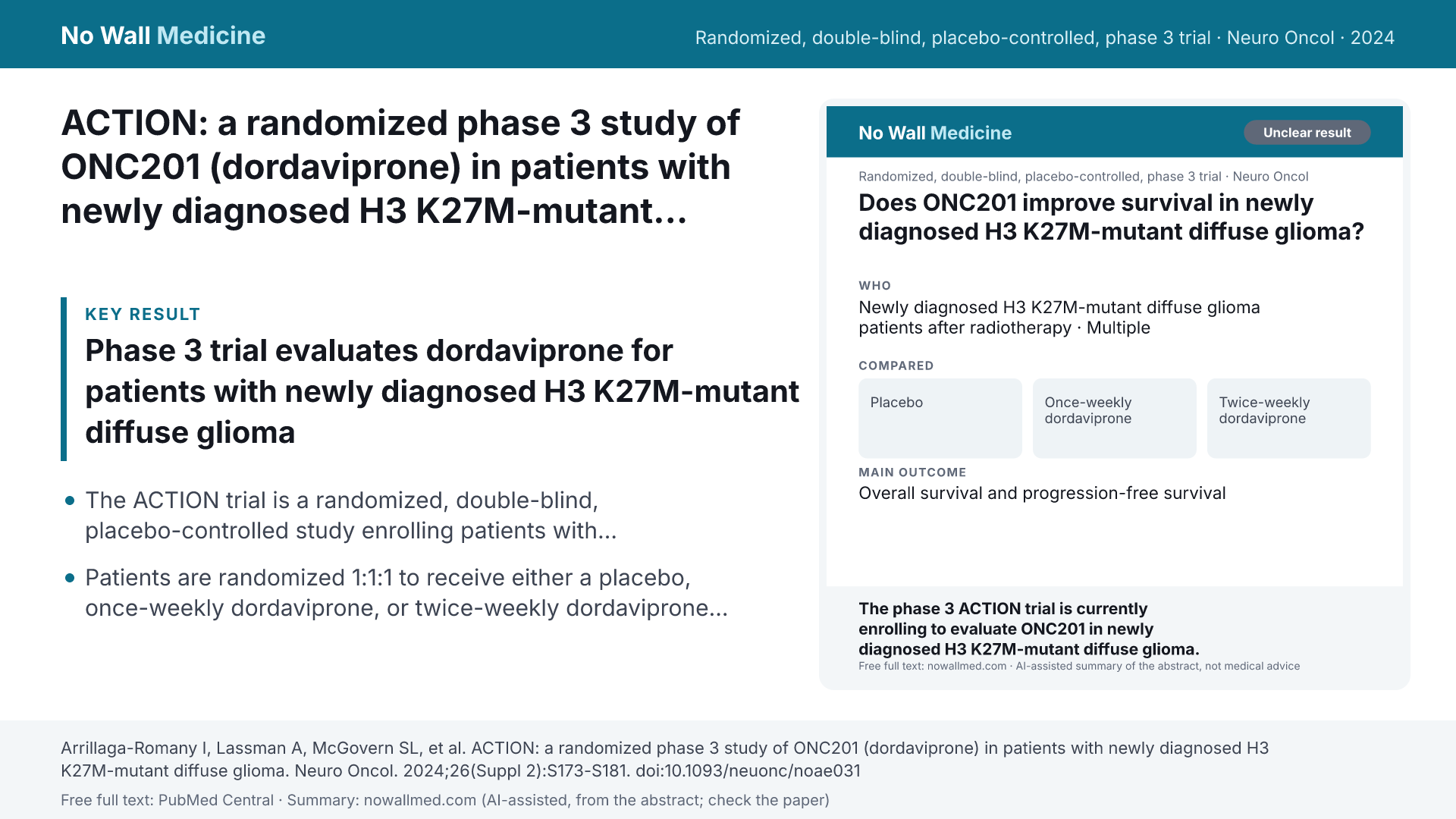
ACTION: a randomized phase 3 study of ONC201 (dordaviprone) in patients with newly diagnosed H3 K27M-mutant diffuse glioma
Key result: Phase 3 trial evaluates dordaviprone for patients with newly diagnosed H3 K27M-mutant diffuse glioma
Key points
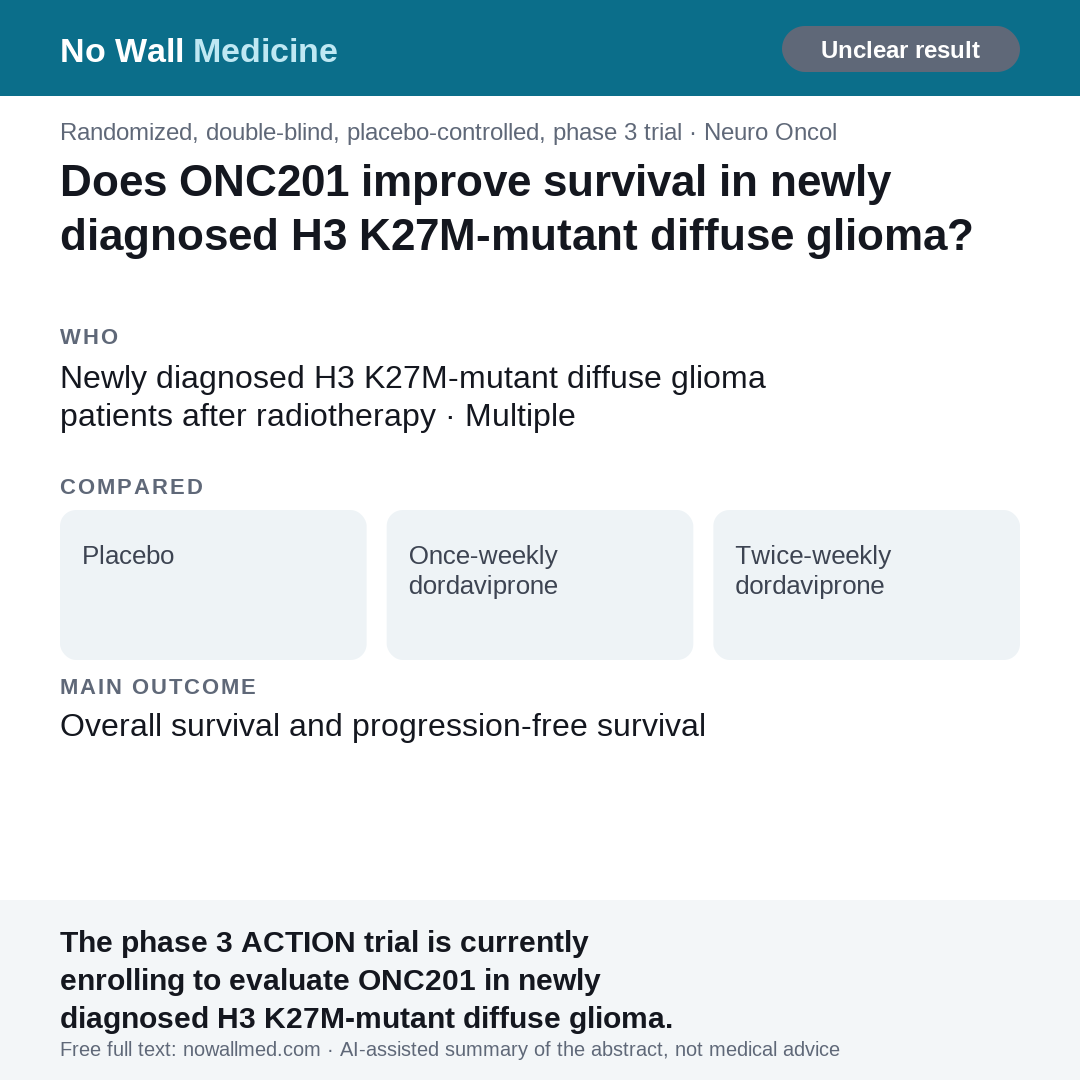
- The ACTION trial is a randomized, double-blind, placebo-controlled study enrolling patients with newly diagnosed H3 K27M-mutant diffuse glioma who have finished standard radiotherapy.
- Patients are randomized 1:1:1 to receive either a placebo, once-weekly dordaviprone, or twice-weekly dordaviprone to measure overall survival and progression-free survival.
- The study measures progression-free survival using response assessment in neuro-oncology high-grade glioma criteria, which is a standardized way to evaluate tumor changes.
Why it matters: No effective systemic therapy is currently available for patients with H3 K27M-mutant diffuse glioma, a condition primarily affecting children and young adults.
Discussion prompts
- Would these patients look like yours? Who was left out?
- Is the main outcome one that matters to patients?
- Is the difference large enough to change what you do?
Cite: Arrillaga-Romany I, Lassman A, McGovern SL, et al. ACTION: a randomized phase 3 study of ONC201 (dordaviprone) in patients with newly diagnosed H3 K27M-mutant diffuse glioma. Neuro Oncol. 2024;26(Suppl 2):S173-S181. doi:10.1093/neuonc/noae031
Free full text: PubMed Central · Summary and visual abstract: nowallmed.com/a/action-a-randomized-phase-3-study-of-onc201-dordaviprone-in-patients-kixada/ (AI-assisted from the abstract; check the paper before relying on it).