Combining intermittent hypoxia with high-intensity walking training improves walking speeds in chronic stroke survivors
Acute Intermittent Hypoxia With High-Intensity Gait Training in Chronic Stroke: A Phase II Randomized Crossover Trial
Double-blind randomized crossover trialBenefit found
Does acute intermittent hypoxia plus high-intensity gait training improve locomotor function in chronic stroke?
Who
28
Individuals 18 to 85 years old, more than 6 months poststroke
Compared
Acute intermittent hypoxia plus high-intensity gait training: self-selected speeds 0.14 [0.08-0.18] m/s
Normoxia plus high-intensity gait training: self-selected speeds 0.05 [0.01-0.10] m/s
Main outcome
self-selected speed, fastest speed, 6-minute walk test, and peak treadmill speed
Bottom line: Acute intermittent hypoxia combined with high-intensity gait training resulted in greater locomotor function gains than high-intensity training alone.
Stroke · 2024-06-11Download image
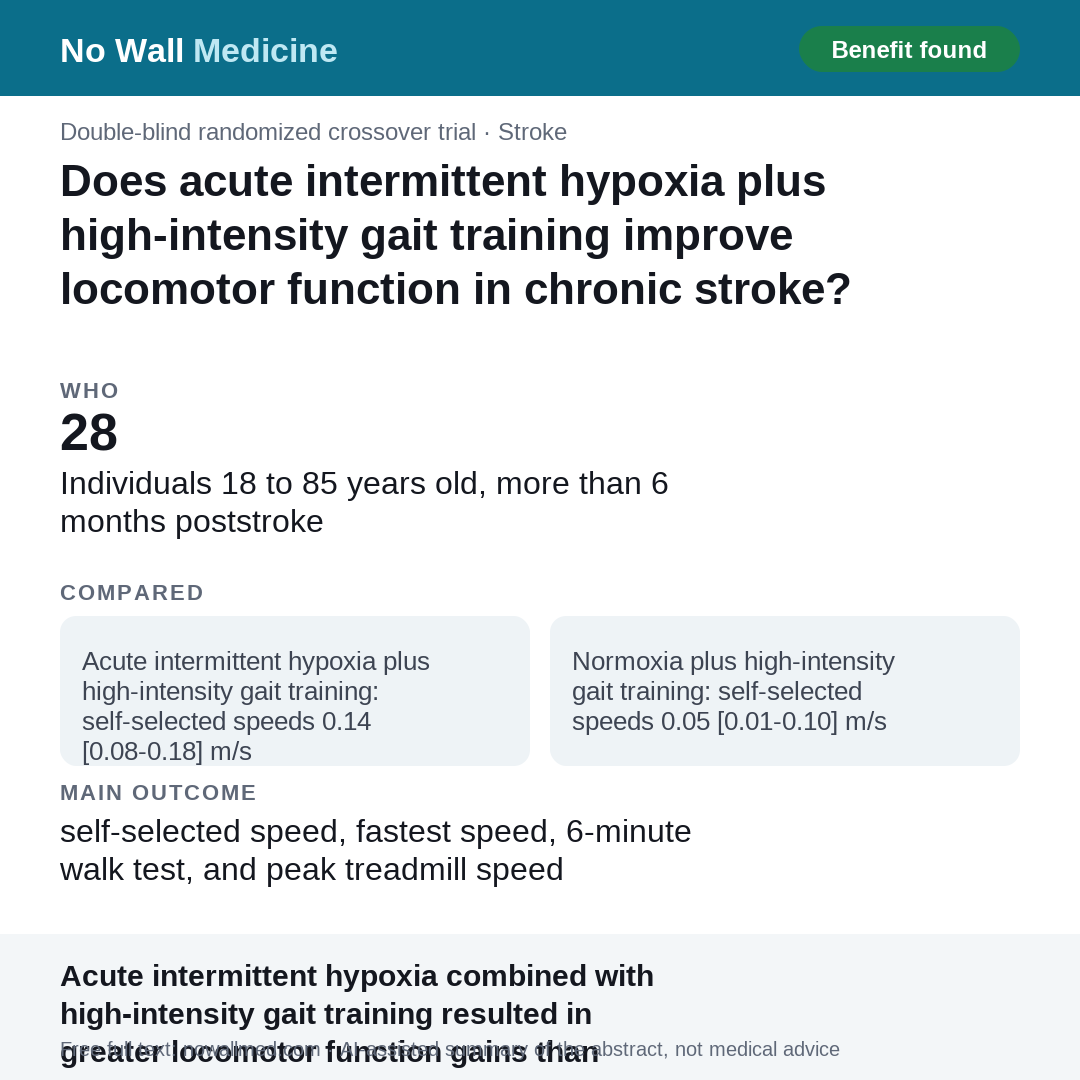
Clinical question: Does acute intermittent hypoxia plus high-intensity gait training improve locomotor function in chronic stroke?
Why it matters: It was unknown if combining acute intermittent hypoxia, which involves brief periods of low oxygen, with high-intensity walking training would improve locomotor function in people after a stroke.
Key points
- The study involved 28 individuals with chronic stroke who underwent a randomized crossover trial comparing high-intensity gait training with or without acute intermittent hypoxia.
- Adding acute intermittent hypoxia resulted in greater gains in self-selected speeds (0.14 [0.08-0.18] versus 0.05 [0.01-0.10] m/s), fastest speed (0.16 [0.10-0.21] versus 0.06 [0.02-0.10] m/s), and peak treadmill speed (0.21 [0.14-0.29] versus 0.11 [0.06-0.16] m/s).
- Participants taking serotonin-mediated antidepressant medications experienced worse outcomes for spatiotemporal symmetry, which refers to the timing and pattern of steps.
Headline and key points written with AI from the paper’s abstract, with every number checked against it. Read the paper before relying on them.
Was this summary helpful?
Subject terms
Cite this article
Hornby TG, Plawecki A, Lotter JK, Shoger LH, Voigtmann CJ, Inks E. Acute Intermittent Hypoxia With High-Intensity Gait Training in Chronic Stroke: A Phase II Randomized Crossover Trial. Stroke. 2024. doi:10.1161/STROKEAHA.124.047261
Spotted a mistake? Suggest a correction
Top studies every Monday
The week’s key trials and guidelines in your specialties, plus any topics you follow. By email, free.
Get the weekly digest