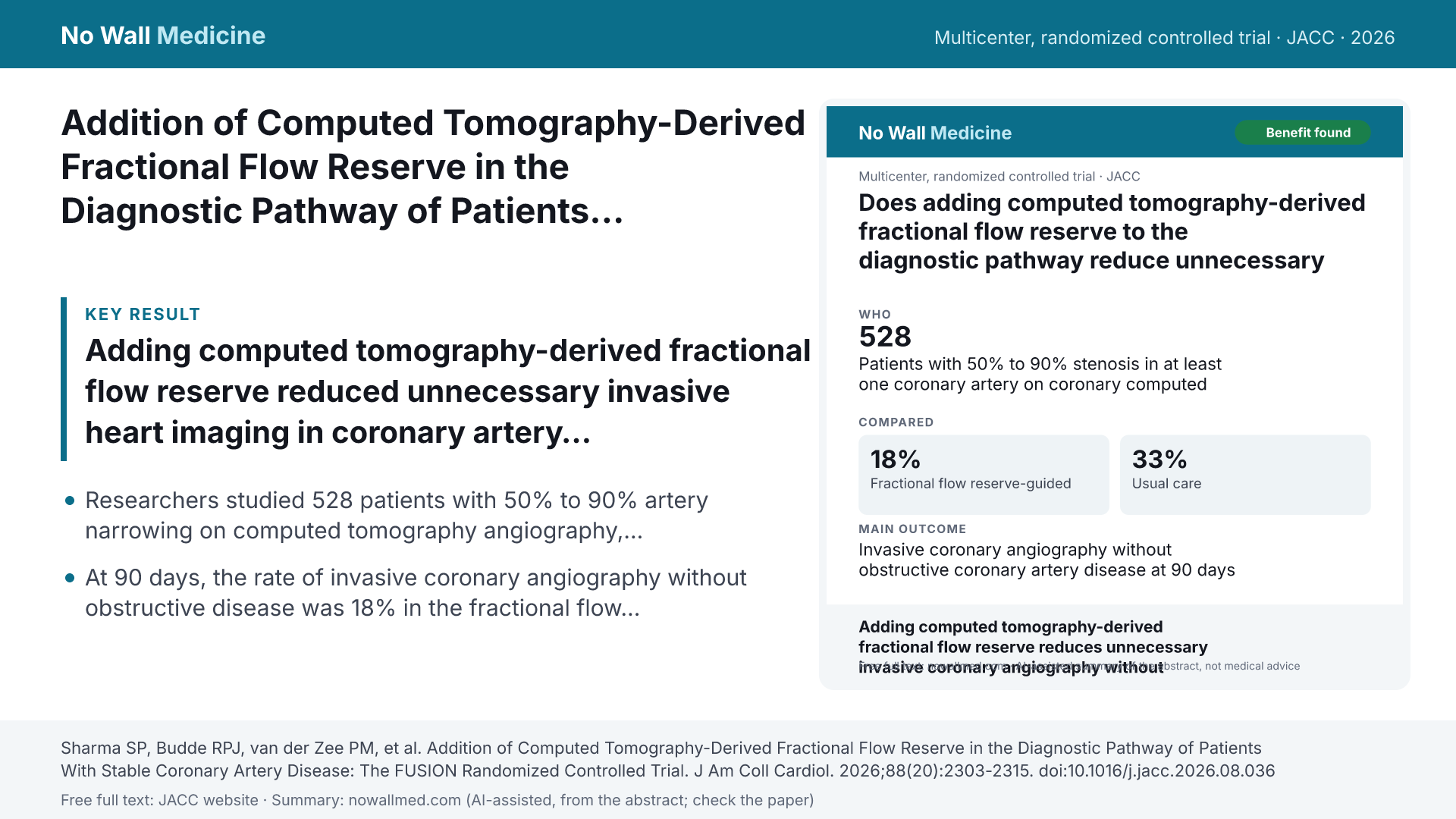
Adding computed tomography-derived fractional flow reserve reduced unnecessary invasive heart imaging in coronary artery disease patients
Addition of Computed Tomography-Derived Fractional Flow Reserve in the Diagnostic Pathway of Patients With Stable Coronary Artery Disease: The FUSION Randomized Controlled Trial
Multicenter, randomized controlled trialBenefit found
Does adding computed tomography-derived fractional flow reserve to the diagnostic pathway reduce unnecessary invasive coronary angiography?
Who
528
Patients with 50% to 90% stenosis in at least one coronary artery on coronary computed tomography angiography · Multicenter
Compared
18%Fractional flow reserve-guided (48 of 263)
33%Usual care (87 of 265)
Main outcome
Invasive coronary angiography without obstructive coronary artery disease at 90 days
Result: odds ratio 0.46 (95% CI 0.31-0.69)
Bottom line: Adding computed tomography-derived fractional flow reserve reduces unnecessary invasive coronary angiography without affecting revascularization rates or clinical events.
JACC · 2026-08-28 · Save PNG
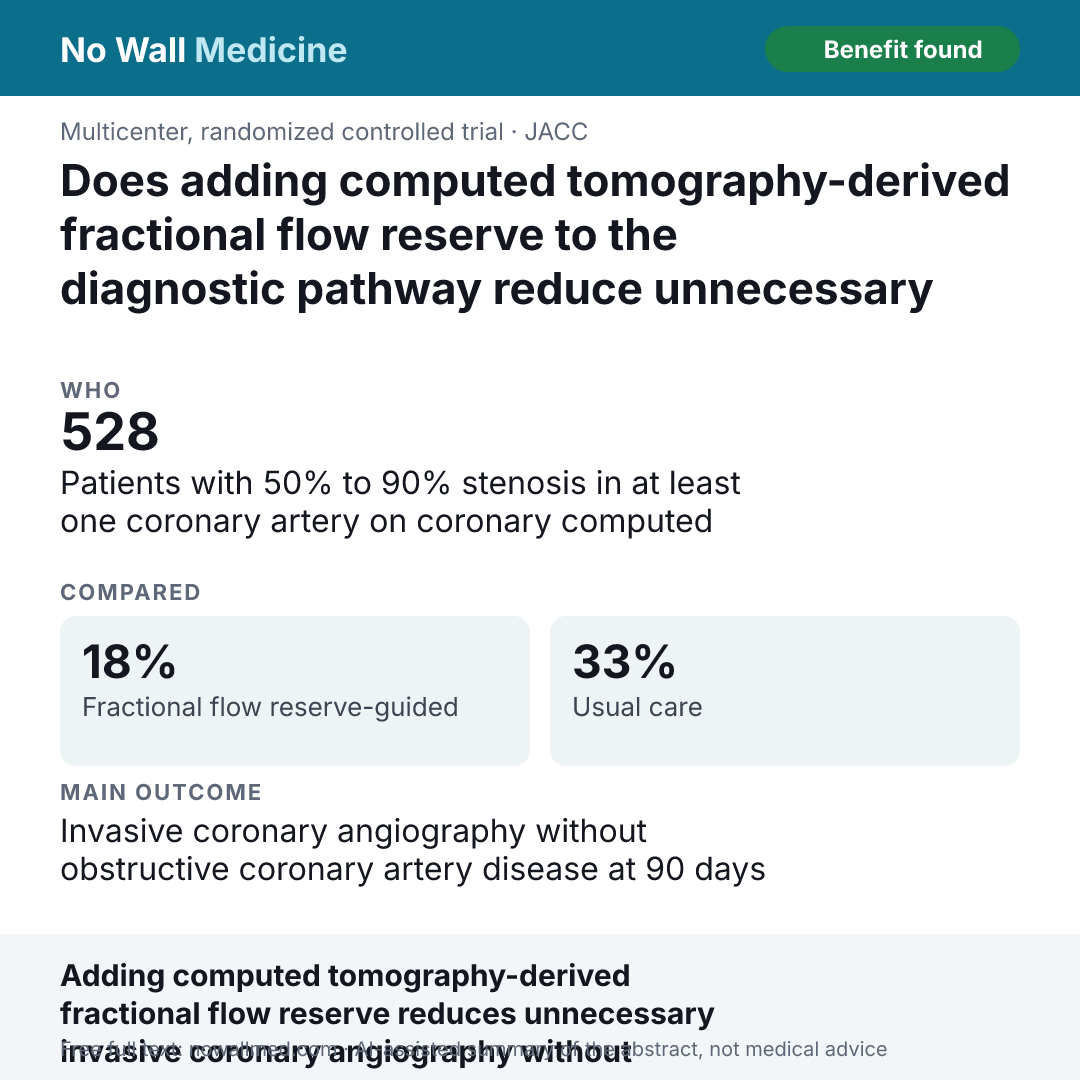
Clinical question: Does adding computed tomography-derived fractional flow reserve to the diagnostic pathway reduce unnecessary invasive coronary angiography?
Key points
- Researchers studied 528 patients with 50% to 90% artery narrowing on computed tomography angiography, comparing fractional flow reserve—a tool combining anatomy and function—to usual care.
- At 90 days, the rate of invasive coronary angiography without obstructive disease was 18% in the fractional flow reserve group compared to 33% in usual care.
- Revascularization rates at 1 year were similar between groups at 20% for both, and there were no differences in costs, quality of life, or major adverse cardiac events.
Headline and key points written with AI from the paper’s abstract, with every number checked against it. Read the paper before relying on them.
Was this summary helpful?
Subject terms
Headline, design, result, key points, caveat and citation as plain text.
Cite this article
Sharma SP, Budde RPJ, van der Zee PM, et al. Addition of Computed Tomography-Derived Fractional Flow Reserve in the Diagnostic Pathway of Patients With Stable Coronary Artery Disease: The FUSION Randomized Controlled Trial. J Am Coll Cardiol. 2026;88(20):2303-2315. doi:10.1016/j.jacc.2026.08.036
Spotted a mistake? Suggest a correction