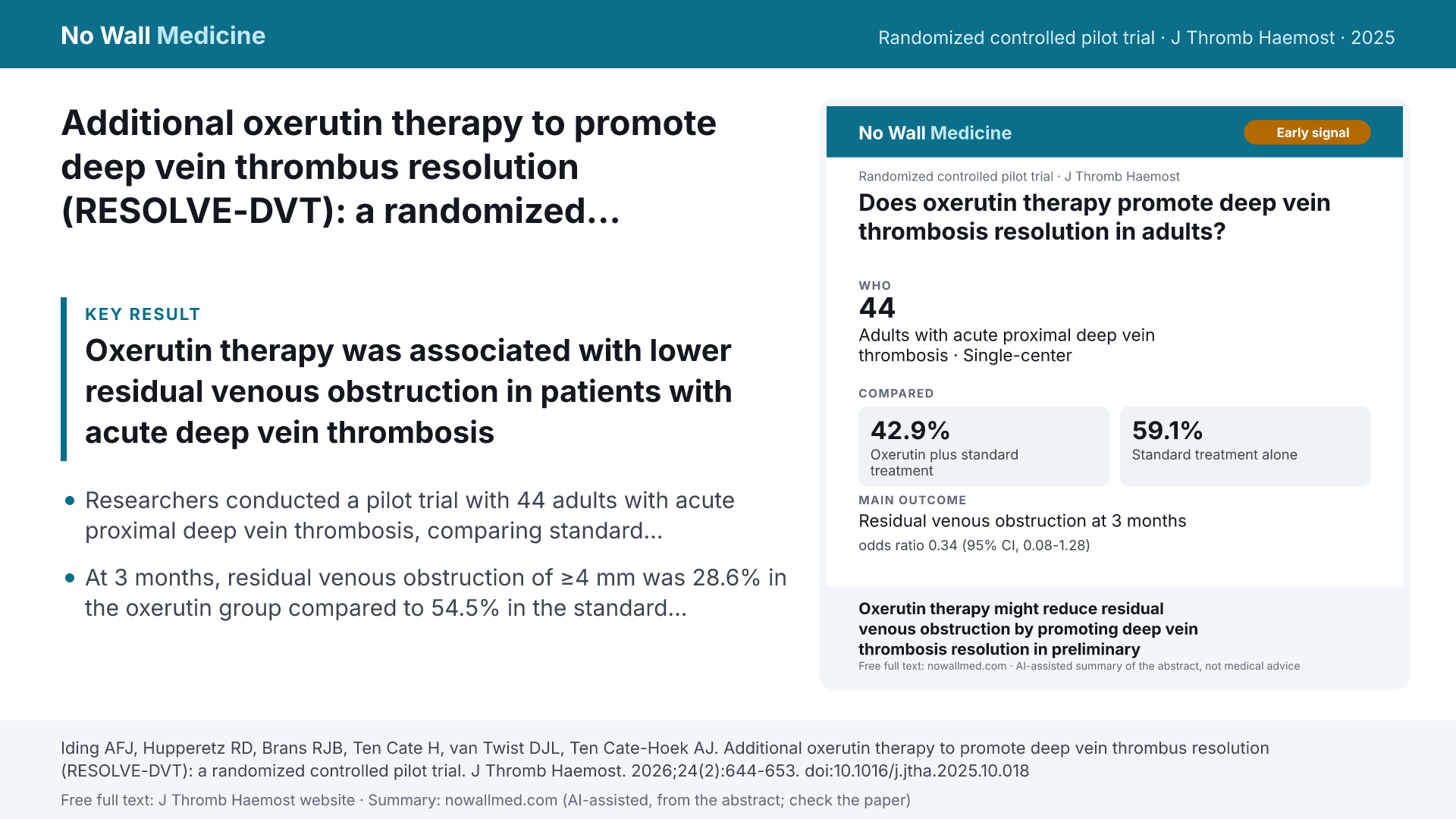
Additional oxerutin therapy to promote deep vein thrombus resolution (RESOLVE-DVT): a randomized controlled pilot trial
Key result: Oxerutin therapy was associated with lower residual venous obstruction in patients with acute deep vein thrombosis
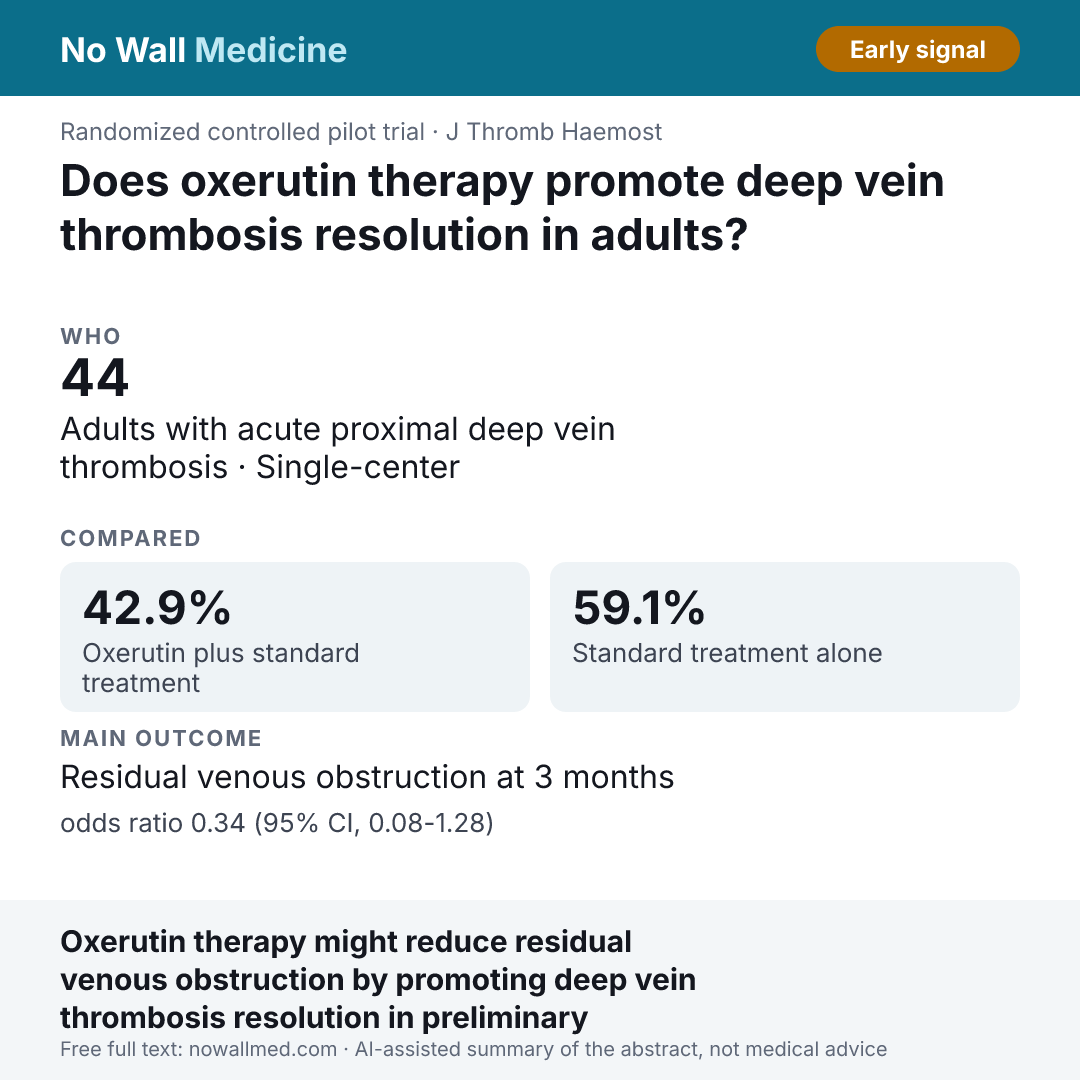
Key points
- Researchers conducted a pilot trial with 44 adults with acute proximal deep vein thrombosis, comparing standard treatment alone to standard treatment plus 2 months of oxerutin.
- At 3 months, residual venous obstruction of ≥4 mm was 28.6% in the oxerutin group compared to 54.5% in the standard treatment group.
- The oxerutin group also showed a lower proportion of postthrombotic syndrome at 3 months, with 28.6% compared to 40.9% in the standard treatment group.
Limitation the authors note: The study was a single-center, patient-unblinded pilot trial with a small sample of 44 patients.
Discussion prompts
- Would these patients look like yours? Who was left out?
- Is the main outcome one that matters to patients?
- Is the difference large enough to change what you do?
Cite: Iding AFJ, Hupperetz RD, Brans RJB, Ten Cate H, van Twist DJL, Ten Cate-Hoek AJ. Additional oxerutin therapy to promote deep vein thrombus resolution (RESOLVE-DVT): a randomized controlled pilot trial. J Thromb Haemost. 2026;24(2):644-653. doi:10.1016/j.jtha.2025.10.018
Free full text: J Thromb Haemost website · Summary and visual abstract: nowallmed.com/a/additional-oxerutin-therapy-to-promote-deep-vein-thrombus-resolution-m7qxgb/ (AI-assisted from the abstract; check the paper before relying on it).