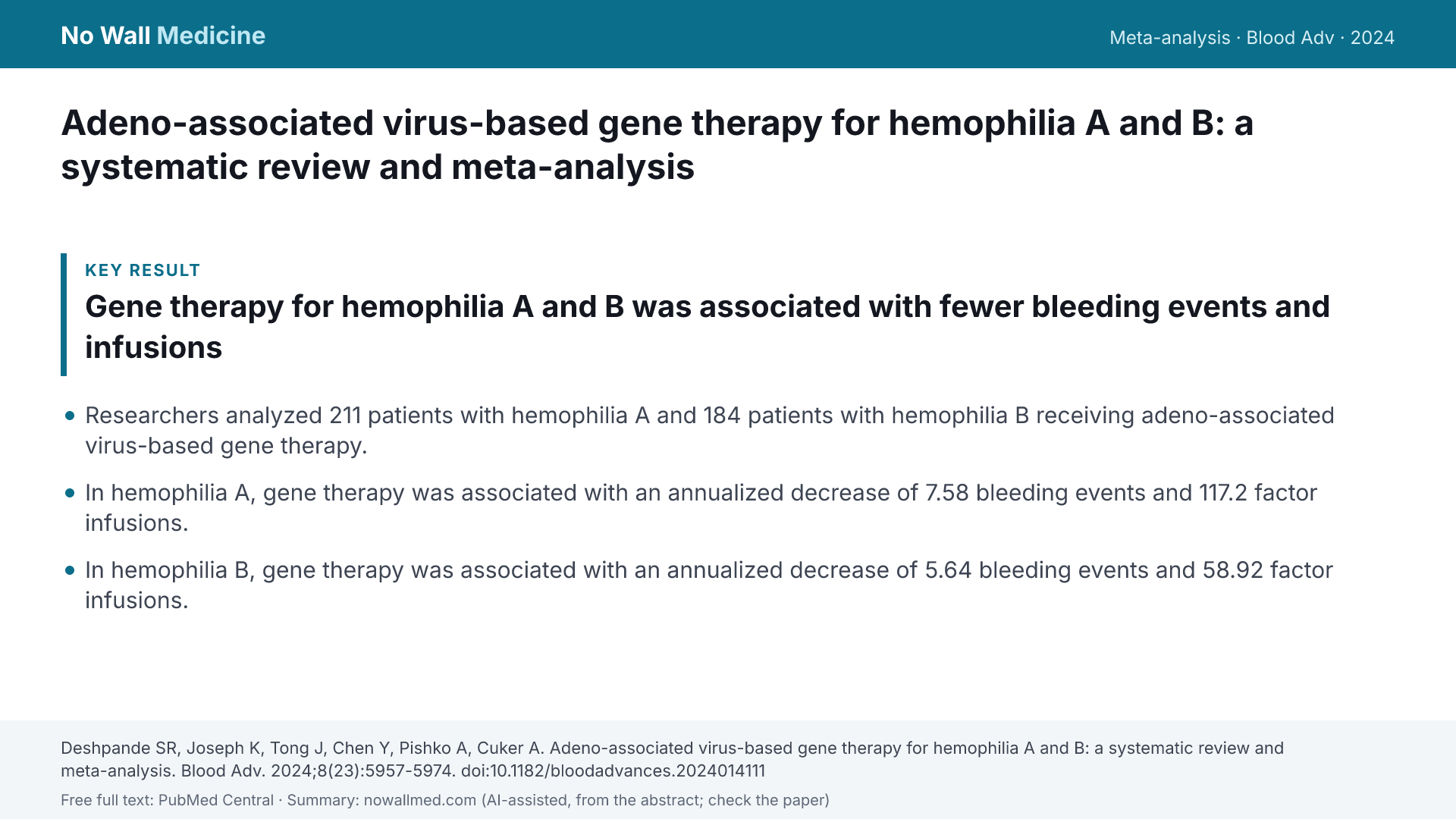
Gene therapy for hemophilia A and B was associated with fewer bleeding events and infusions
Adeno-associated virus-based gene therapy for hemophilia A and B: a systematic review and meta-analysis
Why it matters: The effectiveness and safety of emerging adeno-associated virus-based gene therapies for treating severe or moderately severe hemophilia A and B were not fully synthesized.
Key points
- Researchers analyzed 211 patients with hemophilia A and 184 patients with hemophilia B receiving adeno-associated virus-based gene therapy.
- In hemophilia A, gene therapy was associated with an annualized decrease of 7.58 bleeding events and 117.2 factor infusions.
- In hemophilia B, gene therapy was associated with an annualized decrease of 5.64 bleeding events and 58.92 factor infusions.
Headline and key points written with AI from the paper’s abstract, with every number checked against it. Read the paper before relying on them.
Was this summary helpful?
Abstract
Adeno-associated virus (AAV)-based gene therapy is an emerging treatment for hemophilia A (HA) and hemophilia B (HB). In this systematic review and meta-analysis, we searched for studies of adult males with severe or moderately severe HA or HB who received AAV-based gene therapy. Annualized bleeding rate (ABR), annualized infusion rate (AIR), total factor use, factor levels, and adverse events (AEs) were extracted. Eight HA trials representing 7 gene therapies and 211 patients and 12 HB trials representing 9 gene therapies and 184 patients were included. For HA, gene therapy resulted in an annualized decrease of 7.58 bleeding events (95% confidence interval [CI], -11.50 to -3.67) and 117.2 factor infusions (95% CI, -151.86 to -82.53) compared with before gene therapy. Factor VIII level at 12 months ranged from 10.4 to 70.31 IU/mL by 1-stage assay. HB gene therapies were associated with an annualized decrease of 5.64 bleeding events (95% CI, -8.61 to -2.68) and 58.92 factor infusions (95% CI, -68.19 to -49.65). Mean factor IX level at 12 months was 28.72 IU/mL (95% CI, 18.78-38.66). Factor expression was more durable for HB than HA; factor IX levels remained at 95.7% of their peak whereas factor VIII levels fell to 55.8% of their peak at 24 months. The pooled percentage of patients experiencing a serious AE was 19% (10%-31%) and 21% (10%-37%) for HA and HB gene therapies, respectively. No thrombosis or inhibitor formation was reported. AAV-based gene therapies for both HA and HB demonstrated significant reductions in ABR, AIR, and factor use.
Abstract reproduced under the article’s CC BY NC ND licence.
Subject terms
Cite this article
Deshpande SR, Joseph K, Tong J, Chen Y, Pishko A, Cuker A. Adeno-associated virus-based gene therapy for hemophilia A and B: a systematic review and meta-analysis. Blood Adv. 2024. doi:10.1182/bloodadvances.2024014111
Spotted a mistake? Suggest a correction