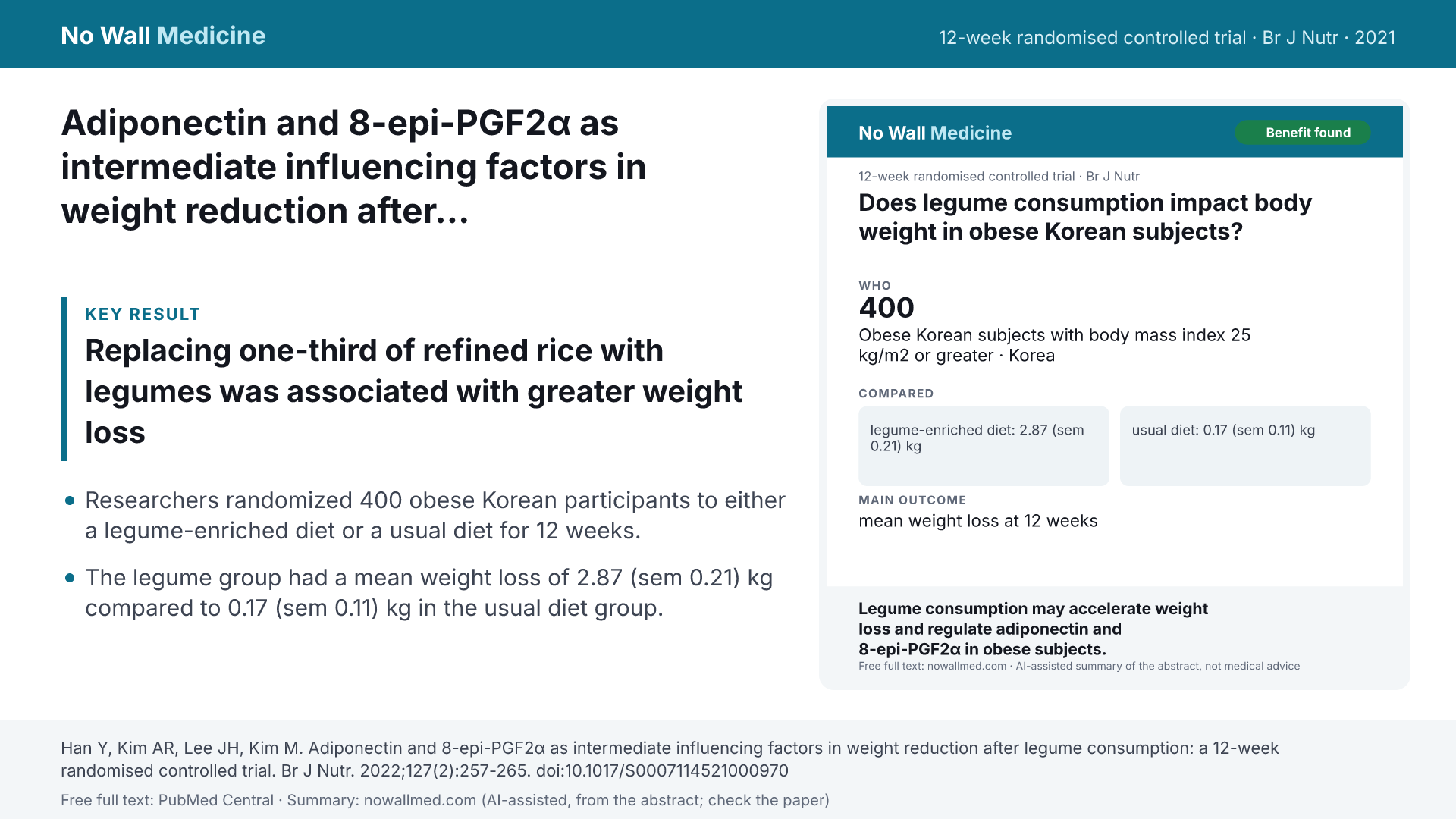
Replacing one-third of refined rice with legumes was associated with greater weight loss
Adiponectin and 8-epi-PGF2α as intermediate influencing factors in weight reduction after legume consumption: a 12-week randomised controlled trial
12-week randomised controlled trialBenefit found
Does legume consumption impact body weight in obese Korean subjects?
Who
400
Obese Korean subjects with body mass index 25 kg/m2 or greater · Korea
Compared
legume-enriched diet: 2.87 (sem 0.21) kg
usual diet: 0.17 (sem 0.11) kg
Main outcome
mean weight loss at 12 weeks
Bottom line: Legume consumption may accelerate weight loss and regulate adiponectin and 8-epi-PGF2α in obese subjects.
Br J Nutr · 2021-03-22Download image
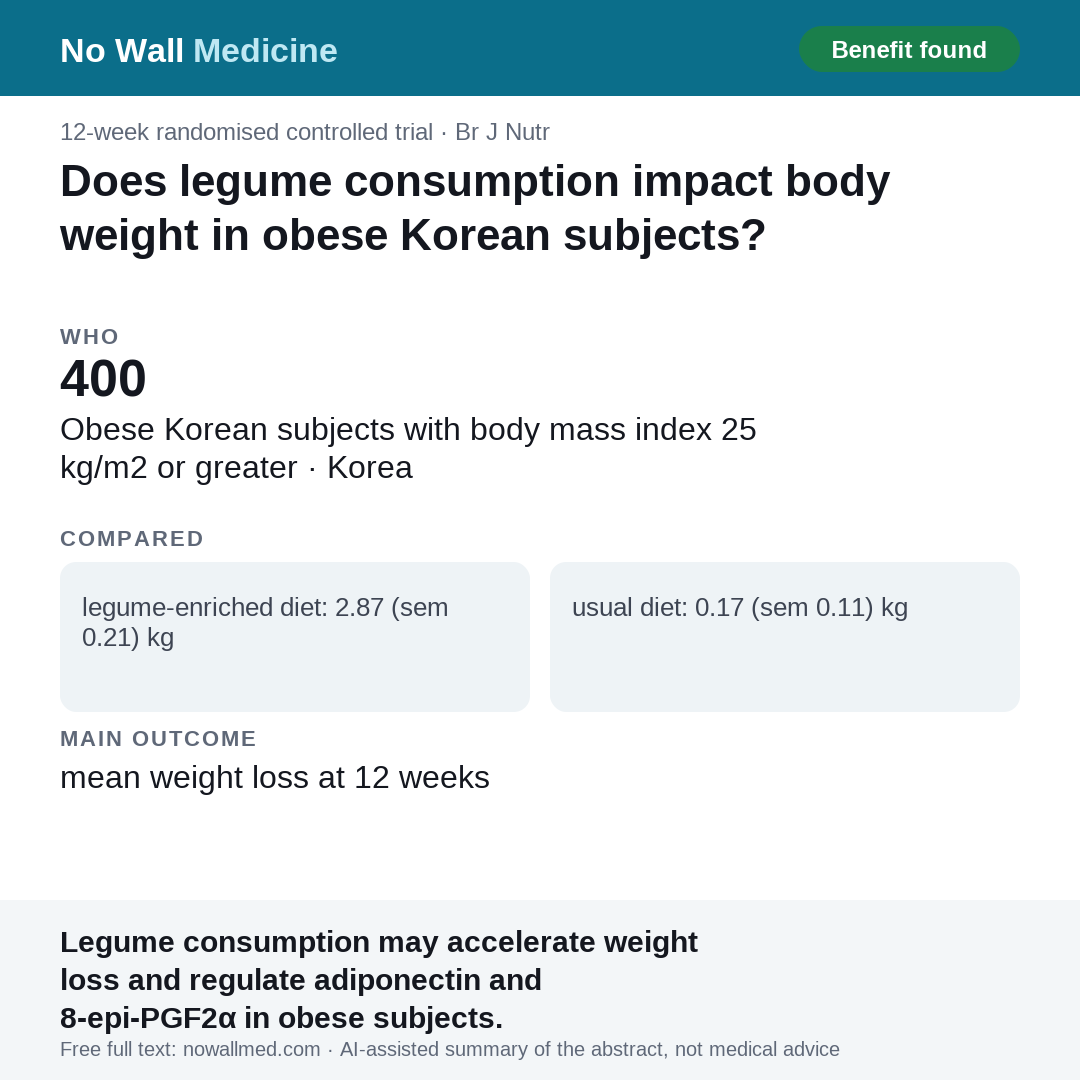
Clinical question: Does legume consumption impact body weight in obese Korean subjects?
Key points
- Researchers randomized 400 obese Korean participants to either a legume-enriched diet or a usual diet for 12 weeks.
- The legume group had a mean weight loss of 2.87 (sem 0.21) kg compared to 0.17 (sem 0.11) kg in the usual diet group.
- In the legume group, adiponectin and HDL-cholesterol levels increased, while glucose, insulin, triglycerides, 8-epi-PGF2α, and insulin resistance index values decreased.
Headline and key points written with AI from the paper’s abstract, with every number checked against it. Read the paper before relying on them.
Was this summary helpful?
Subject terms
Cite this article
Han Y, Kim AR, Lee JH, Kim M. Adiponectin and 8-epi-PGF2α as intermediate influencing factors in weight reduction after legume consumption: a 12-week randomised controlled trial. Br J Nutr. 2021. doi:10.1017/S0007114521000970
Spotted a mistake? Suggest a correction