Adiponectin and 8-epi-PGF2α as intermediate influencing factors in weight reduction after legume consumption: a 12-week randomised controlled trial
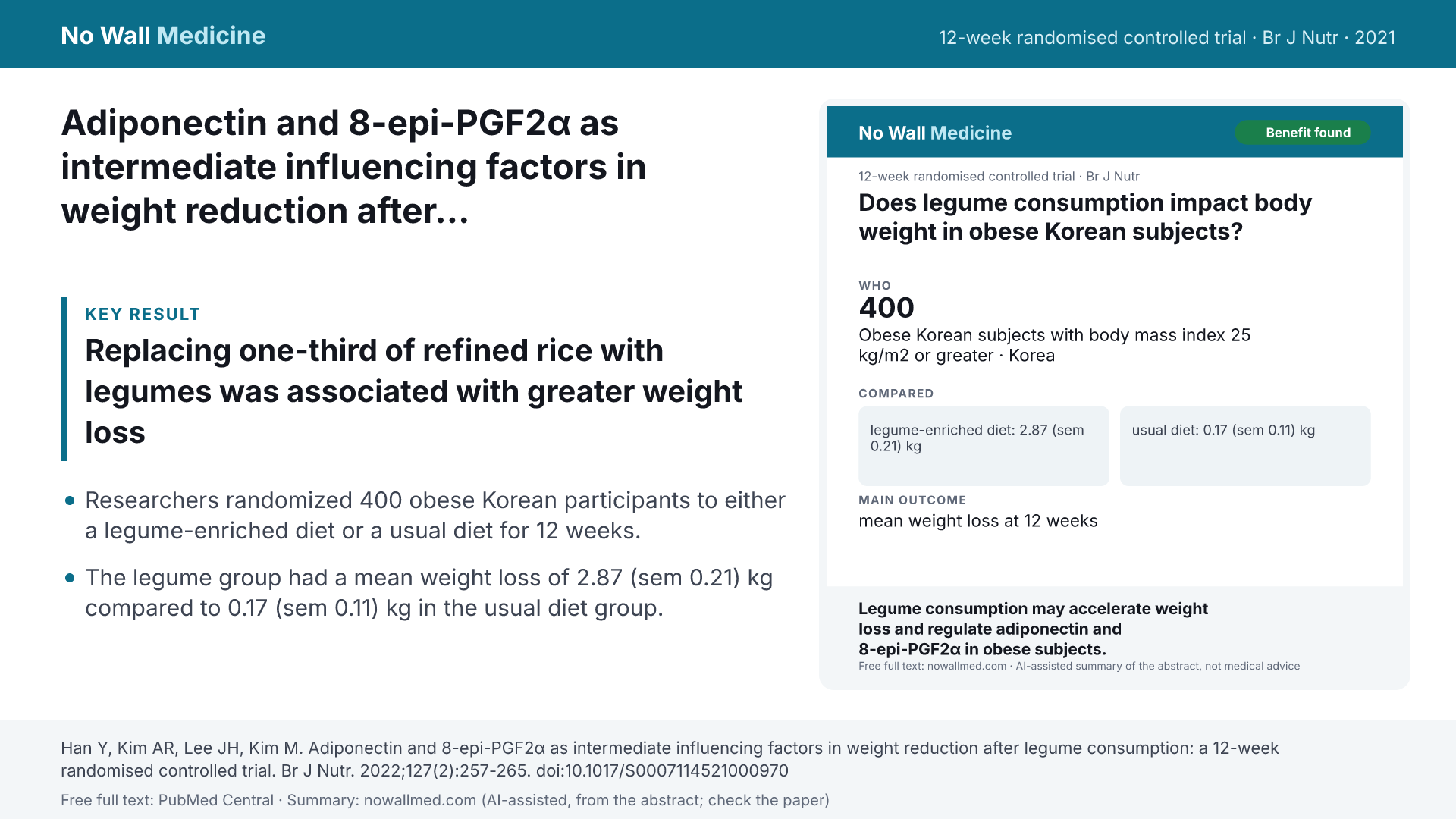
Key result: Replacing one-third of refined rice with legumes was associated with greater weight loss
12-week randomised controlled trialBenefit found
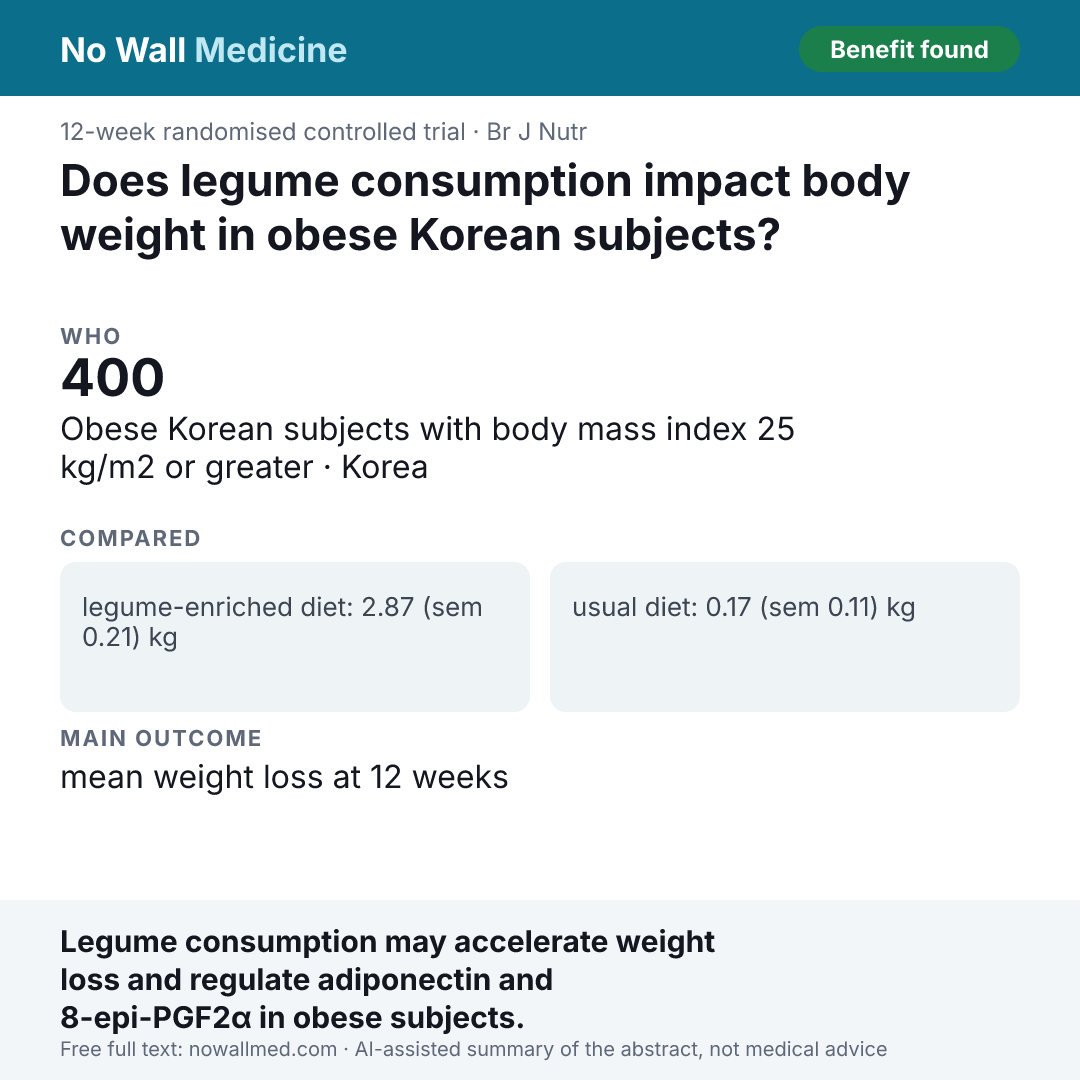
Does legume consumption impact body weight in obese Korean subjects?
Who
400
Obese Korean subjects with body mass index 25 kg/m2 or greater · Korea
Compared
legume-enriched diet: 2.87 (sem 0.21) kg
usual diet: 0.17 (sem 0.11) kg
Main outcome
mean weight loss at 12 weeks
Bottom line: Legume consumption may accelerate weight loss and regulate adiponectin and 8-epi-PGF2α in obese subjects.
Br J Nutr · 2021-03-22 · Save PNG
Key points
- Researchers randomized 400 obese Korean participants to either a legume-enriched diet or a usual diet for 12 weeks.
- The legume group had a mean weight loss of 2.87 (sem 0.21) kg compared to 0.17 (sem 0.11) kg in the usual diet group.
- In the legume group, adiponectin and HDL-cholesterol levels increased, while glucose, insulin, triglycerides, 8-epi-PGF2α, and insulin resistance index values decreased.
Discussion prompts
- Would these patients look like yours? Who was left out?
- Is the main outcome one that matters to patients?
- Is the difference large enough to change what you do?
Cite: Han Y, Kim AR, Lee JH, Kim M. Adiponectin and 8-epi-PGF2α as intermediate influencing factors in weight reduction after legume consumption: a 12-week randomised controlled trial. Br J Nutr. 2022;127(2):257-265. doi:10.1017/S0007114521000970
Free full text: PubMed Central · Summary and visual abstract: nowallmed.com/a/adiponectin-and-8-epi-pgf2-as-intermediate-influencing-factors-in-1fj5440/ (AI-assisted from the abstract; check the paper before relying on it).