Adding intra-arterial alteplase to thrombectomy improves functional outcomes in acute ischemic stroke patients
Adjunctive Intra-Arterial Alteplase After Successful Thrombectomy for Acute Ischemic Stroke: The CHOICE-2 Randomized Clinical Trial
Randomized, open-label trialMixed results
Does adjunctive intra-arterial alteplase after successful thrombectomy improve functional outcomes and cerebral reperfusion?
Who
440
Patients with acute ischemic stroke due to large vessel occlusion · 14 stroke centers in Spain
Compared
57.5%Thrombectomy plus intra-arterial alteplase (123/214)
42.5%Thrombectomy alone (93/219)
Main outcome
Excellent functional outcome at 90 days
Result: adjusted risk difference, 15.0% (95% CI, 5.7% to 24.3%)
Bottom line: Adjunctive intra-arterial alteplase increased excellent functional outcomes but was associated with higher mortality at 90 days.
JAMA · 2026-05-07Download image
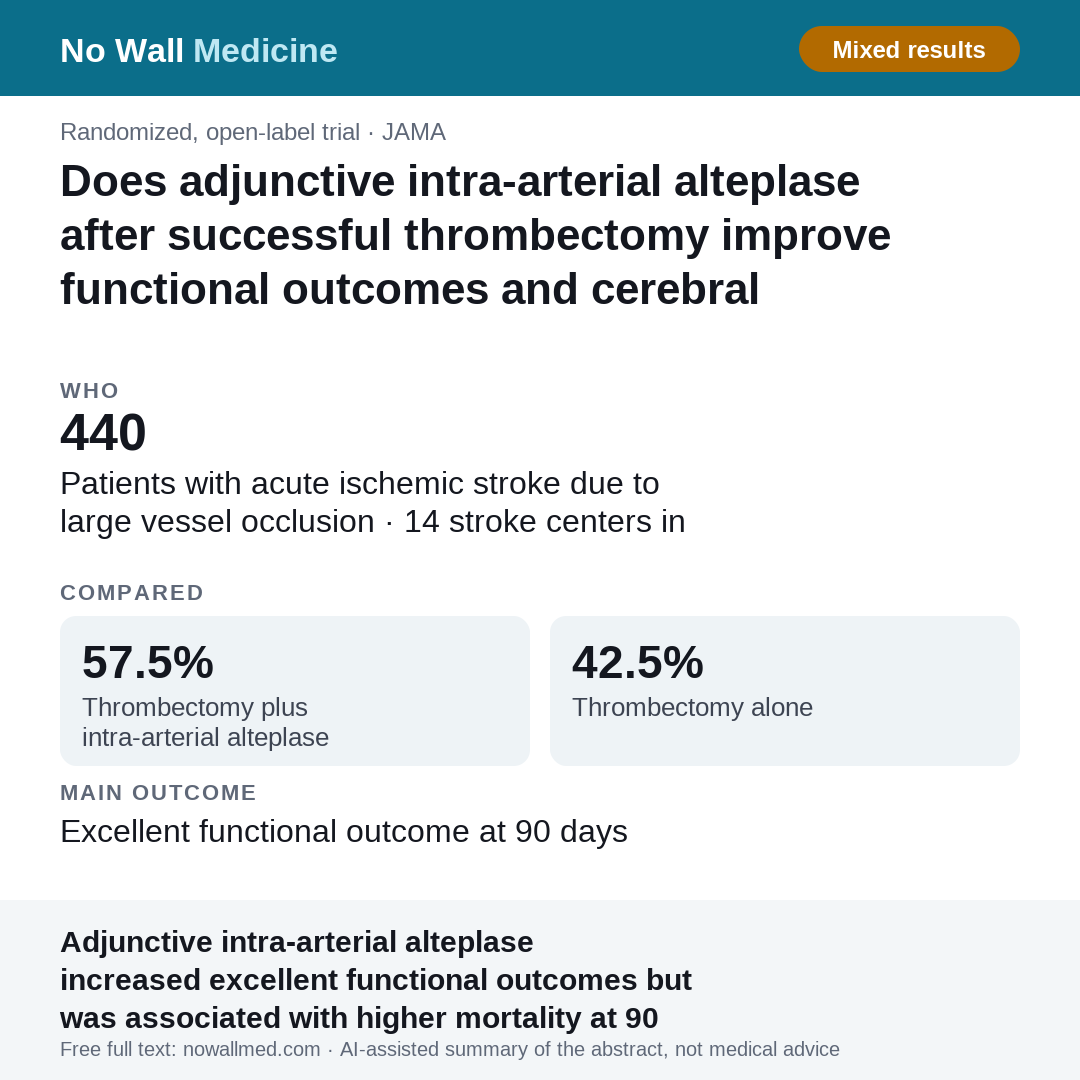
Clinical question: Does adjunctive intra-arterial alteplase after successful thrombectomy improve functional outcomes and cerebral reperfusion?
Why it matters: Functional outcomes remain suboptimal for patients with acute ischemic stroke despite high rates of successful vessel reopening during mechanical clot removal.
Key points
- Researchers studied 440 patients with acute ischemic stroke due to large vessel occlusion who underwent successful mechanical clot removal, or thrombectomy.
- At 90 days, 57.5% of patients receiving both thrombectomy and intra-arterial alteplase achieved an excellent functional outcome compared to 42.5% in the thrombectomy alone group.
- The group receiving both treatments had a higher 90-day mortality rate of 12.1% compared to 6.4% in the thrombectomy alone group.
Headline and key points written with AI from the paper’s abstract, with every number checked against it. Read the paper before relying on them.
Topics
Cite this article
Renú A, Fernández-Couto MD, de la Riva P, Delgado-Mederos R, Herrera M, Morales A. Adjunctive Intra-Arterial Alteplase After Successful Thrombectomy for Acute Ischemic Stroke: The CHOICE-2 Randomized Clinical Trial. JAMA. 2026. doi:10.1001/jama.2026.5164
Spotted a mistake? Suggest a correction