Adjuvant capecitabine improved failure-free survival in patients with advanced nasopharyngeal carcinoma
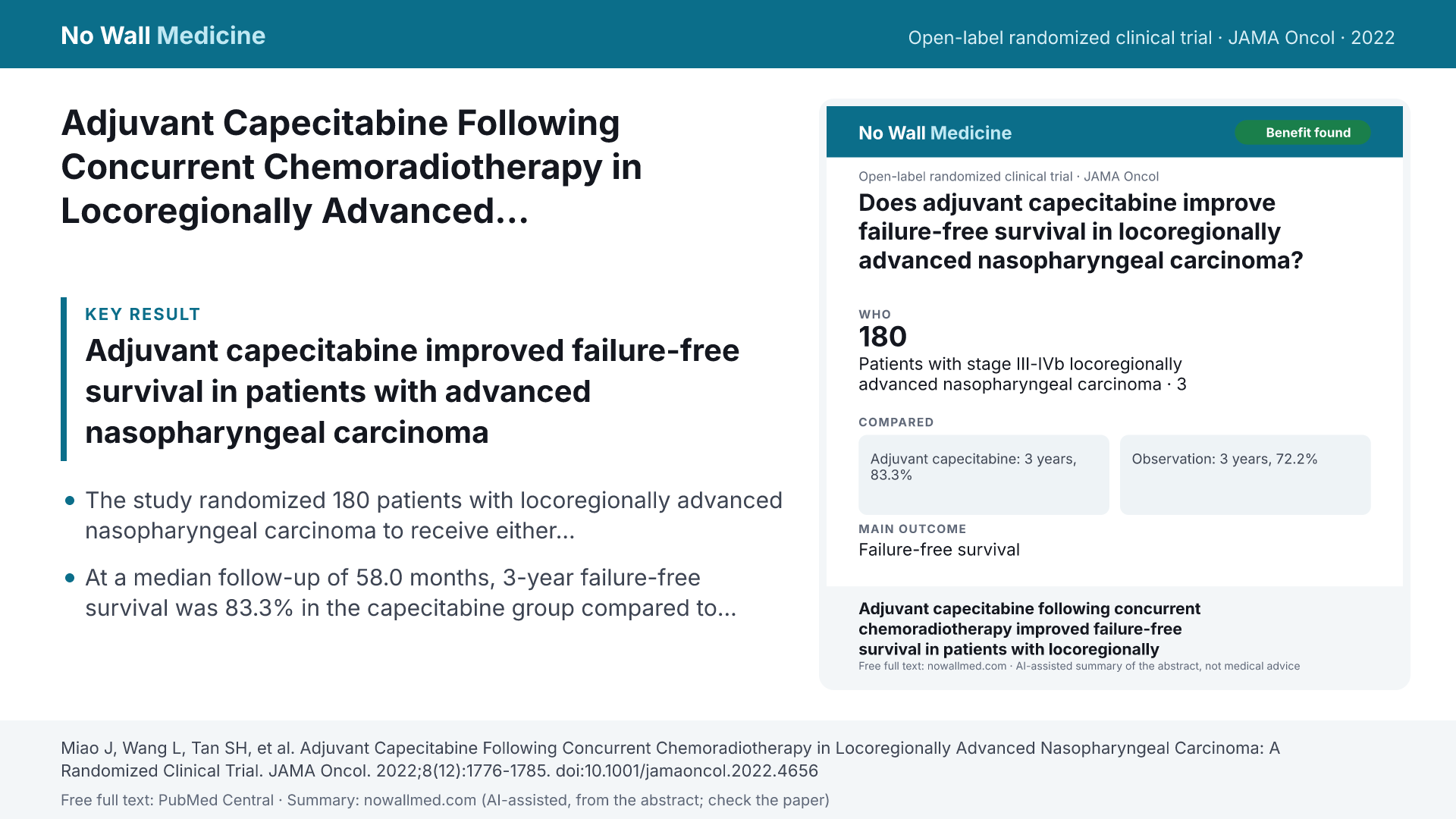
Adjuvant Capecitabine Following Concurrent Chemoradiotherapy in Locoregionally Advanced Nasopharyngeal Carcinoma: A Randomized Clinical Trial
Open-label randomized clinical trialBenefit found
Does adjuvant capecitabine improve failure-free survival in locoregionally advanced nasopharyngeal carcinoma?
Who
180
Patients with stage III-IVb locoregionally advanced nasopharyngeal carcinoma · 3 institutions in China
Compared
Adjuvant capecitabine: 3 years, 83.3%
Observation: 3 years, 72.2%
Main outcome
Failure-free survival
Result: hazard ratio, 0.53 (95% CI, 0.30-0.94)
Bottom line: Adjuvant capecitabine following concurrent chemoradiotherapy improved failure-free survival in patients with locoregionally advanced nasopharyngeal carcinoma.
Limitation: Further investigations assessing optimal dose and duration are warranted.
JAMA Oncol · 2022-10-13Download image
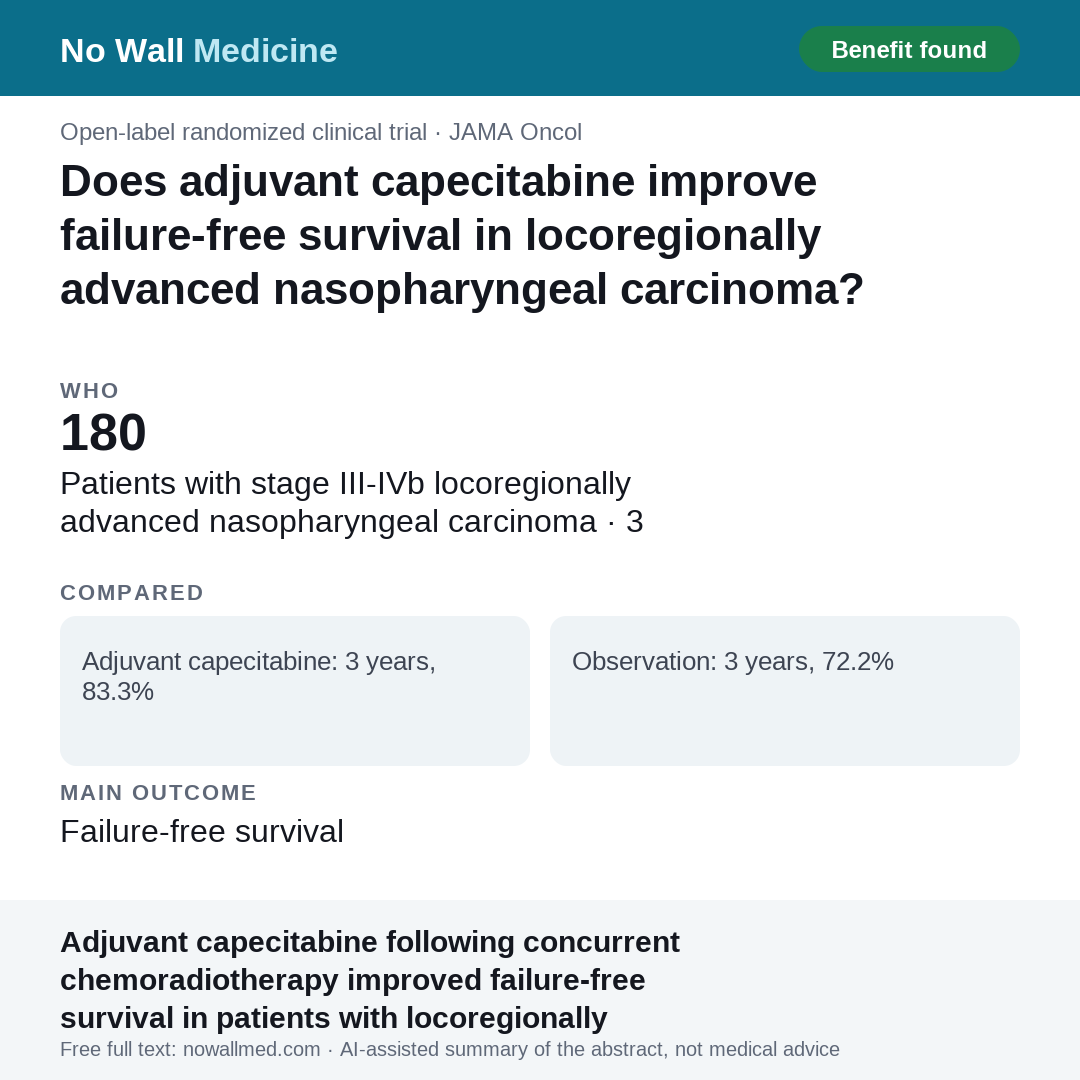
Clinical question: Does adjuvant capecitabine improve failure-free survival in locoregionally advanced nasopharyngeal carcinoma?
Why it matters: Adjuvant platinum-based chemotherapy regimens are poorly tolerated, creating a need for effective and tolerable treatment options for patients with locoregionally advanced nasopharyngeal carcinoma.
Key points
- The study randomized 180 patients with locoregionally advanced nasopharyngeal carcinoma to receive either adjuvant capecitabine or observation following concurrent chemoradiotherapy.
- At a median follow-up of 58.0 months, 3-year failure-free survival was 83.3% in the capecitabine group compared to 72.2% in the control group.
- Grade 3 treatment-related adverse events occurred in 60.0% of the capecitabine group compared to 51.1% in the control group.
Headline and key points written with AI from the paper’s abstract, with every number checked against it. Read the paper before relying on them.
Was this summary helpful?
Cite this article
Miao J, Wang L, Tan SH, Li JG, Yi J, Ong EHW. Adjuvant Capecitabine Following Concurrent Chemoradiotherapy in Locoregionally Advanced Nasopharyngeal Carcinoma: A Randomized Clinical Trial. JAMA Oncol. 2022. doi:10.1001/jamaoncol.2022.4656
Spotted a mistake? Suggest a correction