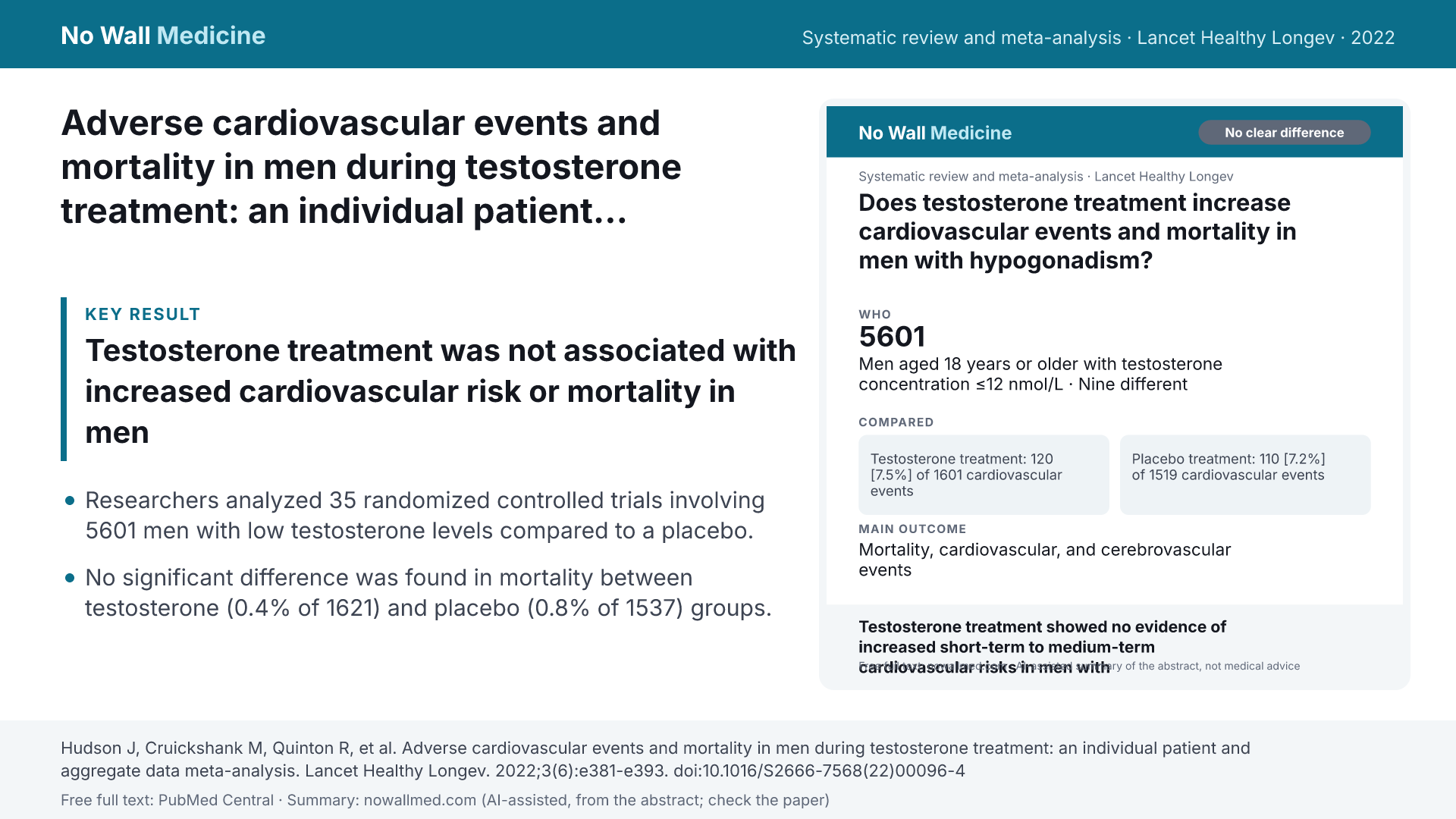
Testosterone treatment was not associated with increased cardiovascular risk or mortality in men
Adverse cardiovascular events and mortality in men during testosterone treatment: an individual patient and aggregate data meta-analysis
Systematic review and meta-analysisNo clear difference
Does testosterone treatment increase cardiovascular events and mortality in men with hypogonadism?
Who
5601
Men aged 18 years or older with testosterone concentration ≤12 nmol/L · Nine different countries
Compared
Testosterone treatment: 120 [7.5%] of 1601 cardiovascular events
Placebo treatment: 110 [7.2%] of 1519 cardiovascular events
Main outcome
Mortality, cardiovascular, and cerebrovascular events
Result: odds ratio 1.07 (95% CI 0.81-1.42)
Bottom line: Testosterone treatment showed no evidence of increased short-term to medium-term cardiovascular risks in men with hypogonadism.
Limitation: There is a paucity of data evaluating its long-term safety.
Funded by: National Institute for Health Research Health Technology Assessment Programme
Lancet Healthy Longev · 2022-06-17Download image
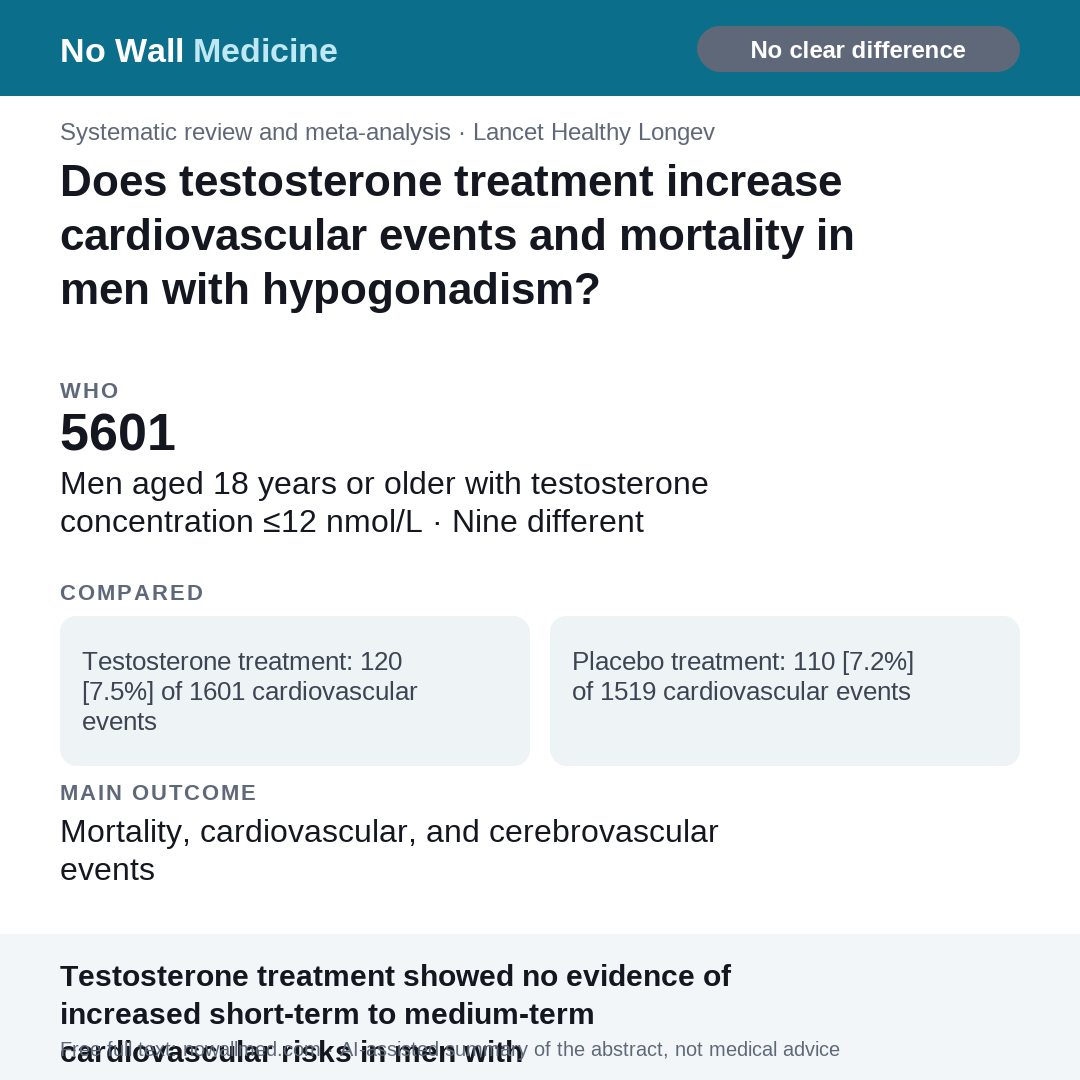
Clinical question: Does testosterone treatment increase cardiovascular events and mortality in men with hypogonadism?
Why it matters: Uncertainty exists regarding the cardiovascular safety of testosterone treatment due to inconsistent findings in previous research.
Key points
- Researchers analyzed 35 randomized controlled trials involving 5601 men with low testosterone levels compared to a placebo.
- No significant difference was found in mortality between testosterone (0.4% of 1621) and placebo (0.8% of 1537) groups.
- Cardiovascular event rates were similar between testosterone (7.5% of 1601) and placebo (7.2% of 1519) groups.
Limitation the authors note: There is a paucity of data evaluating the long-term safety of testosterone.
Headline and key points written with AI from the paper’s abstract, with every number checked against it. Read the paper before relying on them.
Was this summary helpful?
Abstract
Background
Testosterone is the standard treatment for male hypogonadism, but there is uncertainty about its cardiovascular safety due to inconsistent findings. We aimed to provide the most extensive individual participant dataset (IPD) of testosterone trials available, to analyse subtypes of all cardiovascular events observed during treatment, and to investigate the effect of incorporating data from trials that did not provide IPD. Methods
We did a systematic review and meta-analysis of randomised controlled trials including IPD. We searched MEDLINE, MEDLINE In-Process & Other Non-Indexed Citations, MEDLINE Epub Ahead of Print, Embase, Science Citation Index, the Cochrane Controlled Trials Register, Cochrane Database of Systematic Reviews, and Database of Abstracts of Review of Effects for literature from 1992 onwards (date of search, Aug 27, 2018). The following inclusion criteria were applied: (1) men aged 18 years and older with a screening testosterone concentration of 12 nmol/L (350 ng/dL) or less; (2) the intervention of interest was treatment with any testosterone formulation, dose frequency, and route of administration, for a minimum duration of 3 months; (3) a comparator of placebo treatment; and (4) studies assessing the pre-specified primary or secondary outcomes of interest. Details of study design, interventions, participants, and outcome measures were extracted from published articles and anonymised IPD was requested from investigators of all identified trials. Primary outcomes were mortality, cardiovascular, and cerebrovascular events at any time during follow-up. The risk of bias was assessed using the Cochrane Risk of Bias tool. We did a one-stage meta-analysis using IPD, and a two-stage meta-analysis integrating IPD with data from studies not providing IPD. The study is registered with PROSPERO, CRD42018111005. Findings
9871 citations were identified through database searches and after exclusion of duplicates and of irrelevant citations, 225 study reports were retrieved for full-text screening. 116 studies were subsequently excluded for not meeting the inclusion criteria in terms of study design and characteristics of intervention, and 35 primary studies (5601 participants, mean age 65 years, [SD 11]) reported in 109 peer-reviewed publications were deemed suitable for inclusion. Of these, 17 studies (49%) provided IPD (3431 participants, mean duration 9·5 months) from nine different countries while 18 did not provide IPD data. Risk of bias was judged to be low in most IPD studies (71%). Fewer deaths occurred with testosterone treatment (six [0·4%] of 1621) than placebo (12 [0·8%] of 1537) without significant differences between groups (odds ratio [OR] 0·46 [95% CI 0·17-1·24]; p=0·13). Cardiovascular risk was similar during testosterone treatment (120 [7·5%] of 1601 events) and placebo treatment (110 [7·2%] of 1519 events; OR 1·07 [95% CI 0·81-1·42]; p=0·62). Frequently occurring cardiovascular events included arrhythmia (52 of 166 vs 47 of 176), coronary heart disease (33 of 166 vs 33 of 176), heart failure (22 of 166 vs 28 of 176), and myocardial infarction (10 of 166 vs 16 of 176). Overall, patient age (interaction 0·97 [99% CI 0·92-1·03]; p=0·17), baseline testosterone (interaction 0·97 [0·82-1·15]; p=0·69), smoking status (interaction 1·68 [0·41-6·88]; p=0.35), or diabetes status (interaction 2·08 [0·89-4·82; p=0·025) were not associated with cardiovascular risk. Interpretation
We found no evidence that testosterone increased short-term to medium-term cardiovascular risks in men with hypogonadism, but there is a paucity of data evaluating its long-term safety. Long-term data are needed to fully evaluate the safety of testosterone. Funding
National Institute for Health Research Health Technology Assessment Programme.
Abstract reproduced under the article’s CC BY NC ND licence.
Subject terms
Cite this article
Hudson J, Cruickshank M, Quinton R, Aucott L, Aceves-Martins M, Gillies K. Adverse cardiovascular events and mortality in men during testosterone treatment: an individual patient and aggregate data meta-analysis. Lancet Healthy Longev. 2022. doi:10.1016/S2666-7568(22)00096-4
Spotted a mistake? Suggest a correction