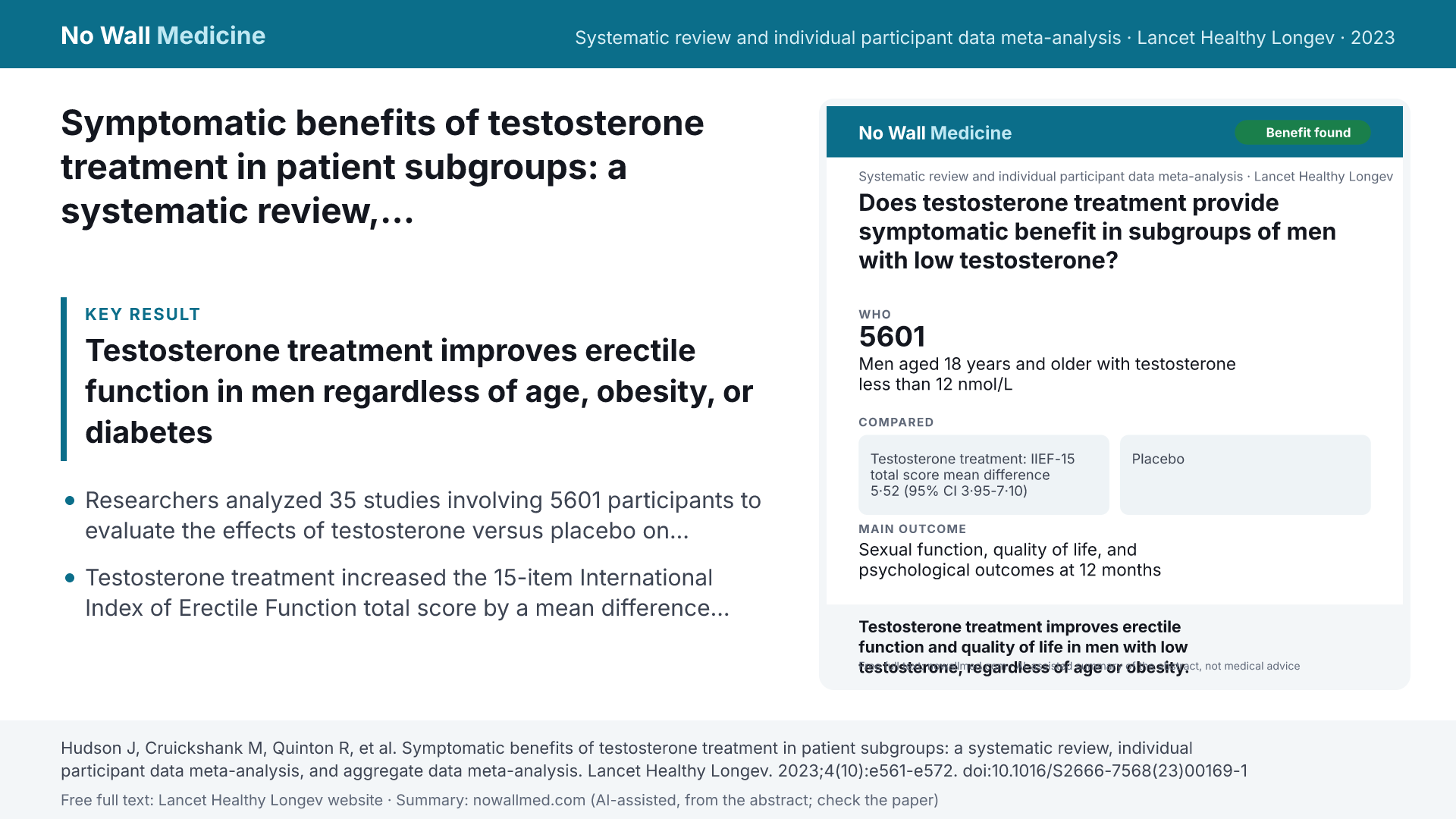
Testosterone treatment improves erectile function in men regardless of age, obesity, or diabetes
Symptomatic benefits of testosterone treatment in patient subgroups: a systematic review, individual participant data meta-analysis, and aggregate data meta-analysis
Systematic review and individual participant data meta-analysisBenefit found
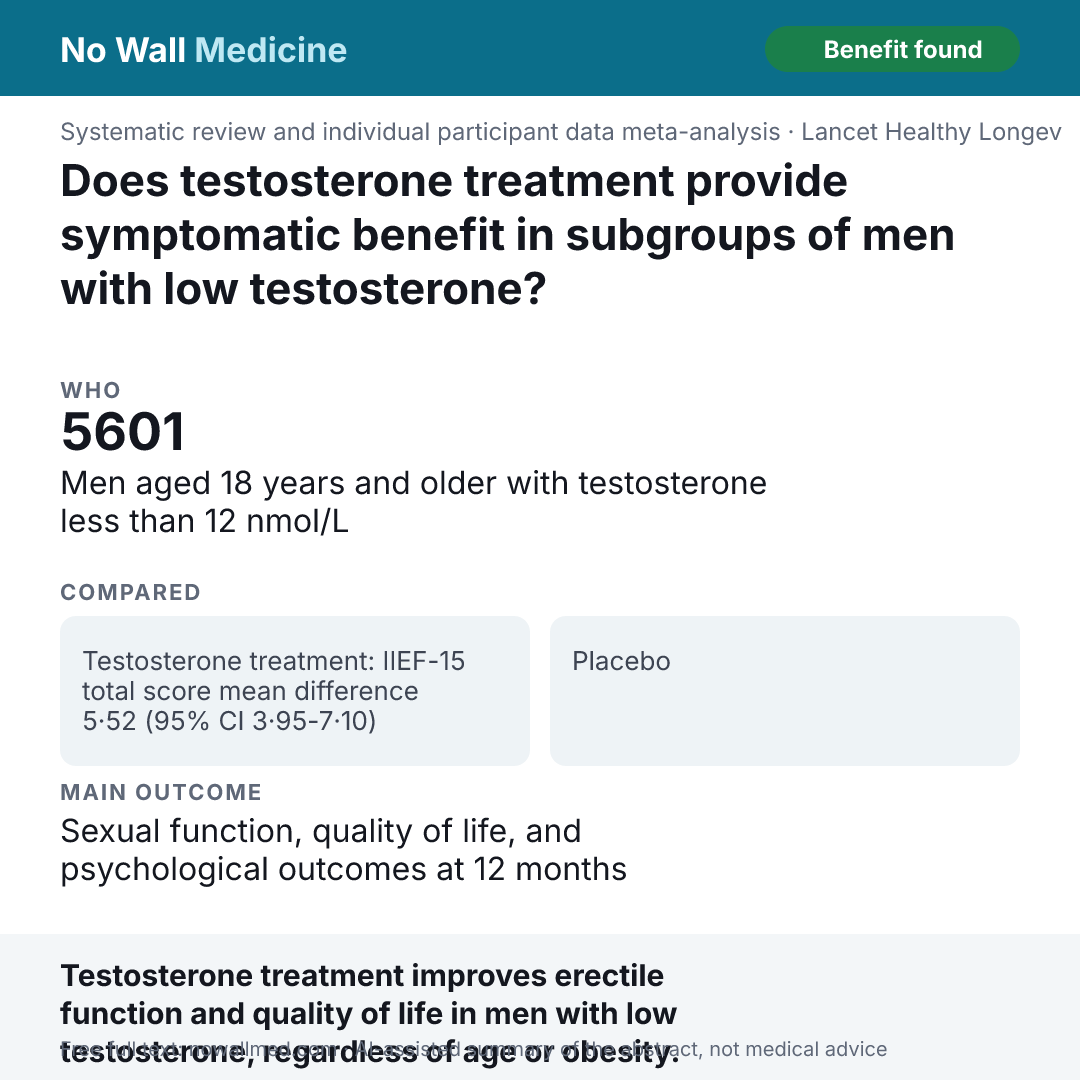
Does testosterone treatment provide symptomatic benefit in subgroups of men with low testosterone?
Who
5601
Men aged 18 years and older with testosterone less than 12 nmol/L
Compared
Testosterone treatment: IIEF-15 total score mean difference 5·52 (95% CI 3·95-7·10)
Placebo
Main outcome
Sexual function, quality of life, and psychological outcomes at 12 months
Result: mean difference 5·52 (95% CI 3·95-7·10)
Bottom line: Testosterone treatment improves erectile function and quality of life in men with low testosterone, regardless of age or obesity.
Limitation: Absolute sexual function levels reached might be lower in older men and men with obesity.
Lancet Healthy Longev · 2023-10-08 · Funded by National Institute for Health and Care Research · PROSPERO CRD42018111005
Headline and visual abstract written with AI from the paper’s abstract, with every number checked against it. Read the paper before relying on them.
Was this summary helpful?
Abstract
Background
Testosterone replacement therapy is known to improve sexual function in men younger than 40 years with pathological hypogonadism. However, the extent to which testosterone alleviates sexual dysfunction in older men and men with obesity is unclear, despite the fact that testosterone is being increasingly prescribed to these patient populations. We aimed to evaluate whether subgroups of men with low testosterone derive any symptomatic benefit from testosterone treatment. Methods
We did a systematic review and meta-analysis to evaluate characteristics associated with symptomatic benefit of testosterone treatment versus placebo in men aged 18 years and older with a baseline serum total testosterone concentration of less than 12 nmol/L. We searched major electronic databases (MEDLINE, Embase, Science Citation Index, and the Cochrane Central Register of Controlled Trials) and clinical trial registries for reports published in English between Jan 1, 1992, and Aug 27, 2018. Anonymised individual participant data were requested from the investigators of all identified trials. Primary (cardiovascular) outcomes from this analysis have been published previously. In this report, we present the secondary outcomes of sexual function, quality of life, and psychological outcomes at 12 months. We did a one-stage individual participant data meta-analysis with a random-effects linear regression model, and a two-stage meta-analysis integrating individual participant data with aggregated data from studies that did not provide individual participant data. This study is registered with PROSPERO, CRD42018111005. Findings
9871 citations were identified through database searches. After exclusion of duplicates and publications not meeting inclusion criteria, 225 full texts were assessed for inclusion, of which 109 publications reporting 35 primary studies (with a total 5601 participants) were included. Of these, 17 trials provided individual participant data (3431 participants; median age 67 years [IQR 60-72]; 3281 [97%] of 3380 aged ≥40 years) Compared with placebo, testosterone treatment increased 15-item International Index of Erectile Function (IIEF-15) total score (mean difference 5·52 [95% CI 3·95-7·10]; τ2=1·17; n=1412) and IIEF-15 erectile function subscore (2·14 [1·40-2·89]; τ2=0·64; n=1436), reaching the minimal clinically important difference for mild erectile dysfunction. These effects were not found to be dependent on participant age, obesity, presence of diabetes, or baseline serum total testosterone. However, absolute IIEF-15 scores reached during testosterone treatment were subject to thresholds in patient age and baseline serum total testosterone. Testosterone significantly improved Aging Males' Symptoms score, and some 12-item or 36-item Short Form Survey quality of life subscores compared with placebo, but it did not significantly improve psychological symptoms (measured by Beck Depression Inventory). Interpretation
In men aged 40 years or older with baseline serum testosterone of less than 12 nmol/L, short-to-medium-term testosterone treatment could provide clinically meaningful treatment for mild erectile dysfunction, irrespective of patient age, obesity, or degree of low testosterone. However, due to more severe baseline symptoms, the absolute level of sexual function reached during testosterone treatment might be lower in older men and men with obesity. Funding
National Institute for Health and Care Research Health Technology Assessment Programme.
Abstract reproduced under the article’s CC BY licence.
Subject terms
Cite this article
Hudson J, Cruickshank M, Quinton R, et al. Symptomatic benefits of testosterone treatment in patient subgroups: a systematic review, individual participant data meta-analysis, and aggregate data meta-analysis. Lancet Healthy Longev. 2023;4(10):e561-e572. doi:10.1016/S2666-7568(23)00169-1
Spotted a mistake? Suggest a correction