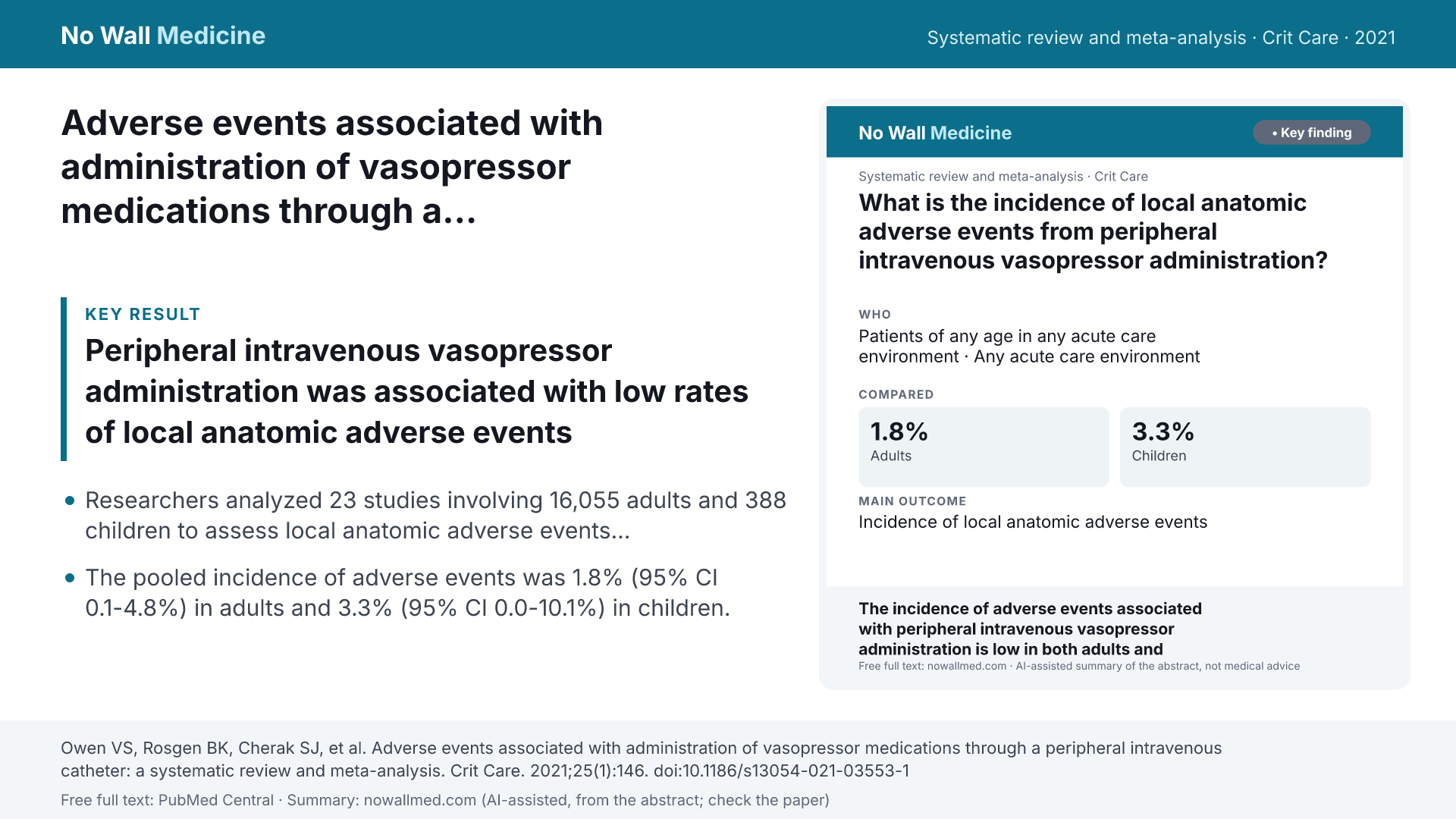
Peripheral intravenous vasopressor administration was associated with low rates of local anatomic adverse events
Adverse events associated with administration of vasopressor medications through a peripheral intravenous catheter: a systematic review and meta-analysis
Critical CareAdult and pediatric
Systematic review and meta-analysisBenefit found
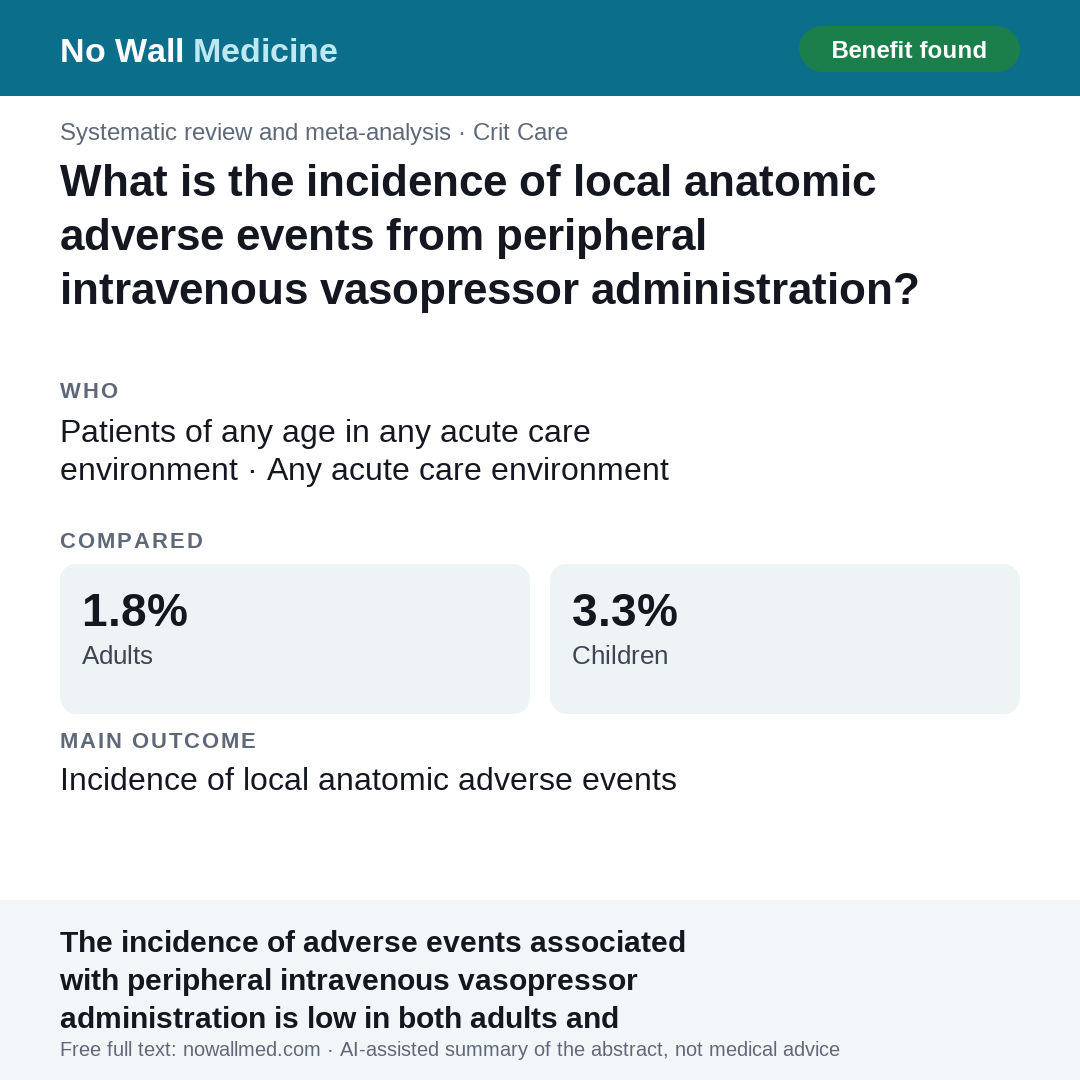
What is the incidence of local anatomic adverse events from peripheral intravenous vasopressor administration?
Who
Patients of any age in any acute care environment · Any acute care environment
Compared
1.8%Adults (95% CI 0.1-4.8%)
3.3%Children (95% CI 0.0-10.1%)
Main outcome
Incidence of local anatomic adverse events
Bottom line: The incidence of adverse events associated with peripheral intravenous vasopressor administration is low in both adults and children.
Limitation: Most studies had high or some concern for risk of bias.
Crit Care · 2021-04-16Download image
Clinical question: What is the incidence of local anatomic adverse events from peripheral intravenous vasopressor administration?
Why it matters: It is unclear whether medications used to raise blood pressure can be safely administered through a peripheral intravenous catheter.
Key points
- Researchers analyzed 23 studies involving 16,055 adults and 388 children to assess local anatomic adverse events from medications used to raise blood pressure via peripheral intravenous catheters.
- The pooled incidence of adverse events was 1.8% (95% CI 0.1-4.8%) in adults and 3.3% (95% CI 0.0-10.1%) in children.
- Subgroup analyses did not find statistically significant differences based on clinical location, catheter size, catheter location, medication type, or duration of use.
Limitation the authors note: Most included studies had high or some concern for risk of bias.
Headline and key points written with AI from the paper’s abstract, with every number checked against it. Read the paper before relying on them.
Was this summary helpful?
Abstract
Background
It is unclear whether vasopressors can be safely administered through a peripheral intravenous (PIV). Systematic review and meta-analysis methodology was used to examine the incidence of local anatomic adverse events associated with PIV vasopressor administration in patients of any age cared for in any acute care environment. Methods
MEDLINE, EMBASE, CINAHL, the Cochrane Central Register of controlled trials, and the Database of Abstracts of Reviews of Effects were searched without restriction from inception to October 2019. References of included studies and related reviews, as well as relevant conference proceedings were also searched. Studies were included if they were: (1) cohort, quasi-experimental, or randomized controlled trial study design; (2) conducted in humans of any age or clinical setting; and (3) reported on local anatomic adverse events associated with PIV vasopressor administration. Risk of bias was assessed using the Revised Cochrane risk-of-bias tool for randomized trials or the Joanna Briggs Institute checklist for prevalence studies where appropriate. Incidence estimates were pooled using random effects meta-analysis. Subgroup analyses were used to explore sources of heterogeneity. Results
Twenty-three studies were included in the systematic review, of which 16 and 7 described adults and children, respectively. Meta-analysis from 11 adult studies including 16,055 patients demonstrated a pooled incidence proportion of adverse events associated with PIV vasopressor administration as 1.8% (95% CI 0.1-4.8%, I2 = 93.7%). In children, meta-analysis from four studies and 388 patients demonstrated a pooled incidence proportion of adverse events as 3.3% (95% CI 0.0-10.1%, I2 = 82.4%). Subgroup analyses did not detect any statistically significant effects associated with stratification based on differences in clinical location, risk of bias or design between studies, PIV location and size, or vasopressor type or duration. Most studies had high or some concern for risk of bias. Conclusion
The incidence of adverse events associated with PIV vasopressor administration is low. Additional research is required to examine the effects of PIV location and size, vasopressor type and dose, and patient characteristics on the safety of PIV vasopressor administration.
Abstract reproduced under the article’s CC BY licence.
Subject terms
Cite this article
Owen VS, Rosgen BK, Cherak SJ, et al. Adverse events associated with administration of vasopressor medications through a peripheral intravenous catheter: a systematic review and meta-analysis. Crit Care. 2021. doi:10.1186/s13054-021-03553-1
Spotted a mistake? Suggest a correction