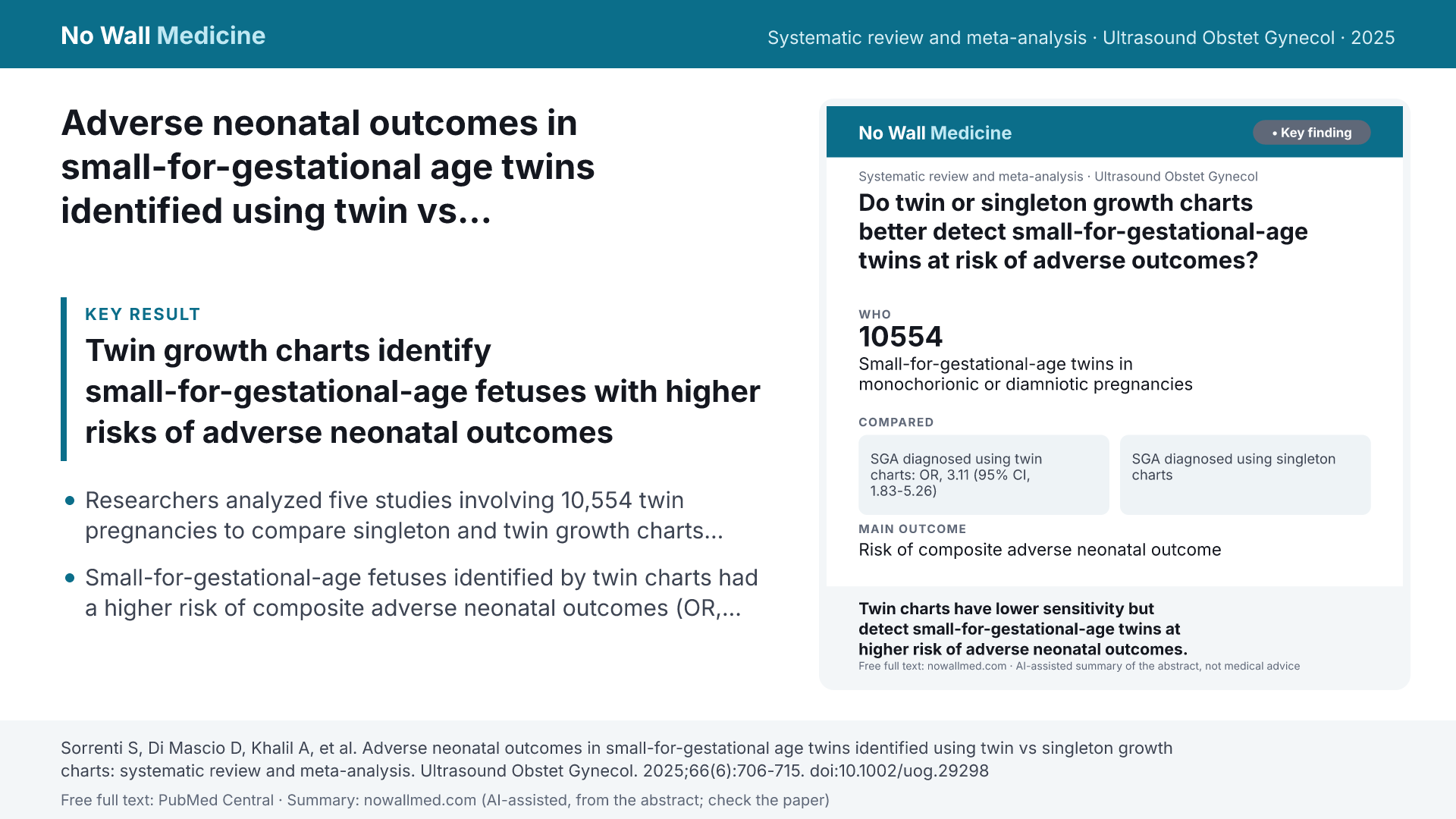
Twin growth charts identify small-for-gestational-age fetuses with higher risks of adverse neonatal outcomes
Adverse neonatal outcomes in small-for-gestational age twins identified using twin vs singleton growth charts: systematic review and meta-analysis
Systematic review and meta-analysisKey finding
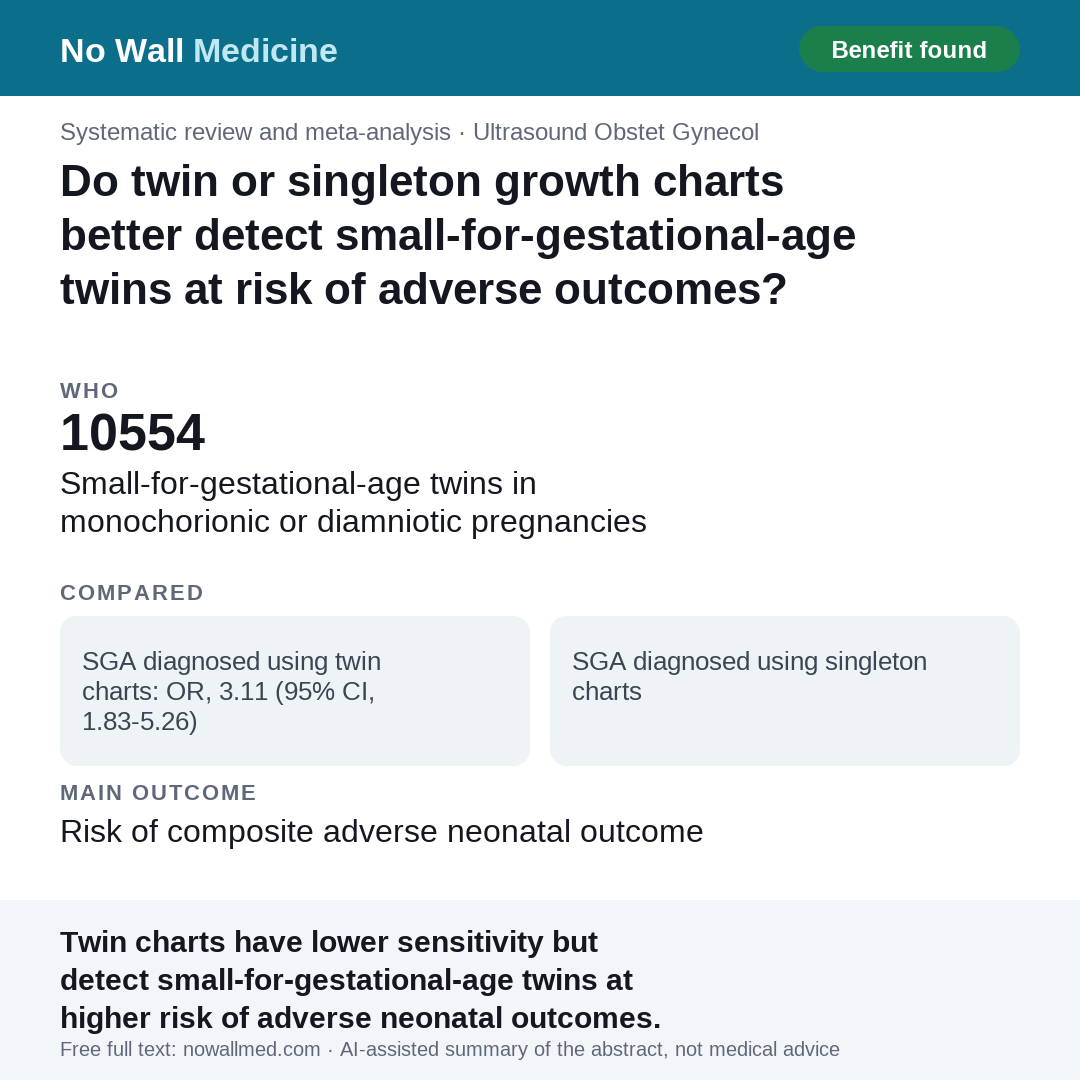
Do twin or singleton growth charts better detect small-for-gestational-age twins at risk of adverse outcomes?
Who
10554
Small-for-gestational-age twins in monochorionic or diamniotic pregnancies
Compared
SGA diagnosed using twin charts: OR, 3.11 (95% CI, 1.83-5.26)
SGA diagnosed using singleton charts
Main outcome
Risk of composite adverse neonatal outcome
Result: OR, 3.11 (95% CI, 1.83-5.26)
Bottom line: Twin charts have lower sensitivity but detect small-for-gestational-age twins at higher risk of adverse neonatal outcomes.
Ultrasound Obstet Gynecol · 2025-07-21Download image
Clinical question: Do twin or singleton growth charts better detect small-for-gestational-age twins at risk of adverse outcomes?
Key points
- Researchers analyzed five studies involving 10,554 twin pregnancies to compare singleton and twin growth charts for identifying small-for-gestational-age fetuses.
- Small-for-gestational-age fetuses identified by twin charts had a higher risk of composite adverse neonatal outcomes (OR, 3.11 (95% CI, 1.83-5.26)) than those identified by singleton charts.
- Twin charts showed lower sensitivity (14% (95% CI, 7-26%)) but higher specificity (95% (95% CI, 86-98%)) compared to singleton charts (32% (95% CI, 24-41%) and 71% (95% CI, 63-77%)).
Headline and key points written with AI from the paper’s abstract, with every number checked against it. Read the paper before relying on them.
Was this summary helpful?
Subject terms
Headline, design, result, key points, caveat and citation as plain text.
Cite this article
Sorrenti S, Di Mascio D, Khalil A, et al. Adverse neonatal outcomes in small-for-gestational age twins identified using twin vs singleton growth charts: systematic review and meta-analysis. Ultrasound Obstet Gynecol. 2025;66(6):706-715. doi:10.1002/uog.29298
Spotted a mistake? Suggest a correction