Aerobic or combined exercise improved cardiovascular risk profiles compared to no exercise in overweight adults
Aerobic, resistance, or combined exercise training and cardiovascular risk profile in overweight or obese adults: the CardioRACE trial
Randomized controlled trialMixed results
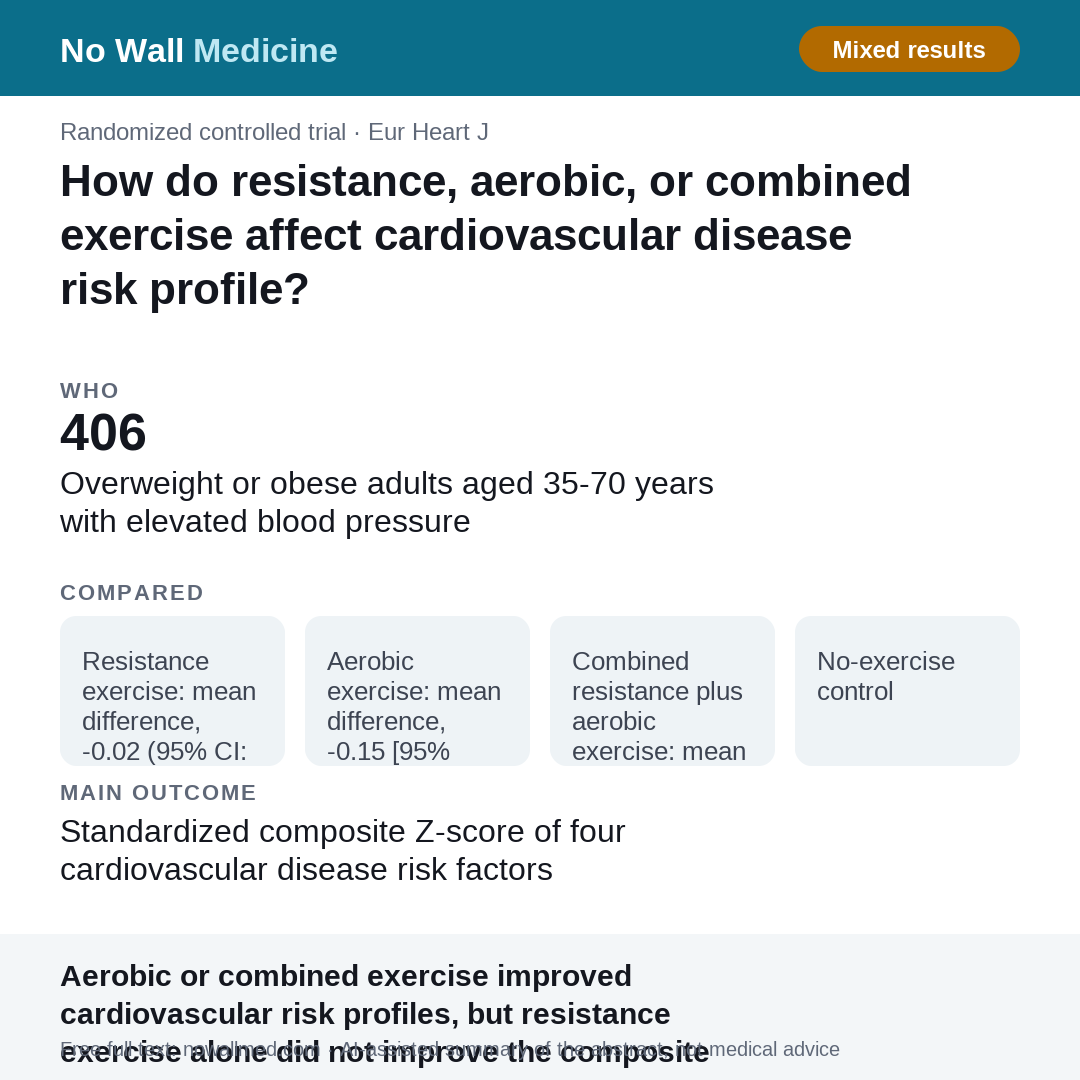
How do resistance, aerobic, or combined exercise affect cardiovascular disease risk profile?
Who
406
Overweight or obese adults aged 35-70 years with elevated blood pressure
Compared
Resistance exercise: mean difference, -0.02 (95% CI: -0.14 to 0.09)
Aerobic exercise: mean difference, -0.15 [95% confidence interval (CI): -0.27 to -0.04]
Combined resistance plus aerobic exercise: mean difference, -0.16 (95% CI: -0.27 to -0.04)
No-exercise control
Main outcome
Standardized composite Z-score of four cardiovascular disease risk factors
Bottom line: Aerobic or combined exercise improved cardiovascular risk profiles, but resistance exercise alone did not improve the composite score.
Eur Heart J · 2024-01-18Download image
Clinical question: How do resistance, aerobic, or combined exercise affect cardiovascular disease risk profile?
Why it matters: It was unknown whether resistance, aerobic, or combined exercise training is most effective for improving the cardiovascular disease risk profile in overweight or obese adults.
Key points
- Researchers studied 406 adults aged 35-70 years with overweight or obesity and elevated blood pressure, comparing resistance, aerobic, and combined exercise to a control group.
- Aerobic and combined exercise groups showed a greater decrease in a composite score of four cardiovascular risk factors than the control group, but resistance training did not.
- While percent body fat decreased in all exercise groups, systolic blood pressure, low-density lipoprotein cholesterol, and fasting glucose did not decrease compared to the control group.
Headline and key points written with AI from the paper’s abstract, with every number checked against it. Read the paper before relying on them.
Was this summary helpful?
Subject terms
Cite this article
Lee DC, Brellenthin AG, Lanningham-Foster LM, Kohut ML, Li Y. Aerobic, resistance, or combined exercise training and cardiovascular risk profile in overweight or obese adults: the CardioRACE trial. Eur Heart J. 2024. doi:10.1093/eurheartj/ehad827
Spotted a mistake? Suggest a correction
Top studies every Monday
The week’s key trials and guidelines in your specialties, plus any topics you follow. By email, free.
Get the weekly digest