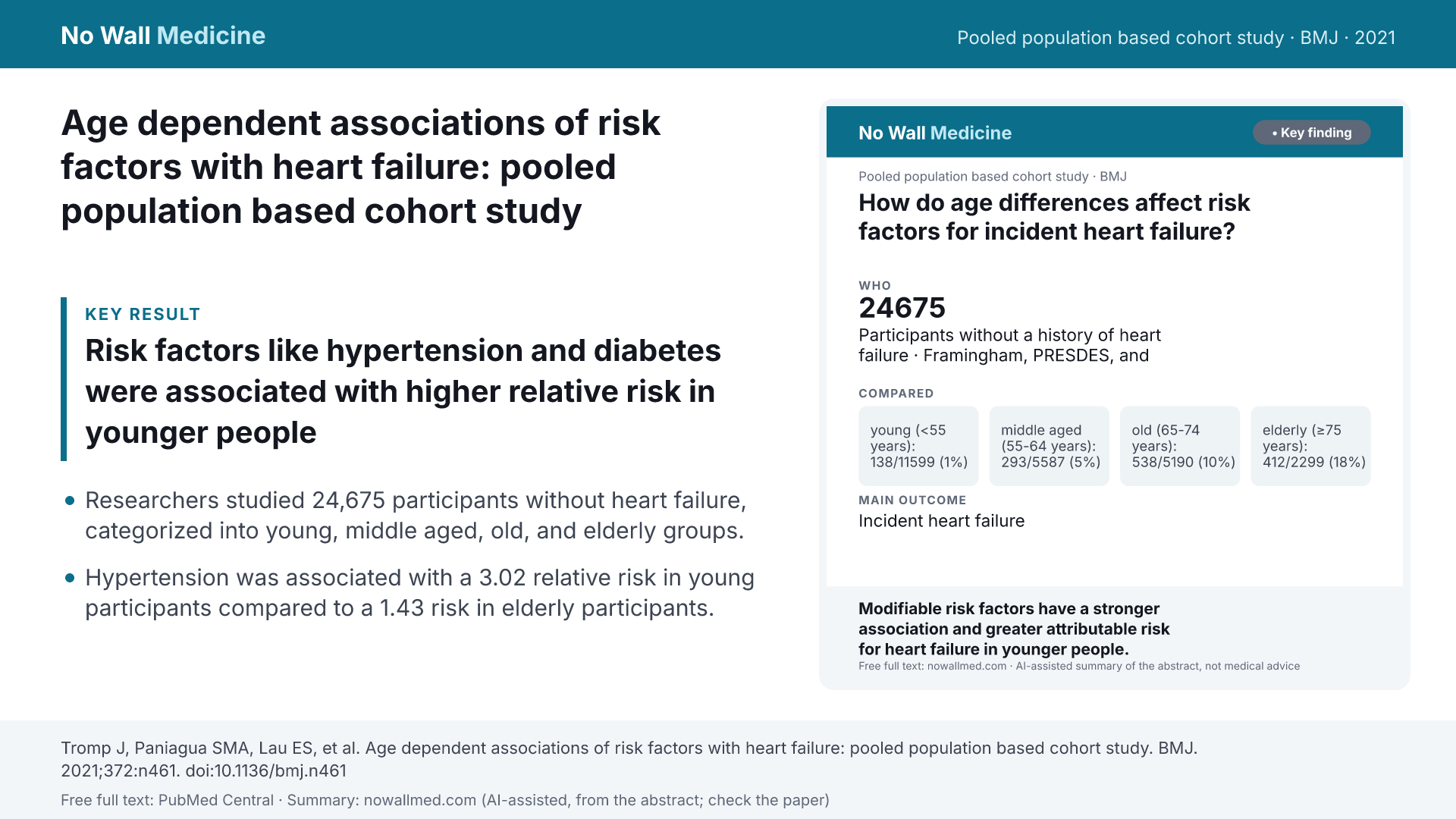
Risk factors like hypertension and diabetes were associated with higher relative risk in younger people
Age dependent associations of risk factors with heart failure: pooled population based cohort study
Pooled population based cohort studyKey finding
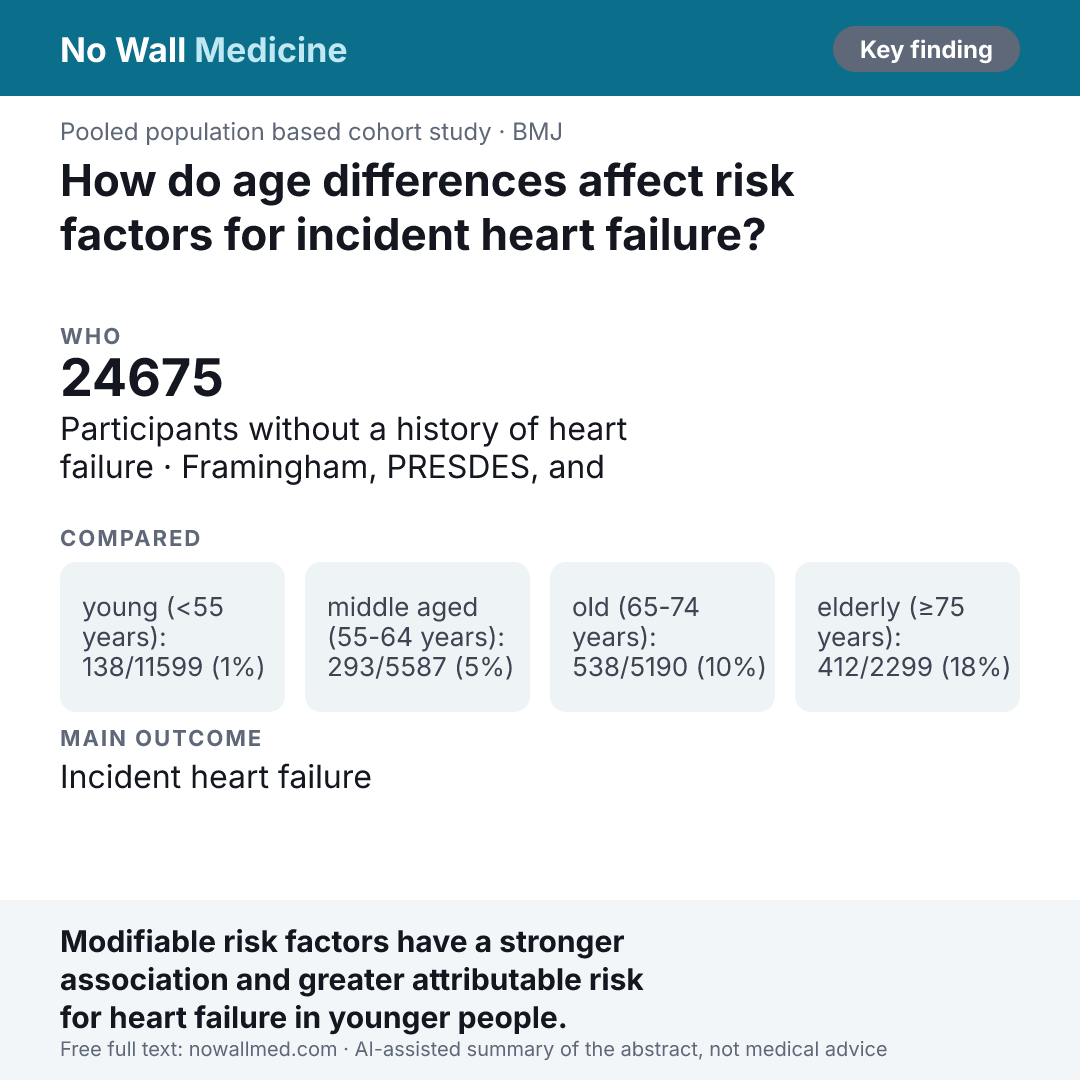
How do age differences affect risk factors for incident heart failure?
Who
24675
Participants without a history of heart failure · Framingham, PRESDES, and Multi-Ethnic Study of Atherosclerosis
Compared
young (<55 years): 138/11599 (1%)
middle aged (55-64 years): 293/5587 (5%)
old (65-74 years): 538/5190 (10%)
elderly (≥75 years): 412/2299 (18%)
Main outcome
Incident heart failure
Bottom line: Modifiable risk factors have a stronger association and greater attributable risk for heart failure in younger people.
BMJ · 2021-03-23 · Save PNG
Clinical question: How do age differences affect risk factors for incident heart failure?
Key points
- Researchers studied 24,675 participants without heart failure, categorized into young, middle aged, old, and elderly groups.
- Hypertension was associated with a 3.02 relative risk in young participants compared to a 1.43 risk in elderly participants.
- Known risk factors explained 75% of heart failure risk in young participants compared to 53% in elderly participants.
Headline and key points written with AI from the paper’s abstract, with every number checked against it. Read the paper before relying on them.
Was this summary helpful?
Abstract
Objective
To assess age differences in risk factors for incident heart failure in the general population. Design
Pooled population based cohort study. Setting
Framingham Heart Study, Prevention of Renal and Vascular End-stage Disease Study, and Multi-Ethnic Study of Atherosclerosis. Participants
24 675 participants without a history of heart failure stratified by age into young (<55 years; n=11 599), middle aged (55-64 years; n=5587), old (65-74 years; n=5190), and elderly (≥75 years; n=2299) individuals. Main outcome measure
Incident heart failure. Results
Over a median follow-up of 12.7 years, 138/11 599 (1%), 293/5587 (5%), 538/5190 (10%), and 412/2299 (18%) of young, middle aged, old, and elderly participants, respectively, developed heart failure. In young participants, 32% (n=44) of heart failure cases were classified as heart failure with preserved ejection fraction compared with 43% (n=179) in elderly participants. Risk factors including hypertension, diabetes, current smoking history, and previous myocardial infarction conferred greater relative risk in younger compared with older participants (P for interaction <0.05 for all). For example, hypertension was associated with a threefold increase in risk of future heart failure in young participants (hazard ratio 3.02, 95% confidence interval 2.10 to 4.34; P<0.001) compared with a 1.4-fold risk in elderly participants (1.43, 1.13 to 1.81; P=0.003). The absolute risk for developing heart failure was lower in younger than in older participants with and without risk factors. Importantly, known risk factors explained a greater proportion of overall population attributable risk for heart failure in young participants (75% v 53% in elderly participants), with better model performance (C index 0.79 v 0.64). Similarly, the population attributable risks of obesity (21% v 13%), hypertension (35% v 23%), diabetes (14% v 7%), and current smoking (32% v 1%) were higher in young compared with elderly participants. Conclusions
Despite a lower incidence and absolute risk of heart failure among younger compared with older people, the stronger association and greater attributable risk of modifiable risk factors among young participants highlight the importance of preventive efforts across the adult life course.
Abstract reproduced under the article’s CC BY licence.
Subject terms
Headline, design, result, key points, caveat and citation as plain text.
Cite this article
Tromp J, Paniagua SMA, Lau ES, et al. Age dependent associations of risk factors with heart failure: pooled population based cohort study. BMJ. 2021;372:n461. doi:10.1136/bmj.n461
Spotted a mistake? Suggest a correction