MicroRNA panels were associated with death and heart failure risk in patients with heart failure
Prognostic and predictive microRNA panels for heart failure patients with reduced or preserved ejection fraction: a meta-analysis of Kaplan-Meier-based individual patient data
Meta-analysis of individual patient dataBenefit found
Do circulating microRNA panels predict outcomes in heart failure patients?
Who
5736
Patients with heart failure with reduced or preserved ejection fraction
Compared
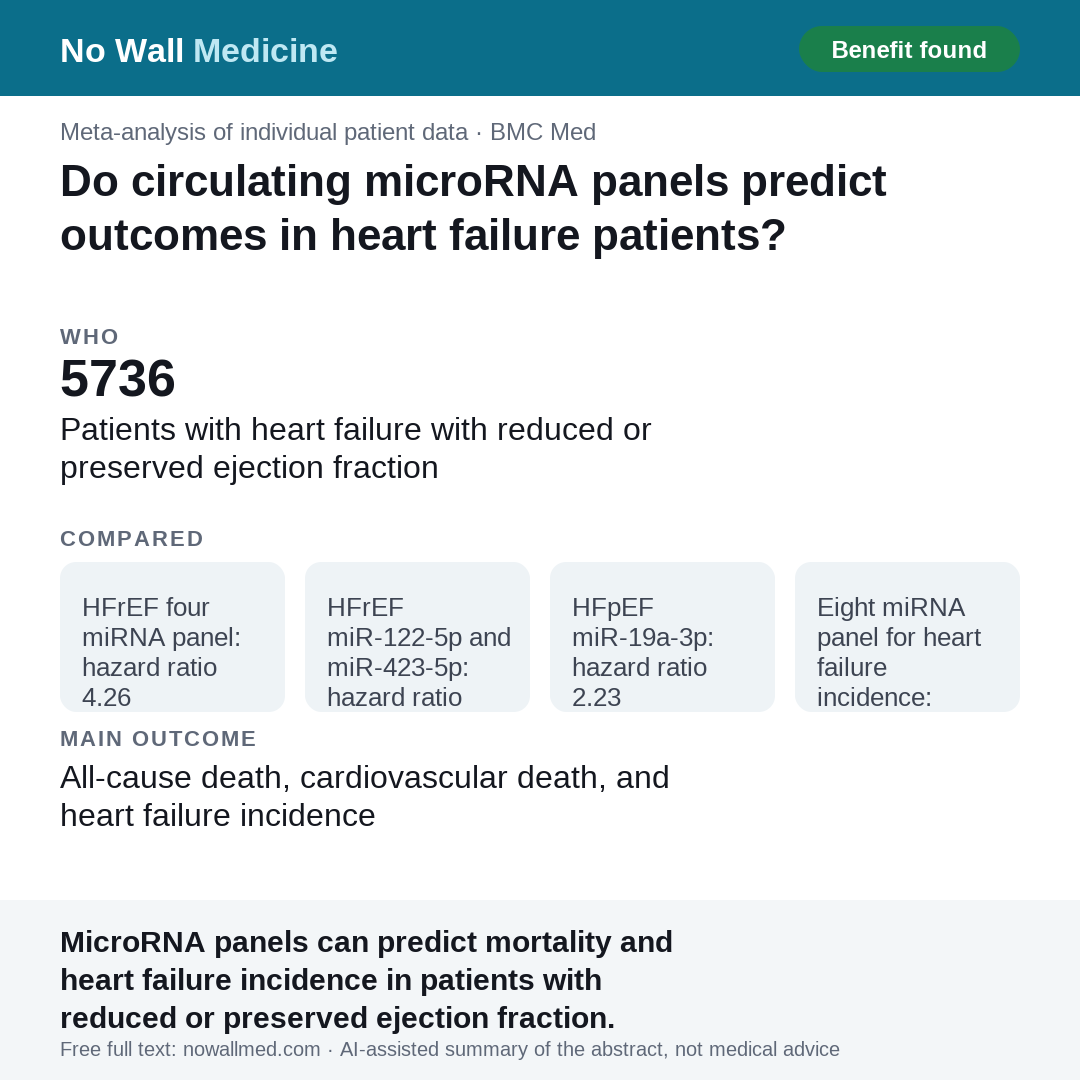
HFrEF four miRNA panel: hazard ratio 4.26 [2.68-6.76]
HFrEF miR-122-5p and miR-423-5p: hazard ratio 3.61 [2.67-4.87]
HFpEF miR-19a-3p: hazard ratio 2.23 [1.16-4.27]
Eight miRNA panel for heart failure incidence: hazard ratio 2.14 [1.81-2.53]
Main outcome
All-cause death, cardiovascular death, and heart failure incidence
Bottom line: MicroRNA panels can predict mortality and heart failure incidence in patients with reduced or preserved ejection fraction.
Limitation: More rigorously designed longitudinal studies are needed to validate clinical application.
BMC Med · 2025-07-07Download image
Clinical question: Do circulating microRNA panels predict outcomes in heart failure patients?
Why it matters: Current biomarkers like natriuretic peptides have limited prognostic performance for patients with preserved ejection fraction, creating a need for new tools to stratify risk.
Key points
- Researchers performed a meta-analysis of 22 studies involving 5736 participants to evaluate microRNA panels as biomarkers for heart failure.
- In patients with reduced ejection fraction, a four-microRNA panel was associated with all-cause death with a hazard ratio of 4.26 [2.68-6.76].
- An eight-microRNA panel was associated with the incidence of heart failure with a hazard ratio of 2.14 [1.81-2.53].
Limitation the authors note: More rigorously designed longitudinal studies are needed to validate the clinical application of microRNAs as prognostic and predictive biomarkers.
Headline and key points written with AI from the paper’s abstract, with every number checked against it. Read the paper before relying on them.
Was this summary helpful?
Subject terms
Cite this article
Parvan R, Becker V, Hosseinpour M, Moradi Y, Louch WE, Cataliotti A. Prognostic and predictive microRNA panels for heart failure patients with reduced or preserved ejection fraction: a meta-analysis of Kaplan-Meier-based individual patient data. BMC Med. 2025. doi:10.1186/s12916-025-04238-0
Spotted a mistake? Suggest a correction
Top studies every Monday
The week’s key trials and guidelines in your specialties, plus any topics you follow. By email, free.
Get the weekly digest