Age-Dependent Heterogeneity in the Efficacy of Prophylaxis With Enoxaparin Against Catheter-Associated Thrombosis in Critically Ill Children: A Post Hoc Analysis of a Bayesian Phase 2b Randomized Clinical Trial
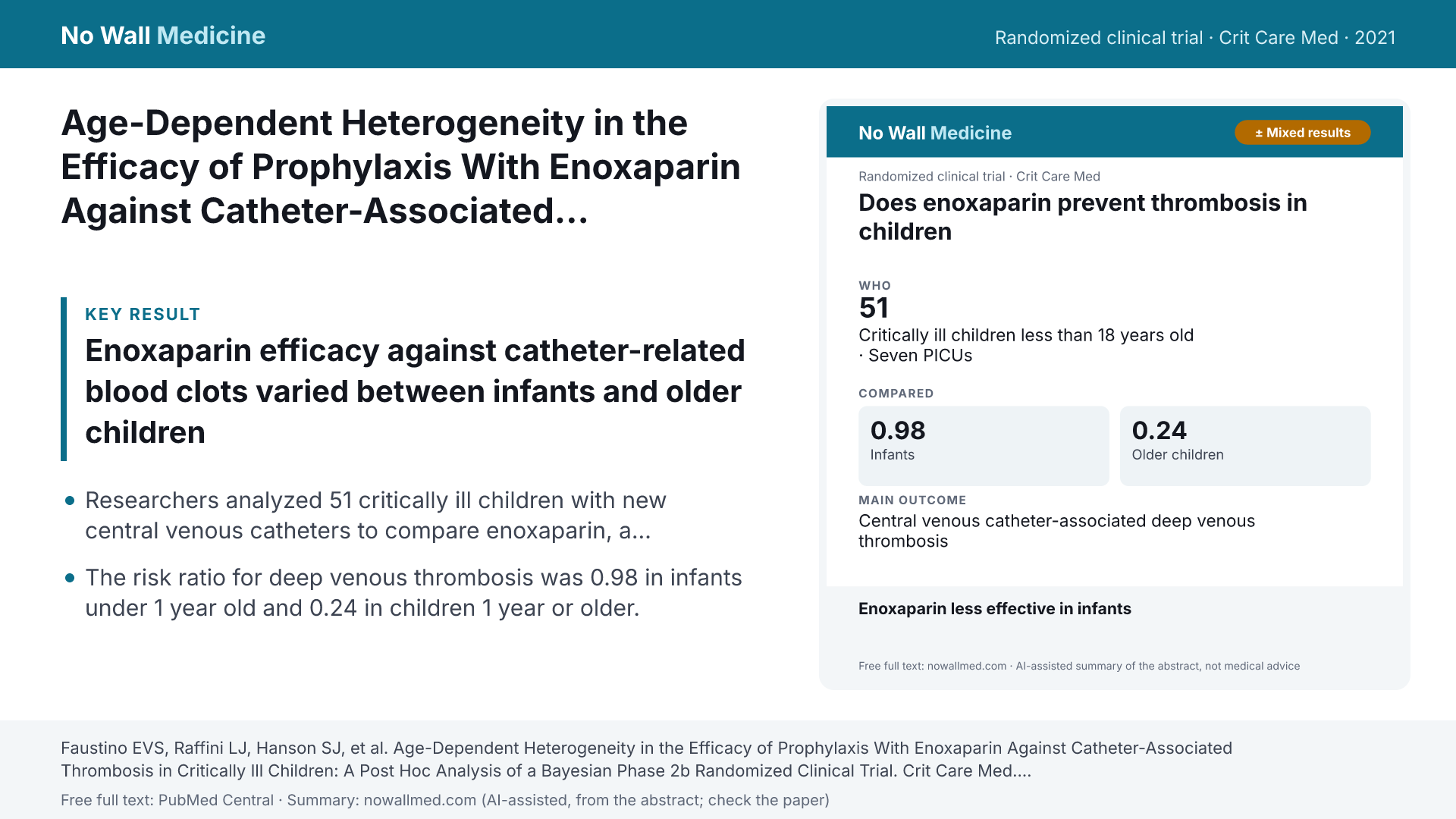
Key result: Enoxaparin efficacy against catheter-related blood clots varied between infants and older children
Secondary analysis of a trialMixed results
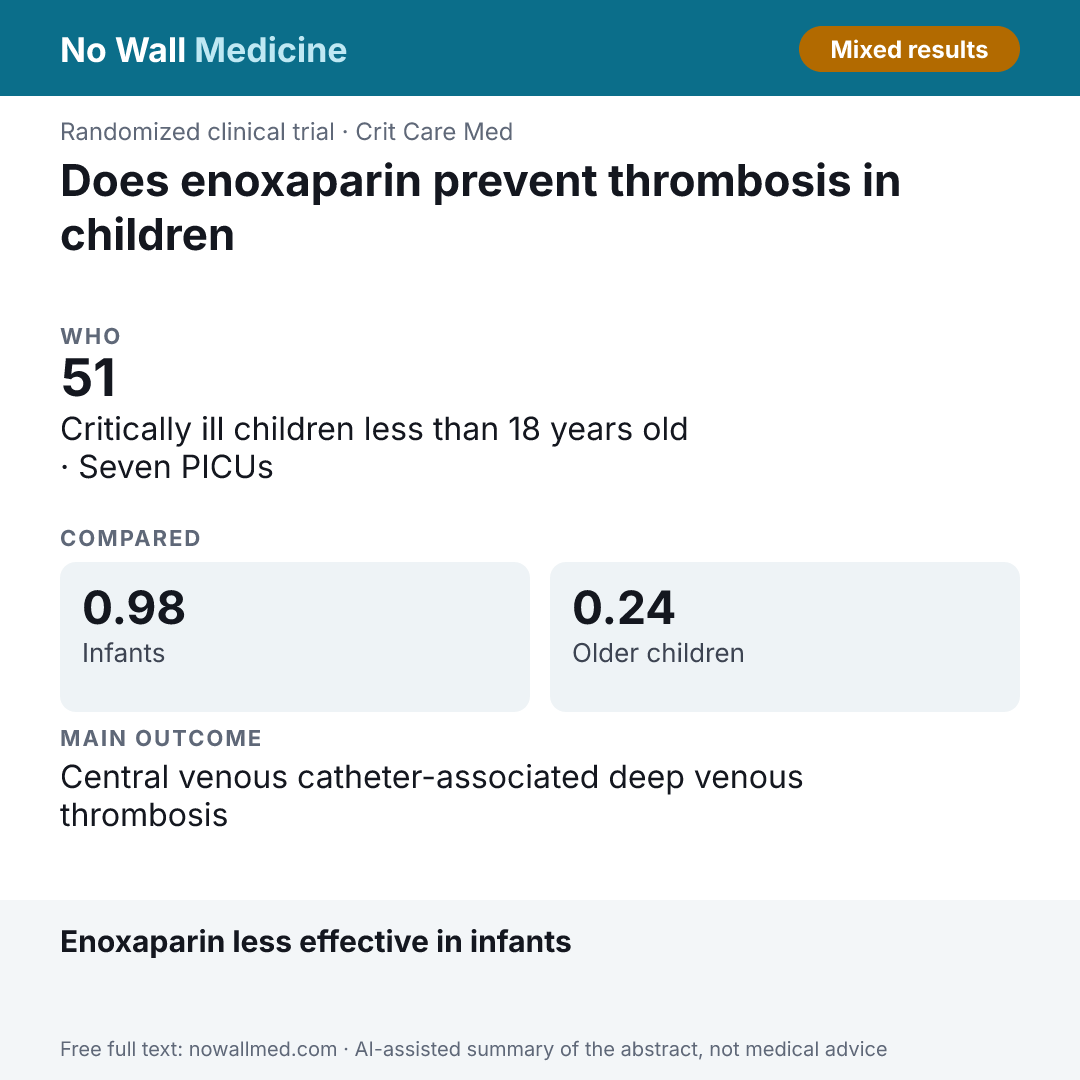
Does enoxaparin prevent thrombosis in children
Who
51
Critically ill children less than 18 years old · Seven PICUs
Compared
0.98Infants (95% credible interval, 0.37-2.44)
0.24Older children (95% credible interval, 0.04-0.82)
Main outcome
Central venous catheter-associated deep venous thrombosis
Result: Risk ratios of 0.98 and 0.24
Bottom line: Enoxaparin less effective in infants
Crit Care Med · 2021-02-11 · Save PNG
Key points
- Researchers analyzed 51 critically ill children with new central venous catheters to compare enoxaparin, a blood thinner, against usual care.
- The risk ratio for deep venous thrombosis was 0.98 in infants under 1 year old and 0.24 in children 1 year or older.
- Infants had 45.1% lower factor VIII activity, a protein that helps blood clot, compared to older children.
Discussion prompts
- Would these patients look like yours? Who was left out?
- Is the main outcome one that matters to patients?
- Is the difference large enough to change what you do?
Cite: Faustino EVS, Raffini LJ, Hanson SJ, et al. Age-Dependent Heterogeneity in the Efficacy of Prophylaxis With Enoxaparin Against Catheter-Associated Thrombosis in Critically Ill Children: A Post Hoc Analysis of a Bayesian Phase 2b Randomized Clinical Trial. Crit Care Med. 2021;49(4):e369-e380. doi:10.1097/CCM.0000000000004848
Free full text: PubMed Central · Summary and visual abstract: nowallmed.com/a/age-dependent-heterogeneity-in-the-efficacy-of-prophylaxis-with-fpvu6l/ (AI-assisted from the abstract; check the paper before relying on it).